
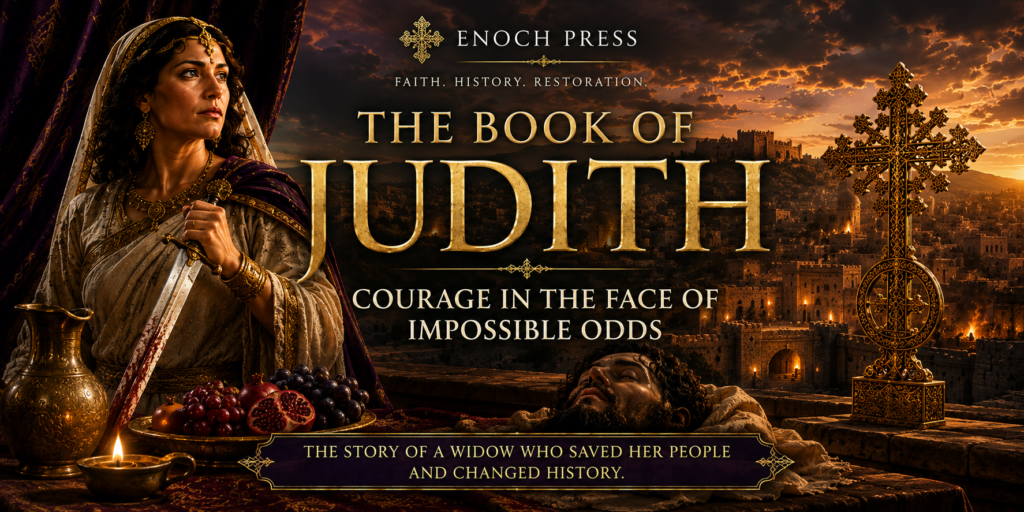
A widow, a besieged city, and a story that refuses to let visible power write the ending.
By the time Judith reached for Holofernes’s sword, the city behind her had almost run out of water.
Bethulia’s springs had been seized. Its cisterns were nearly empty. Children lay weak in the streets while their parents crowded around the town leaders, begging them to surrender before thirst finished what the Assyrian army had begun. The elders had agreed to wait five more days. If God did nothing by then, they would open the gates.
Judith knew none of that made the sword in her hand less dangerous.
Outside the tent, thousands of soldiers slept inside one of the largest military camps described anywhere in ancient Jewish literature. Inside, their commander lay senseless from wine beneath a jeweled canopy, confident that the beautiful widow he had invited to his banquet had finally surrendered to him. Judith’s maid waited near the entrance. The escape route depended on a routine they had quietly established over several nights. The city was still under siege. No army stood ready to rescue them if the plan failed.
Judith prayed. Then she struck twice.
The scene is famous enough to have filled churches, palaces, canvases, and galleries for centuries. Yet the Book of Judith is much more than the story of a woman who beheaded a general. It is a carefully constructed account of a community paralyzed by impossible odds—and of one widow who refuses to confuse faith with passivity, realism with surrender, or power with wisdom.
That is where the book’s real challenge begins. Judith’s courage is not certainty, impulse, or a refusal to see danger. It is disciplined faithfulness that prepares, judges, and acts before the outcome is known.
A Story That Opens With a Historical Impossibility
The Book of Judith does something startling in its first sentence. It calls Nebuchadnezzar the king of the Assyrians and places his capital at Nineveh.
Historically, Nebuchadnezzar II was king of Babylon, not Assyria. By the time his reign began in 605 BC, Nineveh had already fallen. For most modern scholars, the dislocation is too large, too early, and too central to dismiss as a minor slip by an otherwise careful chronicler. The book continues in the same manner, blending Babylonian, Assyrian, Persian, and later Jewish details into a setting that belongs to no single moment in ancient history.
Bethulia, the mountain town at the center of the story, has never been identified with confidence. The government described in Jerusalem resembles the postexilic period, when the high priest held major public authority. Persian names and administrative features appear beside language that many scholars think reflects the pressures faced by Jews under Hellenistic rule. The result reads less like a dated military report and more like a literary gathering of Israel’s imperial enemies into one overwhelming threat.
Modern scholars therefore usually read Judith as historical fiction, a theological novella, or a didactic story shaped from history rather than a straightforward chronicle. Sarah Johnson has placed it among ancient Jewish works that use invented or rearranged history to teach. That classification does not mean the book is careless, meaningless, or “fake.” It means the author is asking readers to recognize the pattern beneath the details.
The invader can wear an Assyrian name, a Babylonian crown, a Persian sword, or the face of a Hellenistic ruler. Empire changes uniforms. Its claim remains the same: resistance is useless, the strong decide what is possible, and the conquered must accept the world their conqueror gives them.
Judith answers that claim.
Most scholars date the book to the late second or early first century BC, often near 100 BC. That places its composition in the world of Second Temple Judaism, after Judea had experienced the violent policies of Antiochus IV Epiphanes and the Maccabean revolt. Some details may echo that crisis, though no single event explains every part of the narrative. The author looks backward through Israel’s scriptures while writing for people who knew what foreign domination felt like in their own generation.
Even the book’s original language remains debated. No ancient Hebrew or Aramaic manuscript has survived. The oldest complete witnesses are Greek, preserved in several textual forms, and ancient translations also survive in Latin, Syriac, Coptic, and Ethiopic. Most scholars have favored a lost Hebrew original because the Greek often sounds strongly Semitic. Jan Joosten and a growing minority have argued that the book may instead have been composed in deliberately Hebraized Greek—a writer making Greek sound like biblical Hebrew because that was the voice the story required.
The surviving Greek tradition is not a single, perfectly uniform text. The major forms are associated with Codex Vaticanus, Codex Sinaiticus, Codex Alexandrinus, and a fourth tradition sometimes called Basiliano-Vaticanus. The oldest surviving physical witness is much smaller: portions of Judith 15:1–7 written on a potsherd from around the third century AD. That fragment does not settle the language debate, but it gives the book a tangible place in the ancient world of copied, read, and translated scripture.
The debate matters, but it does not change the book’s central achievement. Judith sounds like scripture because it is built from scripture. The story remembers the exodus, the conquest traditions, the judges, David and Goliath, prophetic hymns, and the prayers of Israel. It rearranges familiar patterns until a new heroine steps into the space once occupied by Moses, Jael, Deborah, and David.
Her name tells the reader what kind of figure she is meant to become. “Judith” is the feminine form of “Jew” or “Judean.” She is not merely one courageous person within Israel. In literary terms, she becomes the faithful Jewish woman—the people’s identity concentrated into one disciplined, dangerous life.
Is the Book of Judith in the Bible?
Yes—but not in every Christian Bible.
The Book of Judith is included in Catholic Bibles as a deuterocanonical book. Eastern Orthodox and Oriental Orthodox churches also receive it within their broader collections of Hebrew scripture. The Ethiopian Orthodox Tewahedo Church lists Judith explicitly among the eighty-one books of its canon, where it stands beside Tobit and Esther.
Judith is not part of the Jewish Tanakh. Rabbinic Judaism did not receive it within the Hebrew canon, and no copy has been identified among the Dead Sea Scrolls. Most Protestant traditions later followed the Hebrew canon’s shorter boundary for Hebrew scripture. Early Protestant Bibles often placed Judith in an Apocrypha section for useful reading, while many later editions omitted it entirely.
The Catholic Church named Judith in the canon affirmed at the Council of Trent in 1546. That decision did not suddenly create the book’s Christian importance. Judith had already circulated for centuries in Greek and Latin, and early Christian writers knew the story well. Around the end of the first century, 1 Clement pointed to Judith as a woman who placed herself in danger out of love for her besieged people. Jerome, despite his reservations about books outside the Hebrew canon, translated Judith into Latin and praised the widow’s courage. His preface says he worked quickly from a “Chaldean” source—a term normally understood as Aramaic—but that source has not survived, and his shorter Latin form differs substantially from the fuller Greek story.
The Ethiopian tradition preserves Judith within a much larger canonical world than most Western Christians know. Readers who need the broader map can begin with The Ethiopian Bible: 81 Books Most Christians Have Never Read. The important point here is simpler: Judith was not secretly removed from one universal Bible. Different Jewish and Christian communities inherited, translated, and authorized different collections of sacred books.
That canonical history helps explain why some readers meet Judith in church while others encounter her for the first time in an art museum—or in a conversation about books their Bible does not contain.
Before Judith Appears, Defeat Seems Certain
Judith does not enter the story until chapter 8.
That delay is deliberate. The first half of the book belongs to armies, rulers, speeches, maps, and fear. Nebuchadnezzar demands recognition as the supreme power of the earth. When western nations refuse to support his war, he sends Holofernes with orders to punish them, destroy their sanctuaries, and force every people to worship Nebuchadnezzar alone.
Holofernes advances like a machine. Cities surrender. Nations greet him with crowns and dances. Shrines are destroyed. Resistance collapses before the Assyrians even reach Judea.
Then one foreign officer speaks a dangerous truth.
Achior, an Ammonite commander, explains Israel’s story to Holofernes. He argues that Israel cannot be defeated while the people remain faithful to their God. Their strength does not come from numbers, fortifications, or weapons. If they have sinned, Holofernes may prevail. If they have not, an attack will bring disgrace on the invader.
Holofernes is furious. He declares that Nebuchadnezzar alone is god and sends Achior to Bethulia, where he can die with the people whose God he defended. The people of the town rescue Achior, hear his report, and prepare for siege.
Holofernes does not attack the walls. He takes the water.
The tactic is patient, efficient, and merciless. Assyrian forces occupy the springs at the base of the mountain and seal the routes leading outward. For thirty-four days, Bethulia watches its reserves shrink. The city that could resist an assault cannot survive without water.
By the final days, the crisis has reached the children. The text describes them fainting in streets and doorways. Adults lose strength. The people surround Uzziah and the elders, accuse them of bringing death on the town, and demand surrender. Enslavement, they argue, is better than watching their families die.
Uzziah tries to sound faithful, but his answer exposes the city’s deeper collapse. He gives God five days.
If rain or rescue comes, they will continue. If nothing happens, he will surrender Bethulia to Holofernes.
That bargain is the true low point of the story. The walls are still standing. The enemy has not entered. Yet the leaders have already allowed Holofernes to define the limits of their imagination. They have reduced God’s freedom to a deadline and called it patience.
Only then does Judith speak.
The Widow Who Refused to Put God on a Deadline
Judith first appears in mourning clothes.
Her husband, Manasseh, had died three years and four months earlier after suffering heatstroke during the barley harvest. Since then, she has lived as a widow on her own estate. She builds a tent on the roof of her house, wears sackcloth, fasts on most days, and maintains a disciplined life of prayer.
The book is unusually careful in introducing her. Judith receives the longest genealogy given to any woman in the Bible. She is wealthy, manages property, commands servants, and has a reputation for wisdom. Her beauty is mentioned, but it does not define her first. Before she becomes the woman Holofernes sees, the reader meets the woman her community already knows: observant, intelligent, self-governing, and respected.
When Judith hears about Uzziah’s five-day pledge, she does not hurry to the public square. She summons the leaders to her home.
Then she rebukes them.
Her argument is sharper than a general plea to have more faith. The elders have presumed to test God, she says, as though they could understand the divine mind and set the terms on which God must act. Their ultimatum is not humility. It is an attempt to control the One they claim to trust.
Judith does not deny the suffering in the streets. She does not tell exhausted parents to pretend the water is plentiful. Nor does she promise that faithful people are protected from every trial. She reminds the elders that Abraham, Isaac, and Jacob were tested, and she interprets hardship as a place where faithfulness is revealed rather than a timer counting down to abandonment.
Then she makes a claim that changes the entire direction of the book: God will deliver Israel “by my hand.”
Uzziah’s response is revealing. He acknowledges that she has spoken wisely, but asks her to pray for rain.
Judith has already imagined more.
She tells the elders to stand at the gate that night. She will leave the city with her maid. She will not explain the plan, and they must not ask. Before the five days have passed, she says, God will act through her.
The contrast is almost severe. Bethulia’s male leaders have weapons, public office, walls, and soldiers, yet they can imagine only weather or surrender. Judith owns no army. What she has is moral clarity, spiritual discipline, knowledge of the enemy, and the willingness to place herself where the danger is greatest.
The book does not present courage as a sudden emotion. Judith’s courage has been formed in private long before anyone needs it in public.
Prayer, Beauty, and a Dangerous Plan
Judith’s plan begins with prayer, but the prayer is not gentle.
She enters her rooftop tent, puts ashes on her head, falls to the ground, and calls on the God who overturns the strength of armies. She remembers violent episodes in Israel’s past. She speaks of the invaders’ pride in horses, shields, spears, and soldiers. Then she addresses God as the “God of the lowly,” the helper of the weak and protector of those who have lost hope.
She asks for two things: strength for her hand and power for her words.
The second request is morally difficult. Judith asks that her deceptive speech succeed. The book does not hide this or soften it. Her plan requires Holofernes to believe that she has abandoned Bethulia, accepted his cause, and come to reveal a path to victory.
After praying, Judith changes clothes.
She removes the sackcloth of widowhood, bathes, anoints herself, arranges her hair, puts on festive garments and jewelry, and prepares the food she will need to remain faithful to Israel’s dietary practices inside the enemy camp. Her maid carries the provisions. Judith carries the plan.
Readers have sometimes treated this transformation as though Judith becomes someone false. The story suggests something more precise. Her beauty is real, her widowhood is real, her devotion is real, and the clothing is strategic. Holofernes sees only what his appetites allow him to see. Judith does not create his arrogance. She turns it into an opening.
At the city gate, the elders stare at her. Outside the walls, the Assyrian patrol does the same. The soldiers are so captivated that they escort her directly toward Holofernes with a hundred men.
Judith tells them exactly what they want to hear. She has fled the Hebrews, she says, because they are about to sin and lose God’s protection. She can warn Holofernes at the proper moment and guide him through the hill country without losing a man.
The speech echoes Achior’s earlier warning: Israel is safe while faithful, vulnerable when disobedient. Holofernes had rejected that truth from Achior. From Judith, wrapped in beauty and apparent submission, he accepts it eagerly.
The irony becomes sharper with nearly every sentence. Judith repeatedly calls Holofernes “my lord,” a Greek expression that can also point beyond him to God. She promises to lead him toward Jerusalem. In the end, part of him will indeed travel there—his head. She assures him that her words will prove true, though never in the way he imagines.
Holofernes praises her wisdom and beauty. He is certain that a woman so impressive must belong near power. He never considers that she may be the power in the room.
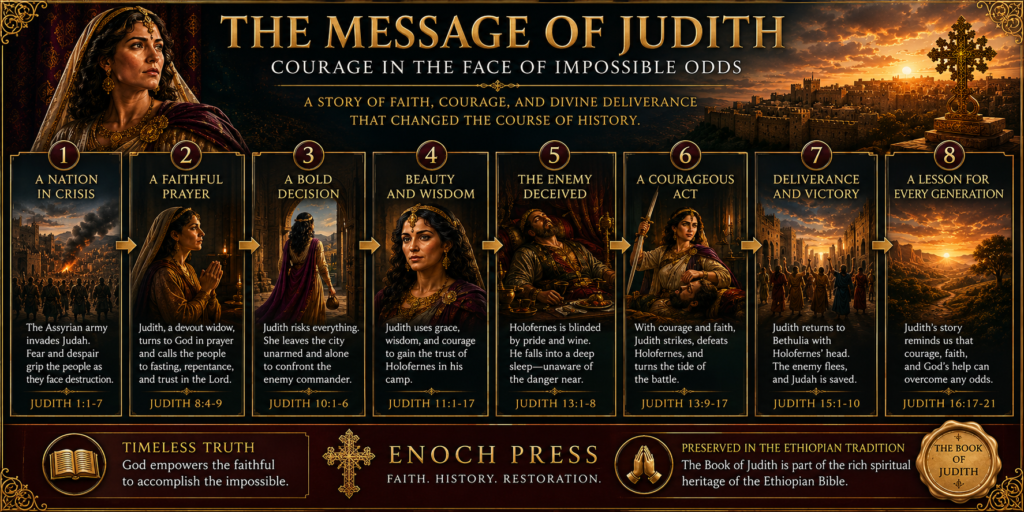
The General Who Could Conquer Nations but Not Himself
For three nights, Judith establishes a routine.
She eats only the food her maid brought. Each night, she leaves the camp to pray near a spring and perform ritual washing. The guards grow accustomed to her movements. The route that will later become an escape path begins to look ordinary.
On the fourth day, Holofernes arranges a private banquet.
His purpose is sexual. The text makes the danger clear without pretending Judith is entering a harmless dinner. Holofernes fears ridicule if he fails to seduce her. He orders Bagoas, his attendant, to persuade Judith to attend. She accepts, telling Bagoas that this will be the greatest day of her life.
Again, the words turn in two directions. Holofernes hears invitation. The reader hears judgment.
The banquet reverses every visible measure of strength. Holofernes possesses the camp, the soldiers, the wealth, the wine, the bed, and the sword. Judith owns none of them. Yet she is the only person in the tent who understands what is happening.
She eats what her maid prepared. Holofernes drinks. He drinks more than he has ever consumed in a single day. One by one, the servants withdraw. Bagoas closes the tent from outside, leaving the commander alone with the woman he believes he has conquered.
The book’s critique of power is exact. Holofernes can command nations but not his own appetite. He can cut off a city’s water but cannot recognize his own thirst. He imagines that Judith’s beauty confirms his mastery when it is exposing his blindness.
This is why the book spends so much time on preparation. The beheading is shocking, but it is not a lucky strike. Judith has studied the moral structure of the enemy camp. She knows what Holofernes believes about women, power, God, wine, and himself. Every one of those beliefs becomes part of his defeat.
When he collapses on the bed, Judith is left alone with him.
She approaches the bedpost, takes down his sword, and prays silently for strength. Then she strikes his neck twice, removes his head, and gives it to her maid, who places it inside the food bag.
The same bag that carried the provisions preserving Judith’s faithfulness now carries the proof of Holofernes’s fall.
The women leave the tent as they have on previous nights. The guards see a familiar routine. Judith and her maid pass through the camp, climb the mountain, and call to the watchmen at Bethulia’s gate.
The maid is not decorative company. She carries the food that preserves Judith’s observance, waits at the tent, receives Holofernes’s head, hides it in the provision bag, and walks the escape route beside her mistress. The book never gives her a name, but Judith’s plan cannot be executed by Judith alone.
The impossible plan has worked.
Two Women Return, and an Army Collapses
When Judith returns, she does not slip quietly into her house.
She calls the people together and orders the head removed from the bag. She displays it beside the canopy taken from Holofernes’s bed and declares that God has struck the enemy through her hand. She also insists that Holofernes did not violate her. The story has placed her under sexual threat, but it refuses to let the threat define the outcome.
Uzziah praises Judith as the glory of Jerusalem and the pride of Israel. Achior is brought forward. When he sees Holofernes’s head and hears what happened, he collapses, then rises to profess faith in Israel’s God. He is circumcised and joins the people.
Judith immediately gives the next instructions. At dawn, the soldiers of Bethulia are to appear ready for battle. The Assyrian guards will wake their commanders, discover Holofernes dead, and panic. Israel must strike at that moment.
The plan succeeds. Bagoas enters the tent expecting to find Holofernes with Judith. Instead, he finds the body. His cry moves through the camp faster than any command. The army that seemed too large to resist loses its center and scatters.
This is where the story’s scale changes. Judith does not personally defeat every Assyrian soldier. She breaks the illusion holding the army together. Holofernes’s men had believed themselves invincible because they believed him invincible. Once his body is found, their confidence collapses before Israel’s attack begins.
The victory ends with a song.
Women gather with branches and wreaths. Judith leads them in a hymn modeled in part on the song of Moses and Miriam after the exodus. She sings that the Lord crushes wars and that the Assyrian commander fell “by the hand of a female.” The phrase is intentionally pointed. The great empire did not fall to a larger empire, the famous general to a greater general, or the proud sword to a stronger sword. He fell through the person he had dismissed as most available to him.
Judith returns to her estate after the celebration. She refuses offers of remarriage, frees the maid who accompanied her, and distributes her property before her death at the age of 105. The book says that no one again spread terror among Israel during her lifetime and for many years afterward.
She saves the city, but she does not seize it.
That final detail matters. Judith does not replace Holofernes with a smaller form of domination. She acts decisively, accepts public honor, and then returns home without turning deliverance into a claim for personal rule.
What Kind of Courage Does Judith Actually Show?
It is easy to reduce Judith’s courage to the moment she lifts the sword. The book spends seven chapters showing why that would be a mistake.
Her courage begins with moral clarity. She names the elders’ five-day bargain for what it is: an attempt to test God while sounding religious. Everyone else sees surrender as inevitable. Judith challenges the assumptions that made it inevitable.
Her courage depends on formation. The widow who walks into the Assyrian camp has already spent years practicing restraint, prayer, fasting, and faithful stewardship. Crisis reveals those habits; it does not invent them.
Her courage includes strategic intelligence. Judith watches how the enemy thinks. She understands military pride, sexual entitlement, religious contempt, and the way repeated routines make guards stop paying attention. She does not charge the camp. She enters its blind spot.
Her courage accepts personal risk. She does not volunteer the town’s children for a glorious last stand. She leaves the safety of the wall herself, accompanied by a maid whose courage the story too easily allows readers to overlook. The plan places their bodies, reputations, and lives in danger.
Her courage preserves identity under pressure. Judith changes clothes but not allegiance. She eats her own food, keeps her prayer routine, and refuses absorption into Holofernes’s world. Adaptability is not the same as surrender.
Her courage moves from prayer into action. She asks God for strength, then prepares provisions, studies the route, builds a pattern, attends the banquet, takes the sword, returns to the city, and directs the battle. The story never asks readers to choose between divine deliverance and human agency. God delivers Israel by Judith’s hand—through her discipline, thought, speech, daring, and physical action.
Finally, her courage knows when to relinquish power. She does not convert gratitude into control. She frees her maid, distributes her property, and leaves behind peace rather than a personal dynasty.
This is not the courage of someone who never feels danger. It is the courage of someone who sees danger accurately and refuses to let it have the final word.
The Hard Question: What About Judith’s Deception?
Any serious reading of Judith has to face the question her plan raises.
She misleads Holofernes. She encourages him to believe that she has defected, that Israel is about to sin, and that she will help him conquer Jerusalem. Her prayer asks God to make her words effective. Calling every statement a harmless double meaning does not resolve the problem, because some of her claims are plainly designed to produce a false conclusion.
The book presents those words within a wartime story about resistance to an invader who intends religious destruction, enslavement, and death. Judith is not deceiving a neighbor for advantage, hiding corruption, or manipulating the innocent. She is operating inside an enemy command whose entire campaign depends on terror and false claims of divine supremacy.
Ancient biblical narratives already contained unsettling deliverance stories. Ehud gains private access to a king through a secret message. Jael welcomes Sisera into her tent before killing him. David takes Goliath’s sword after bringing the giant down. Judith’s story gathers elements from all three. That literary relationship explains how the author frames her actions, though it does not turn the story into a general rule for Christian conduct.
The clean answer is neither that deception never occurs nor that every action taken against an enemy becomes righteous. Judith portrays strategic deception against a murderous occupying force as part of wartime deliverance. Readers may still wrestle with that moral world—and Christian traditions have done so—but the struggle should begin with what the text actually says.
The book itself directs attention toward the character of the conflict. Holofernes uses speech to demand worship for Nebuchadnezzar, intimidate nations, and reduce Judith to an object. Judith uses speech to expose the blindness already inside his power. Her words do not make him arrogant, violent, or predatory. They lead those traits toward the consequence he cannot see.
That does not make the ethical tension disappear. It makes the story honest enough to be worth discussing.
Why Judith Endured in Christian Memory
Judith became unforgettable because the book offers more than one way to remember her.
Early Christians could see her as a model of self-sacrificial love. In 1 Clement, her defining act is that she exposed herself to danger for the sake of her people. The emphasis falls less on the severed head than on the decision to leave safety when others were trapped.
Church teachers also read Judith as a model of prayer, chastity, discipline, and resistance to pride. Jerome’s Latin version shortened and reshaped parts of the Greek story, yet his preface still presents Judith’s victory as an example meant to strengthen readers. Medieval Christian writers frequently turned Holofernes into an image of vice and Judith into the virtue that destroys it.
Artists found another center: the instant before or after the sword falls. Donatello, Botticelli, Michelangelo, Caravaggio, Artemisia Gentileschi, and many others returned to Judith and Holofernes, each making different choices about beauty, horror, strength, vulnerability, and justice. In some works Judith appears serene. In others she strains with the physical labor of killing. Sometimes the maid is old and watchful; sometimes she is young and active. The scene became a mirror in which generations revealed what they believed about women, violence, tyranny, and power.
The book itself refuses to let any single image contain Judith. She is widow, ascetic, estate manager, theologian, strategist, performer, warrior, singer, benefactor, and free woman. Her beauty matters, but so do her genealogy, wealth, wisdom, diet, prayer, speech, and final refusal to remarry or rule.
That complexity helps explain why Judith survived so powerfully even outside traditions that counted her book as scripture. A reader may dispute the history, question the ethics, or stand outside the canon that preserves her. It is much harder to forget her.
Why Judith Still Matters
The Book of Judith begins with an empire insisting that power defines reality. It ends with the empire fleeing because one person recognized that its strength rested on pride, appetite, and fear.
That pattern remains recognizable.
Impossible odds can be real. Bethulia is not rescued because its thirst was exaggerated or its leaders worried too much. The water is running out. The children are suffering. Holofernes’s army is enormous. Judith’s courage does not depend on denial.
What she rejects is the assumption that visible power has already written the ending.
That distinction matters whenever leaders begin calling surrender wisdom simply because resistance is costly. It matters when a deadline imposed by fear is dressed in spiritual language. It matters when people wait for a dramatic rescue while ignoring the knowledge, discipline, relationships, and narrow openings already in their hands.
Judith also warns against confusing preparation with cowardice. Her plan is daring, but it is not reckless. She prays, packs food, recruits a trusted companion, establishes a routine, studies the enemy, protects her route out, and times the city’s attack. Courage without judgment can waste lives. Judgment without courage can become an elegant excuse to do nothing.
For readers of Enoch Press, Judith belongs beside other ancient stories in which faithfulness is tested under pressure. The Books of Meqabyan: Ethiopia’s Forgotten Heroes of Faith explores that same tension through a very different Ethiopian scriptural tradition. The Book of Baruch: Wisdom, Exile, and Hope asks what faithful people do after catastrophe has already arrived. Judith asks the moment before that: what do faithful people do when defeat looks certain, time is short, and no safe choice remains?
Her answer is demanding.
See the danger clearly. Refuse false inevitability. Keep your identity. Prepare with care. Take responsibility. Act without pretending the outcome is guaranteed.
Conclusion
The Book of Judith is not reliable as a conventional record of an Assyrian campaign, and most modern scholars do not read it as one. Its impossible chronology creates a larger enemy than any single empire—a portrait of domination drawn from centuries of Jewish memory. Against that enemy, the author places a widow whose name means “Jewish woman.”
Judith has no official command, no army, and no promise that she will survive. What she possesses has been built quietly: knowledge of her people’s story, disciplined prayer, control of her household, moral courage, strategic imagination, and the ability to see through a powerful man’s performance of strength.
She does what Bethulia’s leaders could not. She imagines faithfulness beyond the choices fear has offered.
Then she prepares. She leaves the gate. She enters the camp. She prays with the sword in her hand.
That is why the story has endured. Judith’s victory is dramatic, but the deepest challenge comes before it: when impossible odds tell a community that surrender is the only adult decision left, who will recognize the lie—and who will accept the cost of acting on what they see?
Reflection
The story of Judith asks a difficult question of faith: have you mistaken God’s silence for God’s absence, or your deadline for God’s limit?
Bethulia’s elders were not foolish men. They were thirsty, responsible for suffering families, and trapped between terrible choices. Their error was subtler. They decided that because they could not imagine another path, no other path existed.
Judith did not receive a map of the outcome. She prayed, prepared, and walked into danger without knowing whether she would return. Her faith did not remove uncertainty. It gave her a reason to remain faithful inside it.
There are seasons when courage looks less like confidence and more like refusing to surrender your obedience to fear. The next step may require patient preparation rather than spectacle. It may require speaking when respected people have accepted defeat. It may require using gifts formed in private long before anyone recognized their value.
And it may require action.
Where have you placed God on a timetable? Where have you called passivity “waiting”? What discipline is being formed in you now for a crisis you cannot yet see?
Judith’s story does not promise that every faithful risk will end in public victory. It does remind us that visible strength is not ultimate strength, that pride creates blind spots, and that God has often worked through people whom power did not think worth fearing.
Courage is not certainty.
It is faithfulness that moves.
✦