
Why these overlooked texts preserve both the memory of return and the anguish of a world after Jerusalem fell
Open two Bibles from two different Christian traditions and the name “Esdras” can make you feel as though someone quietly rearranged the table of contents while you were not looking.
In one Bible, Ezra and Nehemiah appear exactly where you expect them. In another, there is a book called First Esdras. In older Latin traditions, that same book may be called Third Esdras. Then there is Second Esdras, which is also connected with a work scholars call Fourth Ezra. In the Septuagint, Ezra-Nehemiah can be called Esdras B, while another Greek book is Esdras A. The names shift because the manuscripts, languages, and church traditions that carried these books did not all number them the same way.
Confusing? Absolutely. But underneath the numbering problem are two remarkable works that deserve to be read on their own terms.
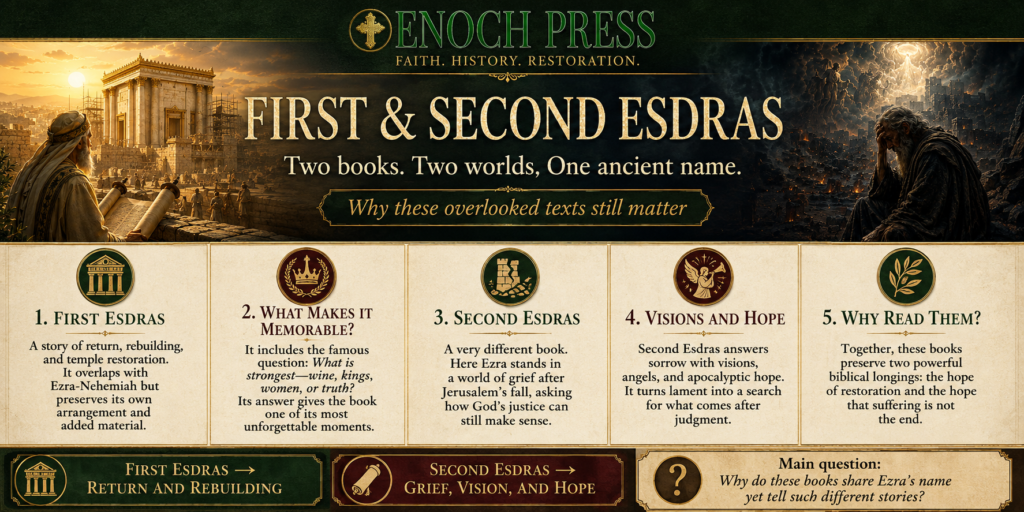
First Esdras looks backward. It retells the crisis of exile, the return from Babylon, the rebuilding of the Temple, and the public reading of the Law. It also preserves a story not found in the Hebrew book of Ezra: three royal guards debate what is strongest in the world, and the answer rises unexpectedly from wine and kings and women to something greater—truth.
Second Esdras looks forward from catastrophe. Its Jewish core, usually called Fourth Ezra, wrestles with a far darker question: how can God be just when Jerusalem has been devastated and the righteous seem to suffer beneath violent empires? It is a book of grief, argument, visions, and hope.
Placed side by side, First and Second Esdras do not feel like sequels. They feel like two conversations separated by centuries. One asks how a people rebuild after exile. The other asks how faith survives when rebuilding no longer seems enough.
First, We Have to Untangle the Names
Before we can follow either story, we need to clear the thicket of titles.
“Esdras” is simply the Greek and Latin form of the name Ezra. The trouble began because different textual traditions used the name for different works.
In the Greek Septuagint, the book commonly called First Esdras in English is known as Esdras A. The familiar canonical material of Ezra and Nehemiah appears as Esdras B. In the Latin Vulgate tradition, Ezra and Nehemiah were often numbered First and Second Esdras, which pushed the Greek Esdras book to Third Esdras and the apocalypse of Ezra to Fourth Esdras. Many Protestant collections of the Apocrypha later called those final two works First Esdras and Second Esdras.
That means the same title can point to different books depending on the Bible in your hands.
For this article, “First Esdras” means the Greek work also known as Esdras A or, in older Latin numbering, Third Esdras. “Second Esdras” means the work printed under that name in many English Apocrypha collections, whose main Jewish apocalypse is commonly called Fourth Ezra.
There is another layer for Enoch Press readers. The Ethiopian Orthodox Tewahedo Church’s official list names “Ezra and Nehemia” and also “Ezra (2nd) and Ezra Sutuel.” Those Ethiopic titles belong to their own transmission history. They should not be casually treated as if they map one-for-one onto every English use of “First” and “Second Esdras.” The family resemblance is real; the numbering is not universal.
Once that is clear, the books themselves become much easier to see.
First Esdras Begins Where a Kingdom Is Falling Apart
First Esdras opens near the end of Judah’s monarchy, with King Josiah’s Passover and his death in battle. The story moves quickly through the collapse of Jerusalem, the Babylonian exile, and then the decree of Cyrus allowing the exiles to return.
If much of this sounds familiar, it should. First Esdras contains a large amount of material parallel to the end of Second Chronicles, the book of Ezra, and a portion of Nehemiah. But it does not simply copy the familiar sequence.
It rearranges some episodes. It creates a smoother narrative bridge between the fall of Jerusalem and the restoration. And most memorably, it inserts a court story that does not appear in the Hebrew Ezra-Nehemiah text.
That story begins in the court of King Darius. Three young guards decide to answer a challenge: what is strongest?
One says wine. Wine can bend the minds of rich and poor alike. Another says the king. His commands move armies, cities, and peoples. The third speaks of women—the mothers who give birth to kings and the women for whom men abandon wealth, power, and reason.
Then the argument turns.
The third speaker, identified as Zerubbabel, declares that truth is stronger than all of them. Wine can deceive. Kings can die. Human desire can be corrupted. Truth endures.
The court erupts in approval. Zerubbabel wins, and instead of asking for personal wealth or status, he asks Darius to remember Jerusalem and support the rebuilding of the Temple.
It is a wonderfully strange scene: part wisdom contest, part court tale, part theology of restoration. And it tells us something important about First Esdras. This is not merely a duplicate Ezra. It is shaping the history of return around a moral claim: the restoration of Jerusalem belongs to the triumph of truth.
Why the Story of the Three Guards Matters
The contest of the three guards is the section most readers remember because it feels almost cinematic. You can imagine the royal hall, the debate sharpening, and the king waiting to see who will produce the most convincing answer.
But the story is doing more than entertaining us.
Zerubbabel’s victory connects wisdom with restoration. His intelligence does not earn him a private reward; it opens a path for the community. The strongest thing in the world is not imperial power, even though the story takes place in an imperial court. It is not desire, even though desire can move kings. It is truth—and truth, in the story’s logic, ultimately serves the rebuilding of God’s house.
That is a bold message for a people who had lived under foreign rule.
First Esdras does not pretend Persia is irrelevant. Cyrus and Darius matter. Imperial decrees matter. Money, letters, legal permissions, and royal patronage matter. Yet the story refuses to let empire become the deepest explanation for restoration. Kings may authorize the work, but they do not own the truth.
That theme carries into the rest of the book, where priests, leaders, returnees, genealogies, sacrifices, opposition, and public reading all become part of the difficult work of rebuilding a people after displacement.
A Different Path Through Ezra’s Story
Scholars have long been interested in First Esdras because its arrangement sometimes differs from the Hebrew Ezra-Nehemiah tradition in ways that may preserve an older form of the story.
The book begins with Second Chronicles 35–36, continues into material parallel to Ezra, includes the three-guards story, and eventually reaches the public reading of the Law found in Nehemiah 8. This creates a narrative that moves from Josiah’s final Passover through destruction, exile, return, Temple restoration, and renewed attention to Torah.
That sequence feels purposeful.
It also means First Esdras is valuable even when a reader already knows Ezra and Nehemiah. It lets us watch an ancient Jewish community remember the same history through a different literary arrangement.
That does not make First Esdras “the original Ezra” by default. Scholars debate the relationship among First Esdras, the Hebrew text, and the Greek versions. Some textual readings in First Esdras may preserve older material; other features reflect its own editorial history. The responsible conclusion is not that one version simply cancels the other, but that ancient scriptural history was sometimes transmitted in more than one textual form.
That is where First Esdras becomes especially valuable for readers interested in how biblical books were copied, translated, and arranged. The differences are not clutter around the Bible’s history. They are part of that history.
Then Second Esdras Changes the Mood Completely
If First Esdras feels like a story of restoration, Second Esdras begins with a wound that will not close.
The work called Second Esdras in many English Apocrypha collections is itself composite. Its central and earliest section, chapters 3–14, is the Jewish apocalypse scholars usually call Fourth Ezra. Chapters 1–2 and 15–16 are later Christian additions often called Fifth Ezra and Sixth Ezra.
The Jewish core is generally understood against the destruction of Jerusalem by Rome in 70 CE.
That historical setting changes everything.
The first destruction of Jerusalem by Babylon could be followed by return, Temple rebuilding, and national restoration. But now Jerusalem has fallen again. The Temple is gone again. Rome stands where Babylon once stood. And the old answers feel unbearably difficult.
Ezra looks at the ruins of his people and argues with God.
Why was Israel given the Law if sin would still destroy them? Why do nations that seem even more wicked prosper over the people God chose? Why create humanity if so many will perish? Why does divine justice move so slowly when suffering feels immediate?
These are not polite questions.
Second Esdras lets Ezra grieve before it asks him to understand.
A Man Arguing With Heaven
The emotional power of Fourth Ezra comes from the fact that its visionary does not begin as a detached prophet calmly receiving information.
He is distressed. He fasts. He mourns. He presses the angel Uriel with questions that sound less like a theology lesson and more like the cries of someone trying to reconcile faith with devastation.
Uriel repeatedly tells Ezra that human understanding is limited. Ezra cannot measure the sea, weigh fire, or comprehend the hidden structure of creation. If he cannot master what is near him, how can he expect to master the mysteries of God’s judgment?
But Ezra keeps asking.
That persistence matters. The book does not shame grief out of him. It stages the argument again and again until the questions themselves begin to change.
At first Ezra is consumed by the injustice of Israel’s condition. Later visions widen the horizon. History is moving toward judgment. Evil empires do not last forever. The apparent chaos of the present is not the final state of the world.
The answers are apocalyptic because the questions have become too large for ordinary political hope.
The Woman Who Becomes a City
One of the most powerful scenes in Second Esdras begins with a grieving woman.
Ezra encounters her mourning the death of her only son. In his own grief over Jerusalem, he becomes frustrated with her. How can she mourn one household tragedy, he asks, when Zion herself lies devastated?
Then the vision turns on him.
The woman is transformed. She becomes the city of Jerusalem.
Suddenly Ezra is forced to see his own grief from the outside. The mourning woman he tried to correct was a sign of the very city he had been mourning. Personal sorrow and communal catastrophe collapse into one image.
This is where apocalyptic literature does something ordinary argument cannot. It does not simply answer a question with a proposition. It changes what the visionary is able to see.
The ruined city is not erased. The pain is not declared imaginary. But Jerusalem appears within a larger promise of restoration.
Ezra’s consolation comes only after the book has allowed him to mourn deeply enough that hope can mean something.
The Eagle, the Empire, and the Son of Man
Second Esdras also contains visions that move beyond grief into the symbolic language of empire and judgment.
Ezra sees a great eagle rising from the sea, an image widely understood as representing Rome and its rulers. The vision portrays imperial power as impressive, complicated, and temporary. Its heads and wings struggle for dominance, but the empire does not escape judgment.
Then another figure appears: a man rising from the sea, associated with divine deliverance and the defeat of hostile nations.
These visions belong to the same apocalyptic world as Daniel and other Jewish writings that interpreted political catastrophe through symbolic revelation. They do not invite the reader merely to decode a timetable. Their deeper claim is that empire is not ultimate.
Rome may dominate the visible world. It does not control the end of the story.
For an audience living after Jerusalem’s destruction, that distinction was not abstract. It was a way of saying that what looked permanent from the street was temporary from heaven.
Why Second Esdras Is More Than a Book of Predictions
Modern readers often hear “apocalyptic” and immediately think of predictions, secret codes, or charts of future events. Second Esdras is much more human than that.
Its central drama is theological grief.
Ezra wants to know why the world seems morally out of order. He wants to know why the chosen people suffer. He wants to know whether God’s promises can still be trusted when history appears to contradict them.
The visions answer by widening his field of view: the present age is not the whole story; judgment is real; resurrection and final accountability matter; the faithful are not forgotten; empire is temporary; restoration belongs to God.
Those answers do not make suffering small. In fact, the book’s power depends on refusing to make suffering small.
Hope becomes believable only after the grief has been allowed to speak.
Where Do These Books Belong in the Bible?
This is where the history becomes complicated again.
First Esdras appears in manuscripts of the Greek Old Testament and remains part of some Orthodox biblical traditions. It is not part of the Jewish Masoretic canon or the Roman Catholic canon defined at Trent. Many Protestant Bibles omit it, although editions that print the Apocrypha may include it.
Second Esdras has an even more varied reception history. Its core apocalypse survives through several ancient language traditions, while the full sixteen-chapter form familiar in English depends heavily on Latin transmission. It appears in the Apocrypha of some English Bibles and in certain Slavonic and other Christian traditions, but it is not part of the standard Roman Catholic or Protestant Old Testament canon.
The Ethiopian picture requires special care. The Ethiopian Orthodox Tewahedo Church officially lists “Ezra and Nehemia” and also “Ezra (2nd) and Ezra Sutuel” among its Old Testament books. Ethiopic manuscript traditions also preserve Ezra-related apocalyptic material. But the numbering and titles do not line up neatly with modern English “First Esdras” and “Second Esdras.”
That is exactly why blanket statements such as “the Ethiopian Bible contains First and Second Esdras” can mislead if they are not explained.
The safer and more accurate statement is that the Ethiopian biblical tradition preserves a broader Ezra/Esdras corpus than most Protestant Bibles, with its own titles, ordering, and textual history.
What First and Second Esdras Reveal When Read Together
The two books are very different, but they share one great concern: what does faithfulness look like after disaster?
First Esdras answers from the world of return. Jerusalem has fallen, but a road home opens. The Temple can be rebuilt. The Law can be read again. Identity can be reconstructed through worship, memory, discipline, and truth.
Second Esdras answers from a world in which Jerusalem has fallen again. This time the question is harder. What happens when the old pattern of destruction followed by restoration no longer seems immediately visible?
The answer becomes apocalyptic. God’s justice may not be completed within the horizon Ezra can see. The restoration of the city points beyond politics toward resurrection, judgment, and the final setting-right of the world.
One book rebuilds stones.
The other rebuilds hope.
And both refuse to let catastrophe have the final word.
Why These Books Still Reward the Curious Reader
First and Second Esdras are easy to ignore because their titles are confusing and their canonical status varies. That is unfortunate, because they illuminate some of the most important transitions in Jewish and Christian scriptural history.
First Esdras shows how sacred history could be retold and rearranged while remaining anchored to familiar events. It preserves a memorable wisdom story about truth and gives us another textual witness to the history of return.
Second Esdras lets us hear Jewish grief after the destruction of the Second Temple with unusual emotional intensity. It shows a believer asking questions many religious texts are tempted to rush past: Why does evil win? Why does God wait? What does covenant mean when history feels broken?
Neither book is valuable because it offers secret information unavailable anywhere else. Their value is more substantial than that.
They preserve voices from communities trying to remain faithful when the world they knew had collapsed.
Conclusion
The name Esdras can be confusing because the books traveled through different languages and traditions, collecting different numbers along the way. But the confusion is worth working through.
First Esdras carries us from destruction toward return. It remembers kings and decrees, priests and builders, opposition and public worship—and then pauses in a Persian court long enough to declare that truth is stronger than power.
Second Esdras carries us into a later devastation. Its Ezra mourns Jerusalem, questions divine justice, wrestles with an angel, watches a grieving woman become Zion, and learns to see empire from the perspective of eternity.
One book asks how a people rebuild after exile.
The other asks how a people believe after the city has fallen again.
That is why these books still matter. They stand in different centuries, under different empires, asking different versions of the same human question: when history breaks what we thought was secure, where does faith go next?
Reflection
There are seasons when faith feels like First Esdras.
The doors open. The road home appears. Broken things can be rebuilt. Truth becomes practical because there is work to do—stones to set, worship to restore, habits to recover, communities to gather again.
And there are seasons when faith feels like Second Esdras.
The answers do not arrive quickly. You pray and still have questions. You look at what has been lost and cannot see how restoration could possibly take shape. Hope has to become larger than the outcome you originally wanted.
Scripture does not always give us one emotional posture for both kinds of seasons.
Sometimes faith rebuilds.
Sometimes faith argues with God and refuses to leave the conversation.
Ezra’s questions remind us that grief is not the opposite of belief. First Esdras reminds us that rebuilding is not the opposite of dependence. In both books, the faithful response begins by refusing to let ruin define the future.
The question they leave with us is not whether our lives will avoid collapse. They will not. The harder question is what we will believe about God, truth, and hope when the familiar structures no longer hold.