How an ancient Jewish story turns exile, grief, marriage, healing, and an unseen angelic guide into a sustained lesson about God’s care.
When Two Prayers Rise at Once
In Nineveh, an aging exile sits in darkness and asks God to let him die. Hundreds of miles away in Ecbatana, a young woman named Sarah makes the same request. Tobit has lost his sight, his former security, and much of his dignity. Sarah has watched seven intended husbands die before their marriages could begin, and the cruelty of others has convinced her that her life has become a burden to her family.
Neither knows the other exists. Neither can see a way forward. Yet the Book of Tobit places their prayers side by side before revealing what the characters cannot see: both petitions have been heard, and the answer to each will travel along the same road.
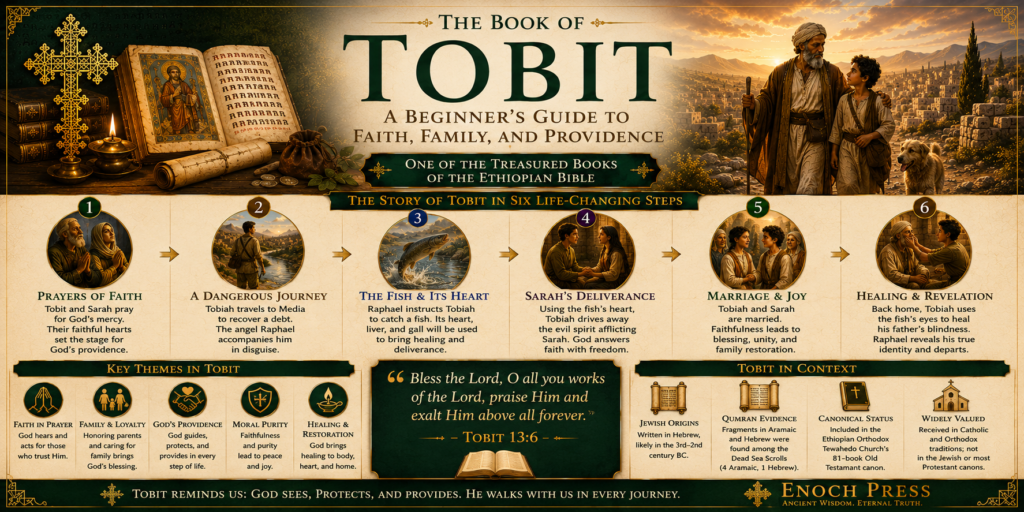
That road is the heart of Tobit. It carries Tobit’s son, Tobiah—often called Tobias in English tradition—out of Nineveh toward Media, accompanied by a stranger who calls himself Azariah. The guide is actually Raphael, an angel whose name means “God heals.” Along the way come a fish, a marriage, a confrontation with evil, the recovery of family money, and the restoration of Tobit’s sight. The story is warm, strange, sometimes funny, and far more serious than its folktale surface first suggests.
Tobit asks a question that remains painfully familiar: what does faithfulness look like when God’s care is real but hidden? Its answer is not that faithful people avoid suffering. Tobit and Sarah are faithful, and both are crushed. The book’s claim is subtler. Providence is often already at work before the sufferer recognizes it, and ordinary obedience may become the road by which an answer arrives.
What Kind of Book Is Tobit?
The Book of Tobit is a Jewish story from the Second Temple period, probably written early in the second century BC. Its author is unknown, and its precise place of composition remains debated. The setting reaches back much earlier, to Israelites living under Assyrian rule after the northern kingdom’s fall, but the book itself was written centuries after the events it portrays.
That distinction matters because Tobit is not best read as a modern chronicle. It uses the shape of a religious novella: vivid characters, carefully paired scenes, wisdom sayings, prayers, travel, danger, dramatic reversals, and a final disclosure that allows the reader to reinterpret everything that came before. Its geography and royal chronology do not always align neatly with external historical records. The author is using an exilic setting to teach rather than writing a court archive.
Yet Tobit is not a late Christian invention. Fragments from four Aramaic manuscripts and one Hebrew manuscript were found in Qumran Cave 4. These witnesses, cataloged as 4Q196–200, show that the book circulated among Jewish readers before Christianity and that a Semitic form of the story stood behind the surviving Greek traditions. The discoveries also strengthened the case that the longer Greek form preserved in Codex Sinaiticus often stands closer to the older text than the shorter form found in other major Greek manuscripts.
That textual history explains why chapter and verse wording can differ noticeably among Bibles. Readers may encounter Tobit, Tobias, or Tobiah; a longer or shorter narrative; and small variations in speeches, prayers, and details. Those differences are not evidence that the story is fraudulent. They are evidence that Tobit traveled through several ancient languages and manuscript traditions before reaching modern readers.
Where Tobit Belongs—and Where It Does Not
Tobit’s canonical status differs across religious traditions. It is received as Scripture in the Catholic Church and in several Orthodox traditions, including the Ethiopian Orthodox Tewahedo Church, whose published list places Tobit among its Old Testament books. The book also appears in the Septuagint and in ancient Christian biblical collections.
Most Protestant traditions do not include Tobit in the Old Testament canon, though some Protestant Bibles have printed it in an Apocrypha section. It is not part of the Jewish Tanakh. Those differences should be stated plainly. Calling Tobit “a book removed from the Bible” collapses many centuries and several communities into a slogan. A more accurate statement is that ancient Jewish and Christian traditions received, used, and classified the book differently.
For Enoch Press readers, Tobit belongs naturally within the wider Ethiopian biblical world. But its importance is not limited to the fact that Ethiopia preserved a broader canon. Tobit also helps readers see what that broader canon contains: not only apocalyptic visions or unfamiliar names, but domestic faith, care for the dead, generosity toward the poor, marriage, grief, travel, medicine, angels, and the moral formation of a family in exile.
A Faithful Man Who Still Breaks
Tobit introduces himself as a man committed to Israel’s covenant even while living far from Jerusalem. He gives alms, honors the law, and buries fellow Israelites whose bodies have been abandoned. That last act is dangerous. An Assyrian ruler has ordered executions and left victims exposed, so Tobit’s burial work is both merciful and defiant.
The book does not reward him with immediate protection. His property is seized. He flees. Later, after burying another murdered man, he sleeps outdoors and becomes blind when bird droppings fall into his eyes. The episode is deliberately humiliating. A man who has spent his life trying to see and do what is right can no longer see at all.
His wife, Anna, then becomes the household’s provider. When she receives a young goat as extra payment for her work, Tobit accuses her of stealing it. Anna’s answer pierces him: where are your charitable deeds now? Her rebuke exposes the weakness inside his piety. Tobit has been generous to strangers, yet suspicion and wounded pride make him unjust toward the person carrying the family.
This is one reason the book remains credible as moral instruction. Tobit is righteous, but he is not polished into a flawless hero. His suffering does not automatically make him gentle. His good record does not prevent him from speaking falsely. The story honors his faithfulness while still allowing Anna to correct him. Wisdom begins when religious identity no longer shields a person from honest examination.
Sarah’s Grief Is Not a Side Plot
At the same moment Tobit prays for death, Sarah is being mocked by a servant in her father’s house. Seven men have died before consummating marriage with her, each killed by the demon Asmodeus. The accusation against Sarah is vicious: perhaps she is responsible; perhaps she should die too.
The narrative refuses to treat her as a curse or as bait in someone else’s adventure. Sarah grieves, considers ending her life, then draws back because she does not want to bring further sorrow and disgrace upon her father. She turns to God instead. Her prayer is not tidy. It is the prayer of someone who feels trapped between unbearable pain and love for her family.
The book then joins her story to Tobit’s with a single theological movement: both prayers are heard. Raphael is sent to heal Tobit, to free Sarah, and to bring her into marriage with Tobiah. The angel’s mission is not a random collection of miracles. It is one answer carrying mercy toward two households at once.
That architecture is the first great lesson in providence. The reader sees a pattern that the characters cannot yet see. Tobit thinks about a debt in Media because death seems near. That decision sends Tobiah toward Sarah. A practical family errand becomes the path of rescue. Providence in Tobit does not erase ordinary causes. It works through them.
The Journey and the Stranger Named Azariah
Before Tobiah leaves, Tobit gives him a long set of instructions. Honor your mother. Remember the Lord. Avoid arrogance. Give alms according to what you have. Pay workers promptly. Do not do to another what you hate. Seek counsel from the wise. Bless God in every circumstance. The advice turns the coming journey into more than travel. Tobiah is being taught how to carry his family’s faith beyond his father’s household.
He still needs a guide, and Raphael appears in human form under the name Azariah. The disguise creates a quiet dramatic irony. Tobit asks detailed questions about the stranger’s family line and credentials while standing before an angel. He believes he is hiring competent help. The reader knows that God has provided far more than Tobit requested.
This is not a command to identify every helpful stranger as an angel. Tobit’s narrative world is explicit when it finally reveals Raphael’s identity. The point is that divine care may arrive in forms the faithful recognize only afterward. Tobit wants safe passage and a trustworthy escort. God sends a healer whose mission includes dangers and wounds Tobit has not even named.
Even the family dog joins the travelers. The detail is small, but it keeps the scene human. Tobiah does not leave as a legendary warrior. He leaves as a son on an errand, with a guide and a dog, carrying his father’s hopes into unfamiliar country.
Why the Fish Matters
At the Tigris River, a large fish lunges at Tobiah. Raphael tells him to seize it and preserve its heart, liver, and gall. To a modern reader, the instructions may sound like magic. Within the story, however, the fish becomes an instrument used in two different healings: smoke from the heart and liver drives Asmodeus away, while the gall is later applied to Tobit’s eyes.
Ancient medicine often used animal substances, and ancient Jewish literature could speak of demons without offering the modern distinctions readers now make between spiritual, psychological, and physical affliction. Tobit belongs to that world. It should neither be mocked for failing to sound modern nor mined as a do-it-yourself medical or ritual manual.
The literary function is clear. What first appears as a threat becomes provision. The creature that attacks Tobiah supplies what the journey will require. He does not understand the whole purpose when he obeys Raphael’s instruction. Meaning comes later.
That pattern runs through the book. Tobit’s remembered deposit, Tobiah’s need for a guide, the fish, Sarah’s kinship, and Raphael’s concealment all serve purposes larger than the characters initially grasp. Providence is not presented as a vague feeling that everything happens for a reason. It is shown as a chain of concrete provisions whose unity becomes visible only near the end.
A Marriage That Begins With Prayer
Raphael tells Tobiah that Sarah is his rightful kinswoman and urges him not to fear the deaths associated with her previous marriages. Tobiah’s fear is understandable. The story does not portray courage as ignorance of danger. He knows exactly what has happened to the seven men before him.
When Tobiah and Sarah enter the bridal chamber, they pray. Their words locate the marriage within creation, mercy, kinship, and a shared desire for a faithful life. The scene has made Tobit especially important in Christian reflection on marriage. Yet it should not be reduced to a sentimental wedding reading. The prayer is spoken under threat. Sarah enters the room carrying grief and public shame; Tobiah enters knowing he may not survive the night.
Their first act together is neither romance nor triumph. It is dependence upon God. Tobiah also follows Raphael’s instruction concerning the fish, and Asmodeus is driven away. The book holds prayer and action together. The couple does not pray instead of obeying what they have been told, and they do not act as though the outcome rests on technique alone.
The marriage also heals more than two individuals. Sarah’s parents move from dread to celebration. Tobiah gains a wife, but he also enters another household. When he returns to Nineveh, Sarah becomes part of the care surrounding his parents. Family in Tobit is not merely biological continuity. It is a network of obligations, hospitality, grief, inheritance, and shared faith.
Almsgiving, Burial, and the Shape of Righteousness
Tobit’s moral world is concrete. Righteousness includes feeding the hungry, clothing the vulnerable, paying laborers, honoring parents, burying the dead, practicing marital fidelity, and giving alms. The book’s repeated praise of almsgiving can sound uncomfortable to readers formed by later debates over faith and works. It should be read first within its own Jewish wisdom setting.
Almsgiving in Tobit is not a bribe paid to God. It is covenant faithfulness expressed toward a neighbor. It loosens wealth’s grip, protects the poor, and makes piety visible. The same is true of burial. Tobit’s reverence for the dead is not decorative compassion; it costs him safety and status.
The book does sometimes speak of righteous deeds in strong language, including rescue from death and the purging of sin. Christian traditions interpret such statements through their wider theology, and they do not all explain them in the same way. An authority article should not pretend those differences disappear. What the narrative itself unmistakably insists upon is that prayer without mercy is hollow. Devotion must enter the household, the marketplace, the graveyard, and the use of money.
That insistence gives Tobit its enduring force. It is possible to admire providence while refusing the ordinary duties through which providence often reaches others. Tobit will not allow that separation. The God who hears prayer also commands generosity, justice, loyalty, and care.
Raphael and the Providence We Cannot See
After the family is restored, Tobit and Tobiah try to pay Azariah for his service. Only then does Raphael reveal who he is: one of the seven angels who stand before God. He tells them that he presented their prayers, witnessed Tobit’s acts of mercy, and was sent to test and heal.
The disclosure changes the meaning of the whole journey. The hired guide was an angel. The apparently separate crises of Tobit and Sarah had been joined before Tobiah ever packed for the road. The help was real while remaining hidden.
Raphael’s role must be described with canonical honesty. Catholic and Orthodox readers encounter him within Scripture; most Protestants encounter him in a book they classify as Apocrypha. Tobit’s angelology should not be imported carelessly into every tradition as though those boundaries do not exist. Nor should readers turn Raphael into an object of fascination detached from the story’s theology.
Raphael repeatedly redirects attention to God. His presence magnifies providence rather than replacing it. He refuses worship, commands the family to bless God, and reveals that divine help has accompanied their obedience. The angel is memorable because the care of God is the real subject.
The Ending Is Praise, Not Possession
Tobit’s restored sight is not the final word. He responds with a hymn. The man who once prayed for death now praises the God who wounds and heals, scatters and gathers, judges and shows mercy. His song looks beyond one family toward Jerusalem and the restoration of God’s people.
This widening matters. Providence does not end with private comfort. Tobit’s household has been rescued, but the family still lives in exile. Nineveh remains Nineveh. The book acknowledges a larger history of judgment and displacement even while celebrating personal healing.
Before his death, Tobit tells Tobiah to leave Nineveh because the city will fall. The son later departs for Media and lives to hear of its destruction. The conclusion places the family’s story within the rise and fall of empires. Assyria looks permanent when Tobit is young. It is not.
The book therefore offers hope without pretending that every earthly structure will be repaired. Tobit sees again, Sarah is freed, a marriage begins, money is recovered, and families are reunited. Yet the final confidence rests not in wealth, city, ruler, or even family continuity. It rests in God, whose mercy outlasts the powers that scatter his people.
What Tobit Does Not Promise
Tobit is easy to sentimentalize. Its ending is joyful, its angelic guide is compelling, and its family themes are warm. But the book does not promise that every faithful person will receive dramatic healing, that every marriage will be protected from tragedy, or that every prayer will be answered along a visible timetable.
The narrative itself begins by refusing that bargain. Tobit’s righteousness does not prevent blindness. Sarah’s innocence does not prevent humiliation. Anna’s labor does not spare her from accusation. Faithfulness is not presented as a technique for controlling outcomes.
Nor should the fish episode be used to promote untested healing practices or attempts to reproduce an exorcism. The story’s ancient medical and spiritual world must be respected without turning narrative details into modern instructions. Its central call is not to master hidden mechanisms. It is to remain faithful, pray honestly, act mercifully, and trust that God’s knowledge exceeds our own.
That is harder than a formula—and more useful. A formula tells suffering people that they can force the right ending. Tobit tells them that they may be unable to see the guide walking beside them.
Why Tobit Still Matters
Tobit survives because it understands that faith is usually lived at family scale. Its great questions appear in kitchens, marriages, debts, funerals, journeys, arguments, and acts of care. It is a book about providence, but its providence moves through packed provisions, remembered money, wise counsel, a trustworthy companion, a courageous bride, and a son who returns home.
It also refuses to divide spiritual life into neat compartments. Prayer belongs beside almsgiving. Marriage belongs beside kinship and responsibility. Angelic help belongs beside practical obedience. Praise belongs beside grief. The dead must be buried, the poor must be seen, workers must be paid, parents must be honored, and God must be blessed.
For readers exploring the Ethiopian Bible, Tobit shows why a broader canon matters. The gain is not merely an additional title in a list of eighty-one books. It is an additional moral world—a story that teaches how exile can become a school of faithfulness and how family love can become one of the places where divine care is received.
The central answer is now clear. Tobit teaches that providence is God’s active care, often hidden within ordinary events and faithful relationships. It does not make suffering unreal. It brings separated sorrows into one story and leads the faithful, step by step, toward a mercy they could not have designed for themselves.
Conclusion: The Road Was Already Being Prepared
When Tobit and Sarah prayed for death, neither knew that an answer had already begun. Tobit remembered a deposit. Tobiah needed a guide. Raphael appeared as Azariah. A fish attacked. A family welcomed a traveler. A frightened couple prayed. A son returned carrying medicine, a wife, and the evidence that despair had not been the whole truth.
That sequence is why the Book of Tobit remains more than a charming ancient tale. It is a disciplined account of faith under pressure. It honors mercy that costs something, family duty that survives inconvenience, prayer that speaks honestly, and obedience that moves before the full explanation arrives.
Its hope is neither loud nor shallow. God’s care may be hidden, but hidden is not absent. The road can look accidental while still carrying an answer. And the stranger beside us may know more of the destination than we do.
Reflection
Tobit invites us to examine the difference between God’s absence and our inability to see what God is doing.
That distinction does not erase grief. Tobit and Sarah were not wrong to feel crushed. Their prayers were born from real pain. Yet the story asks whether despair has claimed knowledge it does not possess. We may know that a situation hurts. We may know that we cannot repair it. We do not always know that no answer is moving toward us.
The faithful response in Tobit is beautifully ordinary: pray, give, honor, work, travel, receive counsel, keep your promises, and bless God. None of those actions guarantees the ending we would choose. Together, however, they form a life ready to recognize mercy when it comes.
Consider one burden that currently feels disconnected from hope. You do not need to call it good. You do not need to pretend you understand it. Bring it honestly before God, then ask what faithful action belongs to today. Providence may remain hidden. Obedience does not have to.