
A clear guide to 1, 2, and 3 Meqabyan – what they contain, how they differ from the better-known Maccabees, and why Ethiopia preserved them as Scripture.
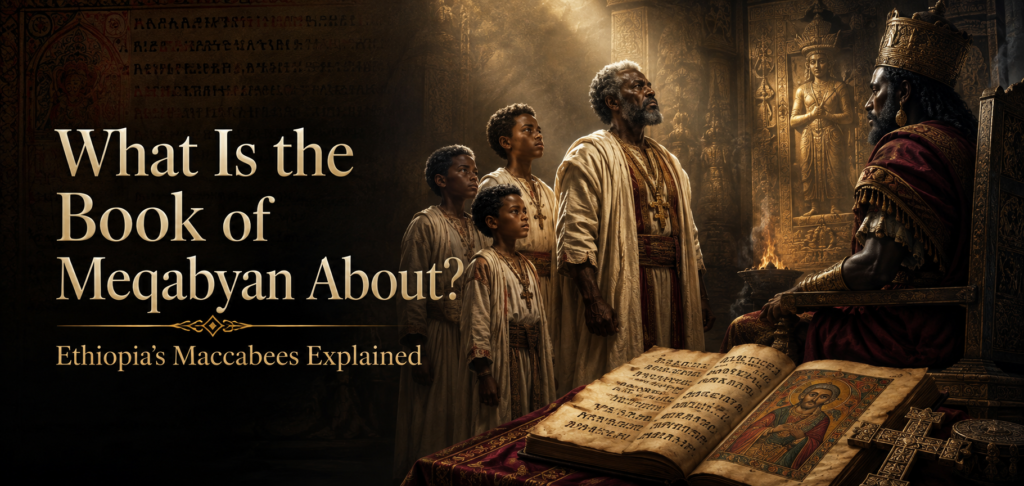
A reader can spend years around the Bible and still be startled by the name Meqabyan. It sounds familiar – close enough to “Maccabees” to suggest Judas Maccabee, Antiochus IV, and the revolt behind Hanukkah. Then the names change. A ruler demands idolatry. A faithful family refuses. A hostile king repents. The final book turns toward moral teaching, judgment, and salvation. If that leaves you asking what is the Book of Meqabyan about, the first surprise is that the question itself hides something important: Meqabyan is a three-book Ethiopian scriptural collection, not one book and not a retelling of the Hasmonean revolt.
The Ethiopian biblical tradition preserves 1, 2, and 3 Meqabyan. Together they speak about faithfulness under pressure, the danger of idolatry and pride, repentance before God, divine judgment, resurrection, and the responsibility to live righteously while there is still time.
They are also not the same books as the Greek Maccabees known from Catholic and Eastern Orthodox biblical traditions. That single distinction clears away most of the confusion.
The Short Answer: What Is Meqabyan About?
If you want the whole collection in a few sentences, it looks like this.
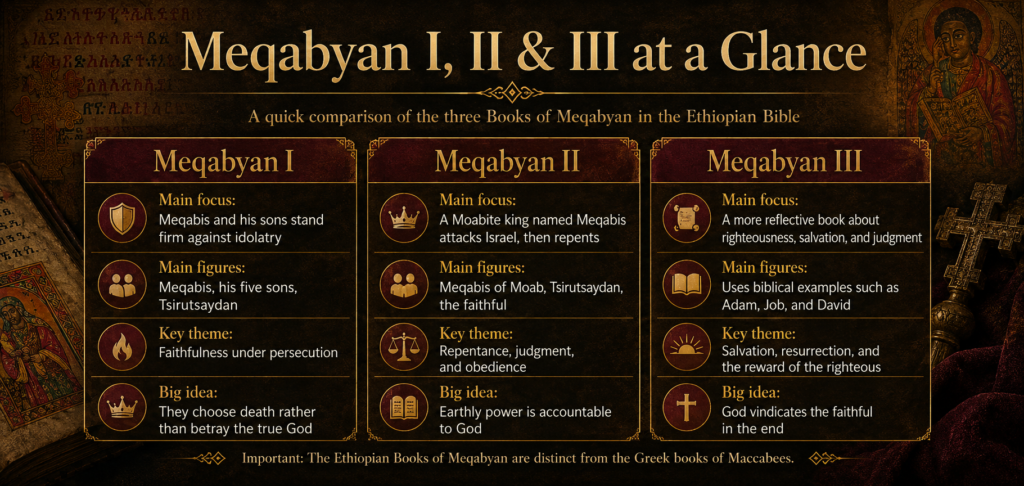
1 Meqabyan centers on a Benjaminite named Meqabis and a ruler called Tsirutsaydan. Meqabis teaches worship of the true God, while his sons refuse the king’s idolatrous demands and face death rather than compromise their allegiance.
2 Meqabyan opens with a king of Moab, also named Meqabis, who makes war against Israel. The story then takes an unexpected turn: the king repents, learns God’s law, and teaches it. Later sections return to idolatry, persecution, mortality, judgment, and the urgency of repentance.
3 Meqabyan is shorter and less like a continuous historical story. It draws on figures such as Adam, Job, and David while teaching about salvation, punishment, moral conduct, death, resurrection, and final judgment.
That is the basic answer. But the books become much more interesting once we stop trying to force them into the story of Judas Maccabee.
First, There Are Three Books of Meqabyan
The Ethiopian Orthodox Tewahedo Church’s current canonical list names 46 books in its older scriptural collection and 35 in its apostolic collection, for the traditional total of 81. In the older collection appear “I Maccabees” and “II and III Maccabees.” The English wording can make the collection look familiar, but the Ethiopian texts behind those labels are the works commonly called 1, 2, and 3 Meqabyan.
Roger W. Cowley’s study of the Ethiopian Orthodox canon explains an important counting detail: the three Meqabyan books have sometimes been counted as two canonical entries because the second and third are reckoned together. Printed Ge’ez and Amharic Bibles, however, preserve three literary books.
That is why a search for “the Book of Meqabyan” can be misleading. There is a collection, not a single continuous volume.
For readers who want the larger map of how Ethiopia’s biblical collection developed, Enoch Press’s guide, The Ethiopian Bible Canon: How It Formed and Why It Stayed Distinct, explains the broader canonical history. The question here is narrower: what actually happens inside Meqabyan?
1 Meqabyan: Faithfulness When a King Demands Worship
The first book gives us the scene most likely to stay in a reader’s mind.
Cowley’s summary describes an idol-worshiping ruler named Tsirutsaydan, associated in the story with Media and Midian. Against him stands Meqabis, a Benjaminite who teaches that people should worship the true God. The account names three of his sons – Abya, Sila, and Fentos – while also speaking of five sons in the martyr tradition.
The important point is not that we can match Tsirutsaydan neatly to a known ruler from Greek or Roman history. We cannot. The book does not give us the kind of securely dateable political setting that Greek 1 Maccabees gives for the Hasmonean revolt.
What it gives instead is a moral collision.
A ruler claims authority over worship. A faithful family recognizes that his authority has limits.
That distinction drives the story. The king may control punishment. He may threaten bodies. He may command public obedience. But the book insists that political power cannot make an idol divine and cannot turn false worship into truth.
Meqabis’s sons refuse to conform and are burned. Their martyrdom places 1 Meqabyan beside a much wider biblical and Christian conversation about faithfulness under persecution: what does a person do when survival is offered at the price of worship?
The book’s answer is severe. Some things cannot be surrendered simply because the cost of keeping them becomes frightening.
Yet 1 Meqabyan does not remain a fast-moving martyr story for thirty-six chapters. Much of the book shifts into instruction – warnings about pride, reflections on death, appeals to humility, biblical examples, judgment, and resurrection.
That change in form tells us what the book is trying to do. The martyr story is not there only to make us admire courageous people. It becomes the doorway into a larger question: what does faithfulness look like before God when power, wealth, fear, and pride all try to redefine what matters?
For a deeper exploration of the characters and the theological movement of all three books, see The Books of Meqabyan: Ethiopia’s Forgotten Heroes of Faith.
2 Meqabyan: The Enemy Who Repents
If 1 Meqabyan is remembered for refusal, 2 Meqabyan introduces a different kind of spiritual drama.
It begins with a king of Moab named Meqabis making war against Israel. The invasion is interpreted within the book as punishment connected to Israel’s wrongdoing. Then the story turns in a direction many readers will not expect.
The aggressor repents.
Meqabis turns from his sins, learns the law of the God of Israel, and teaches what he has learned. In a collection where rulers can easily become symbols of pride, this king becomes an example of something else: power confronted by truth and changed by it.
That matters because Meqabyan does not divide the world into one permanently righteous group and one permanently wicked group. An enemy can turn. A ruler can repent. Belonging to the right people does not excuse wrongdoing, and a sinful past does not make change impossible.
After Meqabis’s death, the book returns to the danger of idolatry and persecution under Tsirutsaydan. Its later material also presses the reader toward moral seriousness. Human strength is temporary. Pride cannot stop death. Repentance should not be postponed as though tomorrow were guaranteed.
That gives 2 Meqabyan a surprisingly hopeful center. Judgment is real, but judgment is not presented merely as destruction. It can expose evil, break arrogance, and create the possibility of a changed life.
3 Meqabyan: When the Battle Moves Into Ordinary Life
The third book is the shortest of the collection – ten chapters in Cowley’s outline – and it does not behave like a conventional war chronicle.
Its attention spreads across salvation and punishment, using biblical figures such as Adam, Job, David, and others as examples. The book is concerned with what people do with the life they have been given and what those choices mean before God.
That makes 3 Meqabyan feel less like the next episode in a political story and more like instruction shaped by the earlier books’ deepest concerns.
In 1 Meqabyan, the threat is easy to see: a king demands false worship.
In 2 Meqabyan, the moral question becomes more complicated: what happens when a violent ruler repents?
By 3 Meqabyan, the struggle comes closer to ordinary life. Pride, greed, temptation, injustice, mortality, repentance, resurrection, and judgment become the field on which faithfulness is tested.
That progression is one reason the three books make more sense when read together. The collection keeps narrowing the distance between the reader and the story.
It is easy to imagine that courage belongs to martyrs in distant courts. It is harder to admit that the same question of allegiance can surface in money, desire, honesty, power, and the decision to delay repentance.
Is Meqabyan the Same as Maccabees?
No. And this is the most important historical distinction in the entire discussion.
The Greek Books of Maccabees are connected in different ways to Jewish life under Hellenistic rule. Greek 1 Maccabees narrates the Hasmonean struggle that begins under Antiochus IV Epiphanes and follows figures such as Judas, Jonathan, and Simon. Greek 2 Maccabees overlaps part of that crisis while emphasizing martyrdom, the Temple, divine justice, and resurrection in its own literary way.
The Ethiopian Books of Meqabyan tell different stories with different central figures. Judas Maccabee is not their hero. Antiochus IV is not their central persecutor. The rededication of the Jerusalem Temple is not their narrative destination.
Cowley stated the distinction plainly: the three Ethiopian books are not the same as any of the four books of Maccabees transmitted in the Greek tradition.
Why, then, are the names so similar?
That question is harder to answer with certainty. The works share themes that readers also associate with Maccabean literature – resistance to idolatry, persecution, martyrdom, divine judgment, and faithfulness under pressure. Their Ethiopian titles became conventionally rendered as “Maccabees” in English-language canon lists, which encourages readers to assume identity where there is only a related name.
The safest rule is simple: when you see Ethiopian Meqabyan, do not mentally substitute the story of the Hasmonean revolt.
Why Is Meqabyan in the Ethiopian Bible?
Because the Ethiopian Orthodox Tewahedo Church received and preserved these books within its scriptural tradition.
Its official canonical page currently lists the traditional total of 81 books and includes the Meqabyan collection among the writings of the older scriptural collection. Cowley’s research also documents Meqabyan in major Ge’ez and Amharic Bible editions and explains the historical variation in how the books were counted.
That does not mean every question about the Ethiopian canon is simple. Ethiopian canon history includes variations in lists, grouping, naming, and the relationship between narrower and broader collections. A modern Western table of contents is often too rigid a model for that history.
But on the question that matters here, the evidence is clear: 1, 2, and 3 Meqabyan belong to the Ethiopian biblical tradition and are not recent internet discoveries being proposed for inclusion.
If the 81-book framework itself is new to you, The Ethiopian Bible: 81 Books Most Christians Have Never Read is the best starting point before moving into individual books.
How Old Are the Books of Meqabyan?
This is one place where careful wording matters.
The surviving Meqabyan works are in Ge’ez, the classical literary and liturgical language of Ethiopian Christianity. Modern scholarship generally treats them as distinctively Ethiopian compositions rather than Ge’ez translations of the Greek Maccabean books.
Their exact date is debated, and the evidence does not support attaching them confidently to the second-century BC Hasmonean revolt. Specialist work by scholars such as Yonatan Binyam, alongside the Encyclopaedia Aethiopica treatment of Mäqabyan, places their formation in medieval Ethiopia, commonly in the high medieval period, rather than in the world of Judas Maccabee.
That later setting does not make them less important to the tradition that receives them as Scripture. It simply changes the historical question. Meqabyan should be studied as Ethiopian Christian literature with its own textual history, not marketed as a secret eyewitness record of events already narrated in Greek Maccabees.
What Is the Main Message of Meqabyan?
If the three books can be reduced to one question, it may be this:
Who deserves your ultimate allegiance when fear, power, pride, and desire all compete for it?
1 Meqabyan answers through people who will not bow to idolatry even when refusal costs their lives.
2 Meqabyan answers through a ruler who discovers that power does not put him beyond correction and that repentance can change what comes next.
3 Meqabyan answers by bringing the issue into ordinary moral life, where faithfulness is measured in the choices people make before death and judgment.
The collection therefore does more than celebrate martyrdom. It connects worship with conduct. It treats pride as dangerous, repentance as urgent, earthly power as temporary, and resurrection as a reason not to measure faithfulness by immediate outcomes.
That is why the books can feel both foreign and familiar. Their names, rulers, and literary world may be unfamiliar to English readers, but their central problem is not.
What do you do when obedience costs something?
What do you do after you realize you were wrong?
What do you do with the ordinary days before the final accounting?
Meqabyan keeps returning to those questions from different angles.
Quick Questions About the Books of Meqabyan
How many Books of Meqabyan are there?
There are three literary books: 1, 2, and 3 Meqabyan. Some Ethiopian canonical counting traditions group the second and third together, which is why an official list may appear to give two Maccabean entries while referring to three books.
Who is Meqabis?
The name appears in the Meqabyan tradition in more than one narrative role. In 1 Meqabyan, Meqabis is a Benjaminite associated with teaching worship of the true God and with sons who resist idolatry. In 2 Meqabyan, a king of Moab named Meqabis wages war against Israel and later repents.
Are the Books of Meqabyan about Judas Maccabee?
No. They are different works from the Greek Maccabean books and do not narrate the Hasmonean revolt led by Judas Maccabee and his family.
Why are they sometimes called Ethiopian Maccabees?
English-language church lists and scholarship often use “Maccabees” as a conventional rendering for Meqabyan. The shared name does not mean the Ethiopian books are translations or alternate versions of Greek 1-4 Maccabees.
Can I read Meqabyan in English?
English access remains much more limited than access to books such as Enoch, Jubilees, or the Greek Maccabees. Translations and online versions exist, but readers should be cautious about relying on unsourced quotations or modern claims that cannot be traced to reliable editions or scholarship.
Conclusion: Ethiopia’s Meqabyan Collection Has Its Own Voice
So, what is the Book of Meqabyan about?
It is really a three-book collection. 1 Meqabyan tells of faithfulness under a ruler who demands idolatry. 2 Meqabyan complicates the picture with a hostile king who repents and learns God’s law. 3 Meqabyan turns toward salvation, judgment, moral conduct, and the choices that shape a life before God.
The books are not Ethiopian translations of the Greek Maccabees. They do not retell the revolt of Judas Maccabee. They belong to a different textual and ecclesial history, preserved in Ge’ez and received within the Ethiopian Orthodox Tewahedo biblical tradition.
That difference is exactly why they are worth understanding on their own terms.
Readers who want the fuller story – the characters, the canon history, the dating questions, and the way all three books build a theology of faithfulness, repentance, and resurrection – can continue with The Books of Meqabyan: Ethiopia’s Forgotten Heroes of Faith.
Meqabyan does not need to be made more mysterious than it is. Its real questions are strong enough: What is worth refusing? Can a wrongdoer truly turn? Does power answer to anyone beyond itself? And how should a person live if death is not the end of the story?
Those questions have traveled a long way through Ethiopian Christian tradition. They still know how to find the reader.
Reflection
It is easy to admire faithfulness when the decision belongs to someone else.
A martyr stands before a ruler. A king is confronted with his wrongdoing. A teacher warns that life is short and judgment is real. From a distance, the right choice can look obvious.
Our own compromises rarely introduce themselves that clearly.
They may arrive as a small silence we know is dishonest, a little surrender made for approval, a resentment we protect because repentance feels humiliating, or a habit we keep postponing because we assume there will always be another day.
Meqabyan’s three movements meet those moments differently. The martyrs say there are things we must not bow to. The repentant king says being wrong does not require staying wrong. The final teachings say faithfulness belongs in ordinary conduct, before the crisis and after it.
For the Christian reader, that is where the books become more than unfamiliar names in a distant canon. They ask whether our worship of God reaches the choices we make when obedience has a cost.
And they leave us with hope: courage is possible, repentance is still open, and faithfulness is never measured only by what can be seen today.
Read More About the Books of Meqabyan
Want to explore these remarkable Ethiopian biblical books more deeply? Continue with these Enoch Press studies:
[The Books of Meqabyan: Ethiopia’s Forgotten Heroes of Faith]
Discover the distinctive stories, characters, themes, and Ethiopian Christian tradition behind all three Books of Meqabyan—and why they should not be confused with the Greek books of Maccabees.
[The Books of Meqabyan: Ethiopia’s Hidden Scripture]
Explore another side of Ethiopia’s Meqabyan tradition, including its place within the Ethiopian biblical canon and what these rarely encountered books reveal about faith, perseverance, judgment, and devotion to God.