
Aksum, Ge’ez, ancient manuscripts, and the living church behind the 81-book tradition
High in the northern Ethiopian highlands, the monastery of Abba Garima has guarded two Gospel books through dynasties, wars, fires, and long centuries when almost no one outside the monastery knew how old they were. Their pages are written in Ge’ez. Their painted arches, birds, plants, and evangelists belong to the visual world of late antiquity. Radiocarbon analysis now places the manuscripts between the late fifth and early seventh centuries.
The most arresting detail is not simply their age. The two books preserve different forms of the Gospel text, which means the Ge’ez translation behind them had already been copied, compared, and revised before these surviving manuscripts were made. Ethiopia did not receive a finished European Bible in the Middle Ages. It possessed a mature Christian book culture while the ancient Mediterranean world was still taking shape.
Yet the Garima Gospels do not contain a neat explanation of Ethiopia’s 81-book canon. No ancient title page announces, “Here is the final list.” That absence is the key to the whole story.
The Ethiopian Bible canon was not created in one meeting, by one ruler, or through one dramatic decision. It formed through reception: books translated into Ge’ez, read in worship, copied in monasteries, taught by clergy, preserved during crisis, and carried forward by the Ethiopian Orthodox Tewahedo Church. It remained distinct because that church developed within the ancient Christian world while retaining its own language, institutions, memory, and rules of faith.
That answer is less sensational than a story about forbidden books. It is also far more interesting.
A Canon Is a Life Before It Is a List
Modern readers usually meet the Bible as a bound volume with numbered pages and a printed table of contents. That format encourages a reasonable assumption: the canon must have been settled first, then copied unchanged into every Christian tradition.
History worked in the opposite direction.
The word canon refers to a recognized rule or measure. Applied to Scripture, it means the body of sacred writings a community receives as authoritative. But recognition did not happen everywhere at the same speed or by the same process. Ancient churches inherited Jewish sacred texts in several languages. They copied apostolic writings. They read certain books publicly. They argued over others. Some collections became stable early; the edges remained less uniform.
That is why Christian Bibles differ. Protestant editions generally contain thirty-nine books in the older covenant collection and twenty-seven in the New Covenant collection. Catholic editions include seven additional books in the older collection, along with expanded portions of Esther and Daniel. Eastern Orthodox churches commonly receive a broader Greek-scripture inheritance, though their exact lists are not identical in every jurisdiction. The Ethiopian Orthodox Tewahedo Church names an 81-book canon and preserves works absent from most Western Bibles.
These differences cannot be explained by imagining one original bound Bible from which later churches removed pages. The early Christian centuries left no such universal volume. What existed were texts, collections, liturgical practices, teaching traditions, and communities making judgments about what they had received.
Ethiopia belongs inside that history, not at its edge.
Aksum Enters the Christian Story
Christianity took public root in the Aksumite kingdom during the fourth century, under King Ezana. Aksum was no isolated mountain village. It was a trading power connected to the Red Sea, northeast Africa, Arabia, and the Roman world. Its coins traveled. Its merchants crossed borders. Greek appeared in royal inscriptions alongside Ge’ez.
Ancient church historians tell the story through Frumentius, a young man from Tyre who reached the Aksumite court after a maritime disaster. He served within the royal household, encouraged Christian merchants, and later traveled to Alexandria. Athanasius, bishop of Alexandria, consecrated him as bishop for Aksum. Ethiopian tradition remembers him as Abba Salama, the Father of Peace.
The precise details arrive through sources written outside Ethiopia and must be read with normal historical care. The broad outline is secure: by Ezana’s reign, Christianity had become tied to Aksumite royal power, and the Ethiopian church entered a lasting relationship with the Alexandrian church.
That relationship mattered for Scripture. It connected Ethiopia to Greek-speaking and Egyptian Christian worlds without making Ethiopian Christianity a copy of either one. The faith took root in Ge’ez. It entered local worship, royal culture, monastic life, architecture, music, and education. Over time, books arriving through wider Christian networks were translated, revised, and received within an Ethiopian setting.
The canon grew inside that process. It did not arrive as a sealed package.
Ge’ez Gave Scripture a Durable Home
Language is one of the strongest reasons the Ethiopian canon remained distinct.
Ge’ez was the literary language of Aksum and became the sacred and scholarly language of the Ethiopian church. The earliest biblical translations were made primarily from Greek forms of Scripture, especially the Septuagint tradition, though scholars also find Syriac, Hebrew, and later Arabic influence. The translation history was layered. It stretched across centuries and included correction, revision, and fresh comparison with other textual traditions.
That complexity is visible in the Garima Gospels. Their differing texts show that Ge’ez Christianity already possessed more than one copy line. A translator had done the first work. Scribes had transmitted it. Readers had noticed differences. Revision had begun. The manuscripts are surviving evidence of a much larger activity now mostly lost.
This matters because translation changes the survival odds of a book. A writing that exists only in a fading scholarly language can disappear when its readers disappear. A writing translated into a church’s sacred language can be copied into worship, commentary, education, and memory. It can become difficult to remove because it no longer lives as a foreign curiosity. It has a home.
First Enoch is the clearest example. Aramaic fragments recovered at Qumran prove that the work circulated in ancient Judaism, but the complete text survived through Ge’ez. Jubilees followed a similar path: fragments attest its antiquity, while Ethiopia preserved the complete form. The Books of Meqabyan survived as a distinct Ethiopian collection, unrelated in plot to the Greek Maccabean histories familiar to Catholic and Eastern Orthodox readers.
For readers meeting this larger world for the first time, Enoch Press’s introduction to the Ethiopian Bible’s 81 books offers the broad map. The beginner’s guide to the Book of Enoch follows one of its most famous roads. The Books of Meqabyan show how different the landscape becomes once identical-looking titles are no longer assumed to contain identical works.
Ge’ez did more than translate words. It created continuity.
The Canon Was Formed More Than Once
It is tempting to imagine canon formation as a single ancient phase that ended before the manuscripts reached Ethiopia. The evidence points to repeated stages.
The first stage was reception. Christian communities in Aksum received the Gospels, apostolic letters, Jewish sacred writings, and other religious works through the networks linking Ethiopia to Egypt and the eastern Mediterranean. We rarely know the exact journey of a particular book. The surviving record is too uneven. What we can see is the result: texts present in Ge’ez and rooted deeply enough to be recopied.
The second stage was translation. Translation required choices about wording, names, book divisions, and textual sources. A Ge’ez version could preserve a Greek reading in one period, absorb Syriac influence in another, and later be revised against Arabic copies. The Ethiopian biblical tradition therefore carries a history inside its sentences. It is not a photographic copy of one source text.
The third stage was liturgical and educational use. Some books were read publicly. Others shaped commentary, church discipline, calendar calculation, monastic instruction, or private devotion. These uses did not always create one flat rank in which every work functioned identically. They did create a sacred literary world broader than the printed Bible familiar to most Western readers.
The fourth stage was classification. Church-order books, legal compilations, and later canon discussions attempted to name and count what the church had received. By then, the texts had already lived through centuries of translation and use. Lists described an inheritance; they did not create it from nothing.
The fifth stage was print. Printing forced choices that manuscript culture could leave flexible. A publisher had to decide which works belonged between two covers, how to divide combined books, what order to use, and what could be omitted because of cost or size. This helps explain why the traditional number can remain steady while printed editions differ. A manuscript culture can preserve a recognized collection across several volumes and locations. A commercial press demands a finite object.
The Library of Congress holds a striking marker of that transition: a Ge’ez Gospel book printed in Rome in 1548, the first printed New Covenant edition in the language. Three Ethiopian monks connected with Debre Libanos helped prepare it. The object joins worlds that are often separated in popular retellings—Ethiopian monastic scholarship, Roman printing, ancient liturgical language, and early modern technology.
Canon formation, then, was not one gate that opened and closed. It was a sequence of receptions, translations, uses, lists, and editions. Each stage left its own kind of evidence.
The Number 81 Is True—and More Complicated Than It Looks
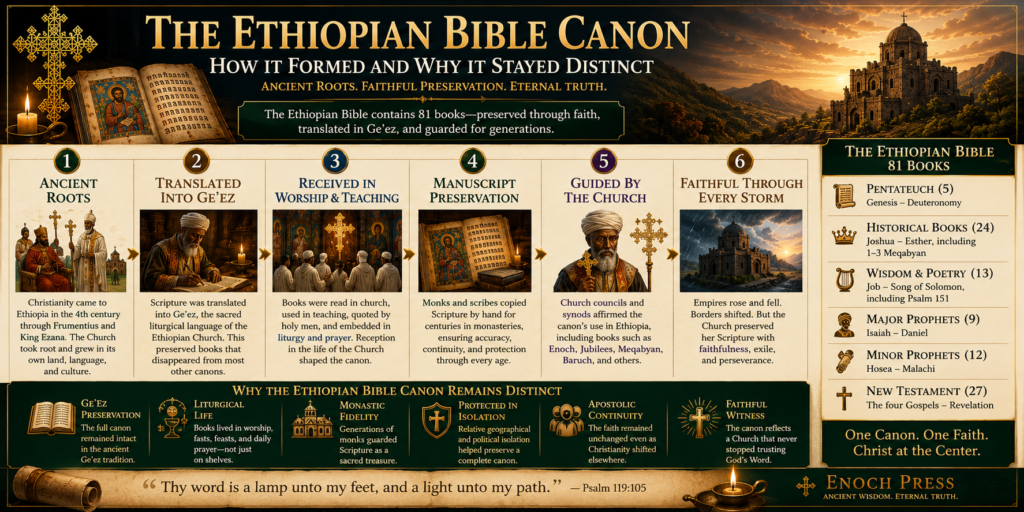
The Ethiopian Orthodox Tewahedo Church’s official English-language canon page states the familiar count directly: forty-six books in the older covenant collection and thirty-five in the New Covenant collection, making eighty-one.
That number is real. It should not be dismissed as internet folklore. It belongs to the church’s own public description of its Bible. At the same time, the page is a modern church statement, not an ancient decree proving that every century used the same divisions.
The difficulty begins when a modern reader asks for one universally printed list in which every title is separated and counted exactly the same way. Ethiopian sources do not always oblige.
Some books that appear as separate volumes in one tradition are combined in another. Titles vary across Ge’ez, Amharic, and English. Collections may be counted by sections rather than by the number of physical works a modern publisher would bind separately. The three Books of Meqabyan, for example, can appear in grouped counting. Ezra materials are named and arranged differently across traditions. Wisdom collections can be divided in more than one way.
The New Covenant side raises a second issue. Alongside the twenty-seven books familiar across most Christian churches, the broader Ethiopian count includes eight works connected to church order and apostolic instruction: four sections of Sinodos, two Books of Covenant, Ethiopic Clement, and the Ethiopic Didascalia. These writings explain why the phrase “81-book Bible” cannot always be pictured as one modern study Bible with eighty-one equally sized, equally accessible entries.
Roger Cowley described narrower and broader ways of presenting the Ethiopian canon. Bruk A. Asale later warned that even those categories can make the tradition seem tidier than it is. Published lists have varied. Different editions can reach the traditional total through different counting arrangements. In the church’s life, that variation did not create the same crisis it creates for readers trained to expect one spreadsheet and one answer.
A medieval legal and church-order work called the Fetha Nagast helps explain how old the number is—and why the counting problem is old too. The work speaks of eighty-one divine books received by the church, yet the list associated with that statement contains only seventy-three or seventy-four, depending on how its items are counted. Asale’s conclusion is blunt: the 81-book tradition is ancient and authoritative within Ethiopian Christianity, but no known council left a clean decree identifying one permanent modern-style list.
The most responsible summary is simple. Ethiopia has a genuine 81-book canonical tradition. The exact arrangement of those eighty-one has been more fluid than popular charts suggest.
No, the Council of Laodicea Did Not Create Ethiopia’s Canon
One claim needs to be removed from the story entirely: the Council of Laodicea did not confirm a list containing Enoch, Jubilees, Meqabyan, Baruch, and the other distinctively Ethiopian books.
Laodicea was a regional fourth-century synod in Asia Minor. Its canons addressed church order, worship, clerical conduct, relations with other religious groups, and which writings could be read publicly. A list often called Canon 60 is attached to some later copies, though its authenticity has long been disputed. Even that list does not match the Ethiopian canon. It omits Revelation from the New Covenant collection and does not include Enoch, Jubilees, or Meqabyan.
The council matters to the wider history of Christian canon lists. It cannot serve as the moment when Ethiopia’s 81 books were fixed.
This correction changes the story for the better. It moves attention away from a borrowed council and back toward the actual Ethiopian process: ancient reception, translation, teaching, liturgy, canon law, monastic copying, and continued church authority.
It also exposes a common mistake in canon history. Readers often search for the meeting where “the Bible was decided.” Sometimes councils did issue influential lists. Yet a list could only name books that communities already knew, copied, read, disputed, or revered. Reception came before the decree. In Ethiopia, the evidence points to a tradition that remained broader and less dependent on one definitive list than Western models lead readers to expect.
What the Ethiopian Canon Actually Preserves
The distinctive books are often marketed as a pile of forbidden secrets. That framing makes them sound like contraband. In the Ethiopian church, they are inherited sacred literature.
First Enoch carries readers into the world of the Watchers, heavenly judgment, cosmic order, and the coming righteous kingdom. Its language stands close to the thought world of Second Temple Judaism and leaves visible marks in the letter of Jude. The full work survived in Ge’ez when most of the Christian world knew it only through quotations and fragments.
Jubilees retells Genesis and the early chapters of Exodus through revealed chronology, covenant, angels, sacred festivals, and a 364-day calendar. Its fragments among the Dead Sea Scrolls confirm that it belonged to ancient Jewish debate long before Christianity reached Aksum.
The three Books of Meqabyan are not Ethiopian translations of Greek 1-4 Maccabees. They tell different stories and press different concerns: resistance to idolatry, the limits of political power, repentance after grave wrongdoing, divine judgment, and resurrection hope. Their presence makes the Ethiopian canon distinct even from other broad Christian collections.
The church also receives books familiar to Catholic or Eastern Orthodox readers but absent from Protestant editions, including Tobit, Judith, Wisdom, Sirach, and Baruch. Then there are the additional church-order writings associated with the broader New Covenant count.
The result is not simply “the Protestant Bible plus fifteen extras.” The counting systems do not line up that neatly, and the added works do not all belong to one period or genre. The Ethiopian canon is a library formed from several streams: Jewish Scripture, Greek Christian inheritance, ancient Jewish literature preserved in Christian use, Ethiopian compositions and recensions, and church-order texts received within ecclesial life.
That is why comparison charts help only up to a point. They can show that the collections differ. They cannot explain how a community lived with those books.
Why the Tradition Stayed Distinct
No single cause preserved the Ethiopian canon. Several forces worked together.
First came antiquity. Ethiopian Christianity did not begin after the great canon debates of medieval Europe. It entered the Christian story in the fourth century and developed its scriptural life from that early position.
Second came language. Ge’ez allowed books to remain active after Greek or Aramaic copies disappeared. Translation placed them inside Ethiopian worship and scholarship.
Third came liturgy and education. A sacred book survives more securely when it is read, chanted, taught, copied, and interpreted than when it rests on a shelf as an antiquarian object. Canon lived through use.
Fourth came monastic labor. Ethiopian monasteries functioned as schools, libraries, scriptoria, and places of refuge. The Metropolitan Museum of Art notes that copying manuscripts could form part of a monk’s spiritual training. Parchment, ink, binding, illumination, correction, and recopying demanded time. Each manuscript embodied a decision that the text was worth another generation’s labor.
Fifth came institutional continuity. For centuries the Ethiopian church maintained its own worship and literary culture while remaining linked to Alexandria. Later Western disputes – the Reformation, the Catholic response at Trent, and the rise of mass-printed vernacular Bibles – did not determine Ethiopia’s collection in the same direct way they reshaped European editions.
Geography played a role, but “isolation” is too blunt a word. Aksum was connected to trade routes. Ethiopian Christianity absorbed Greek, Egyptian, Syriac, and Arabic influence. Ethiopian monks traveled. The 1548 Ge’ez New Covenant edition was printed in Rome under the direction of three Ethiopian monks from Debre Libanos. Ethiopia was connected and distinct at the same time.
Crisis also shaped preservation. Warfare and religious conflict destroyed churches, libraries, and manuscripts. The sixteenth-century campaigns of Ahmad ibn Ibrahim al-Ghazi devastated Christian institutions across the highlands. Survival was never automatic. Texts endured because communities moved them, hid them, recopied them, and rebuilt what had been lost.
The canon remained distinct, then, because a living church kept making costly acts of continuity.
What the Ethiopian Bible Does—and Does Not—Prove
The Ethiopian Bible proves that Christian scriptural history is larger than the Western story many readers inherited. It proves that African Christianity belongs near the beginning of the Christian era, not in a modern appendix. It proves that Ge’ez preservation is essential to the study of works such as Enoch and Jubilees. It proves that a church can maintain a broader sacred library across many centuries.
It does not prove that every book absent from a Protestant Bible was removed in one conspiracy. It does not prove that the Ethiopian canon was settled by the Council of Laodicea. It does not prove that one surviving Ethiopian manuscript contains all eighty-one books in their modern order. It does not make every popular claim attached to the phrase “oldest Bible” true.
Nor does the existence of different canons settle the theological question for every Christian. Churches recognize authority through their own traditions, doctrines, and governing structures. A Protestant reader, a Catholic reader, an Eastern Orthodox reader, and an Ethiopian Orthodox reader will not begin with identical assumptions.
Historical honesty does something more useful than forcing instant agreement. It tells each reader what kind of claim is being made.
The historical claim is that Ethiopia received Christianity in late antiquity, developed a deep Ge’ez scriptural culture, preserved books lost or marginalized elsewhere, and came to confess an 81-book canon whose exact counting has varied. The ecclesial claim is that the Ethiopian Orthodox Tewahedo Church receives these writings as sacred within its rule of faith. The personal question—what authority those books should carry for a reader outside that church—requires theology, humility, and careful study.
Confusing those layers creates arguments. Separating them creates understanding.
How to Read Claims About the Ethiopian Bible
A careful reader can test almost any dramatic claim by asking three questions.
First: which Ethiopian source is being described? A church canon page, a printed Amharic Bible, a Ge’ez manuscript, a scholarly reconstruction, and a social-media chart are not interchangeable. The phrase “the Ethiopian Bible” can refer to a canonical tradition, a particular edition, or a modern English compilation. A claim that is true of one may fail when applied to the others.
Second: what does the number count? Book divisions differ. A source may combine writings that another source separates. The traditional total can remain eighty-one even when the path to that number changes. Counting without naming the system creates false certainty.
Third: what kind of authority is being claimed? A book can be ancient without being canonical in every church. It can be canonical in Ethiopia without having circulated there in its present form during the fourth century. It can preserve early material while surviving only in much later manuscripts. Age, canonicity, manuscript date, and theological authority answer different questions.
These distinctions protect the reader from two opposite errors. The first is dismissal: assuming that unfamiliar Ethiopian books are late inventions because they are absent from Western Bibles. Qumran fragments of Enoch and Jubilees make that position impossible. The second is exaggeration: assuming that every Ethiopian book is older than every Western canonical book, or that one ancient Ethiopian codex contains the entire 81-book collection. The evidence does not support that either.
Serious history is rarely as tidy as a viral claim. Here, the untidiness is part of the value. It reveals a church receiving texts through several languages, preserving them across disruptions, and counting them according to inherited categories that do not always match modern publishing habits.
Conclusion: A Canon Carried by a Church
The Ethiopian Bible canon did not fall from the sky as an 81-item table of contents. It formed through a long chain of human faithfulness: translators giving Scripture a Ge’ez voice, scribes bending over parchment, clergy teaching inherited texts, monks protecting books during upheaval, worshipers hearing those writings inside the life of the church, and scholars continuing to argue over how the traditional number should be counted.
Its distinctiveness survived because those practices survived.
That is the answer to the central question. Ethiopia’s canon formed through ancient Christian reception, translation, liturgy, law, teaching, and manuscript transmission. It remained distinct because the Ethiopian Orthodox Tewahedo Church possessed enough continuity to preserve its own scriptural memory while other Christian worlds narrowed, rearranged, or standardized theirs along different lines.
The 81-book tradition is real. So is its complexity. Respecting both truths is the beginning of serious study.
Reflection
There is a spiritual warning hidden inside every old manuscript: what one generation neglects, the next may never receive.
The Ethiopian church preserved sacred writings through work that was often slow, repetitive, and unseen. A scribe did not know which future scholar would study his page. A monk carrying a manuscript away from danger could not know whether the monastery would survive. Faithfulness came before visible results.
That pattern reaches beyond books. Families preserve prayers. Churches preserve worship. Teachers preserve understanding. Believers preserve truth by returning to it, practicing it, and handing it forward with care.
The Ethiopian canon invites humility because it reminds us that familiarity is not the same as fullness. We inherited Scripture through the faithfulness of people we will never meet. The proper response is neither suspicion toward every unfamiliar book nor blind excitement over anything ancient. It is gratitude joined to discernment—and a willingness to become faithful stewards of what has been placed in our hands.