Most Christians who hear the word Maccabees think of one thing: the Jewish revolt against Antiochus IV, the cleansing of the Jerusalem temple, and the story remembered in Hanukkah. Others may think of the mother and her seven sons who refused to deny their faith under torture.
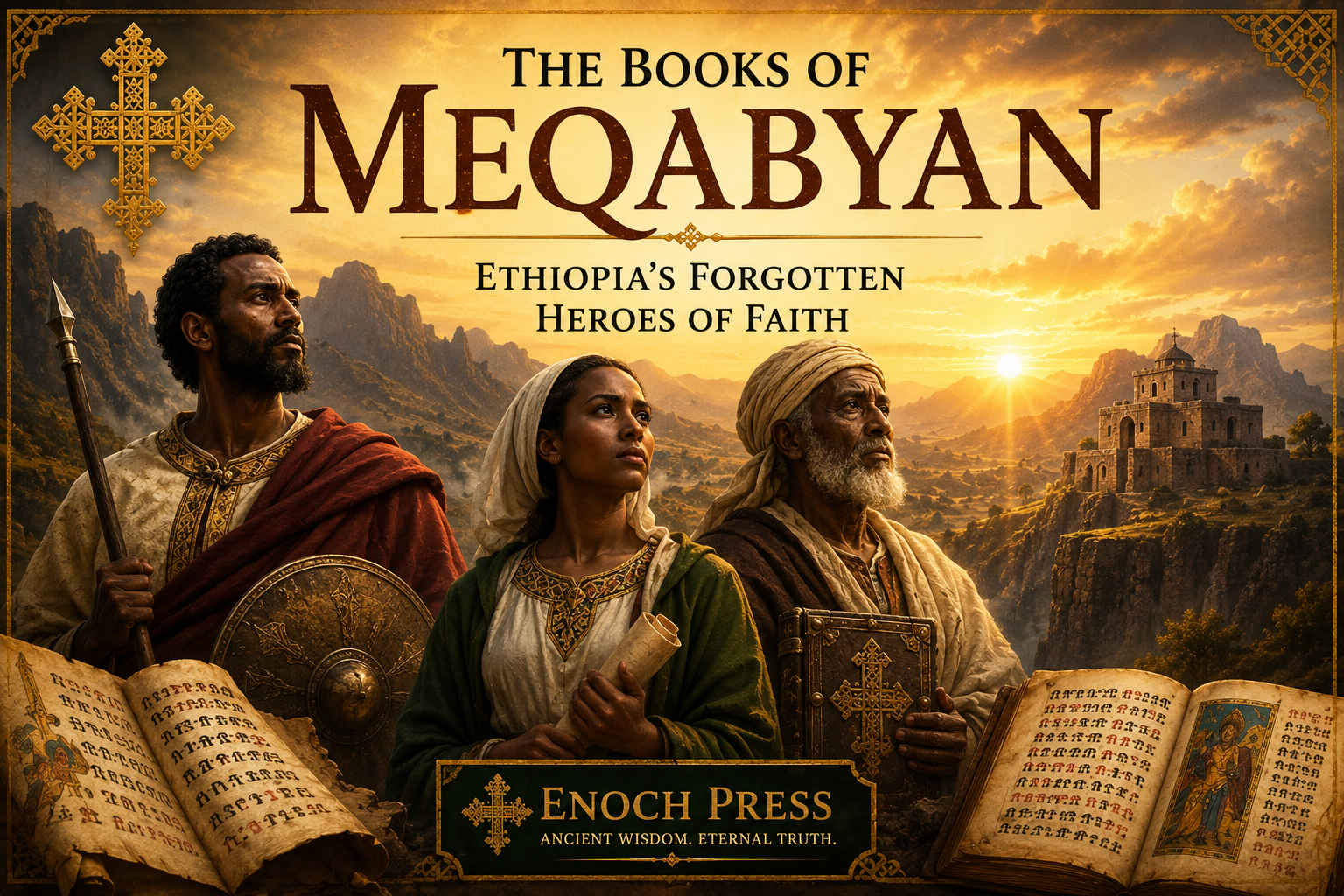
But in the Ethiopian biblical tradition, there is another set of books with a similar name: Meqabyan.
That name causes confusion immediately. The Books of Meqabyan are often called the Ethiopian Maccabees, but they are not the same books as 1–4 Maccabees found in Greek, Catholic, and Eastern Orthodox traditions. Roger Cowley's study of the Ethiopian Orthodox canon specifically notes that the three books of Mäqabeyan are not the same as any of the four Greek books of Maccabees or Pseudo-Josephus. [2]
That distinction matters. If readers assume Meqabyan is simply Ethiopia's version of the familiar Maccabean revolt, they will misunderstand the books from the start. These texts belong to the Ethiopian scriptural world, where biblical memory, martyrdom, repentance, judgment, and resurrection hope are woven together in a way that feels both ancient and unfamiliar.
So the real question is not simply, "What are the Books of Meqabyan?" The better question is: Why did the Ethiopian tradition preserve these books, and what kind of faith do they teach?
The Ethiopian Bible Preserves a Wider Biblical World
The Ethiopian Orthodox Tewahedo Church is famous for preserving one of the broadest biblical traditions in Christianity. Its official church page states that the Ethiopian Orthodox Church recognizes 46 Old Testament books and 35 New Testament books, bringing the total to 81 canonized books. It also lists Maccabean books among the Old Testament books. [1]
That alone surprises many Western Christians. Most Protestant Bibles contain 66 books. Catholic and Eastern Orthodox Bibles include additional deuterocanonical books, but even those readers may not be familiar with Enoch, Jubilees, or the Ethiopian form of Meqabyan.
The Ethiopian church's own explanation also emphasizes that the Ethiopic Bible differs from the biblical canon of other churches and that many books were written in Ge'ez and preserved in Ethiopia's manuscript tradition. [1]
But there is a guardrail here. The Ethiopian canon is not as simple as a clean modern table of contents. Cowley observed that Ethiopian canon lists vary, that the number 81 can be reached in different ways, that book names do not always identify texts with modern precision, and that some books recognized as authoritative were historically difficult to obtain or print. [2]
Bruk A. Asale likewise argues that the Ethiopian Orthodox Tewahedo Church's concept of canon is better understood as "neither open nor closed" in the strict Western sense. [3]
That means readers should avoid two mistakes. The first mistake is dismissing Meqabyan as "not real Bible" simply because it is unfamiliar in the West. The second mistake is making careless claims that flatten the Ethiopian tradition into viral slogans like "the forbidden Bible" or "the lost Bible they hid from you." That kind of marketing is trash. It gets clicks, but it teaches badly.
A better approach is reverent, historically honest curiosity.
Why Meqabyan Is Not the Same as Greek Maccabees
The familiar Greek Maccabean books are tied to the historical crisis of the second century BC, when Antiochus IV Epiphanes attempted to suppress Jewish religious practice and the Maccabean revolt followed. Museum of the Bible notes that in Jewish tradition, "Maccabee" normally refers to Judah Maccabee and his brothers, while in some Christian traditions the term can also refer to the martyrs of 2 Maccabees 7. [4]
Meqabyan moves in a different world.
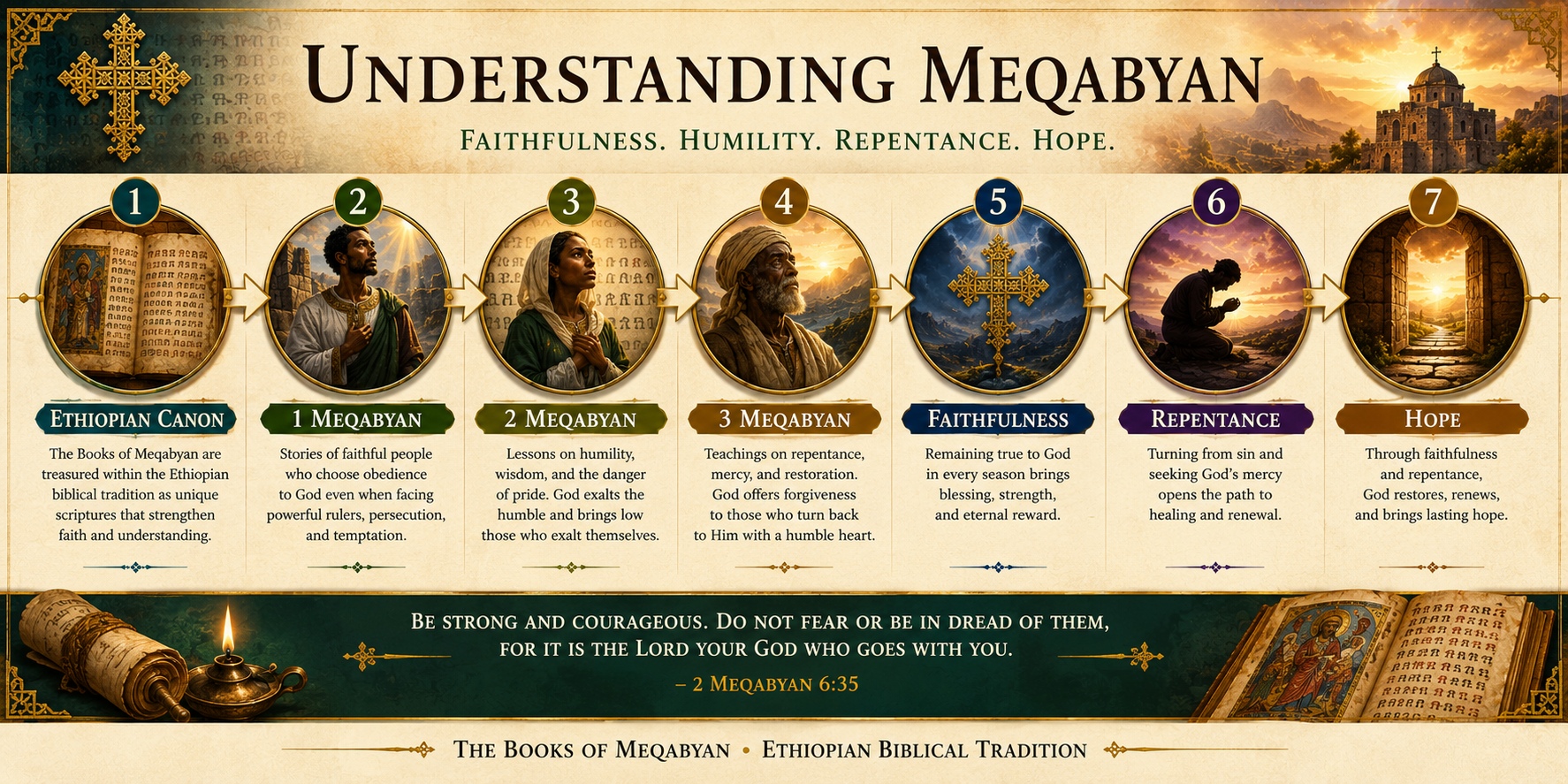
The names, structure, theological emphasis, and story-world of the Ethiopian books do not line up neatly with 1–4 Greek Maccabees. In 1 Meqabyan, the story opens with an idolatrous ruler named Tseerutsaydan, a king who trusts in idols and commands others to worship them. A public-domain English rendering of 1 Meqabyan's opening chapter presents Tseerutsaydan as a ruler obsessed with false gods, sacrifice, power, and coercion. [5]
The conflict is not framed primarily as a political revolution. It is framed as a test of worship.
Who is God? Who deserves obedience? What does faithfulness look like when the ruler demands compromise? What does courage look like when survival requires silence?
Those are the questions Meqabyan presses on the reader.
The Heroes of 1 Meqabyan: Faithfulness Under Fire
The heart of 1 Meqabyan is the courage of faithful witnesses who refuse idolatry. The text presents figures associated with Meqabees and his sons, including Abya, Seela, and Fentos, who refuse to bow to idols even under threat. In an accessible English rendering of the text, these faithful ones declare that they will not bow or sacrifice to lifeless idols made from silver, gold, stone, and wood. [5]
This is why the title "heroes of faith" fits.
Their heroism is not built on conquest first. It is built on worship. They stand before political power and say, in effect: You may control the punishment, but you do not control the truth.
That is the spiritual center of 1 Meqabyan. Idolatry is not treated as a harmless private mistake. It is portrayed as a corruption of worship, moral judgment, public life, and human dignity. The tyrant's false worship leads to violence, arrogance, and cruelty. The faithful response is not clever compromise. It is clear witness.
The text also places strong emphasis on resurrection hope. In the Meqabyan story, martyrdom is not the end of the faithful. The martyrs' courage points beyond death toward vindication before God. This is not a minor theme. The text presents resurrection hope as the reason faithful people can endure suffering without surrendering their worship. [5]
That makes Meqabyan spiritually powerful even for readers outside the Ethiopian Orthodox tradition. It asks a hard question modern Christians often avoid: What would you refuse to worship, even if refusal cost you something?
2 Meqabyan: Judgment, Repentance, and the Mercy of God
The second book shifts the emphasis. A publicly available rendering of 2 Meqabyan begins with Meqabees making war against Israel, with the destruction presented as connected to Israel's wrongdoing. Then the prophet Re'ay confronts him, calling him to repentance and warning him that military strength cannot save him from divine judgment. [6]
This matters because 2 Meqabyan is not merely a repeat of heroic resistance. It also teaches repentance.
The oppressor is not allowed to hide behind power. The violent man is exposed. The proud man is warned. The sinner is summoned to return to God.
In the text, Meqabees mourns, repents, rejects idolatry, and begins to learn the law of God. [6]
That movement is important. Judgment in Meqabyan is not random rage. It is moral clarity. God sees violence, pride, idolatry, and injustice. But the call to repentance remains real.
That is one of the reasons these books deserve more careful attention. They do not present faithfulness only as resistance against external enemies. They also present faithfulness as the painful turning of the sinner back toward God.
This is where Meqabyan becomes uncomfortable in a useful way. It does not let readers divide the world neatly into "bad people out there" and "good people in here." The books press inward. They ask whether the heart has become proud, whether worship has become compromised, whether repentance is still possible, and whether God's mercy is being ignored.
3 Meqabyan: Pride, Evil, and Final Accountability
The third book moves even more directly into theological reflection. A publicly available rendering of 3 Meqabyan opens with a dramatic reflection on evil, pride, deception, and divine judgment, presenting the devil as one who misleads people through wealth, beauty, pride, quarrels, false signs, and worldly desire. [7]
This is not the same kind of material as a straightforward historical chronicle. It reads more like moral and theological instruction. The concern is not merely, "What happened?" The concern is, "How does evil work, and how does God judge it?"
That distinction is important. Some readers approach every ancient text looking only for modern historical reconstruction. That is the wrong tool for this part of Meqabyan. These books are deeply interested in moral formation. They teach through story, warning, contrast, and theological imagination.
The result is a set of texts that repeatedly return to the same core themes:
- Faithful worship matters.
- Idolatry destroys discernment.
- Power without humility becomes monstrous.
- Repentance is still possible.
- God sees what rulers and crowds ignore.
- Death does not erase the hope of the righteous.
That is why Meqabyan belongs in a serious conversation about the Ethiopian Bible. It is not a curiosity to mention once and forget. It is part of a preserved tradition of Christian moral imagination.
Why These Books Are "Forgotten" by Many Christians
The Books of Meqabyan are not forgotten because they are unimportant. They are forgotten by many Christians because most Christians have inherited a narrower biblical world.
Western Christians usually learn the Bible through the canon of their own church tradition. Protestants usually learn 66 books. Catholics learn a broader canon that includes books such as Tobit, Judith, Wisdom, Sirach, Baruch, and 1–2 Maccabees. Eastern Orthodox Christians often inherit an even broader Old Testament tradition. But the Ethiopian Orthodox Tewahedo tradition preserves texts that many other Christians never encounter, including Enoch, Jubilees, and Meqabyan. [1]
This does not mean every Christian must treat Meqabyan with the same canonical authority. Different churches receive different canons. That should be stated honestly.
But it does mean Christians should stop acting as if their own table of contents is the entire history of biblical tradition. That assumption is too small. The Ethiopian Bible forces readers to remember that Christianity is older, wider, and more geographically diverse than many modern believers realize.
Meqabyan also matters because it shows how Ethiopia preserved a scriptural imagination centered on worship, courage, repentance, and judgment. These themes are not fringe. They are deeply biblical themes, even when expressed through texts unfamiliar to Western readers.
What Modern Readers Should Take from Meqabyan
The safest way for non-Ethiopian Orthodox readers to approach Meqabyan is with humility.
Do not treat these books as internet bait. Do not claim they were "banned from the Bible" unless you are prepared to explain which Bible, which church, which century, and which canon. Do not pretend the books are identical to Greek Maccabees. They are not. Do not turn them into conspiracy content. That dishonors the tradition that preserved them.
Instead, read them as witnesses to a Christian tradition that took faithfulness seriously.
The heroes of Meqabyan are not impressive because they are famous. Most Christians do not know their names. They are impressive because they refuse to trade worship for safety. They understand that idolatry is not only bowing to a statue. It is giving ultimate trust to something that cannot give life.
That lesson is not ancient only. Modern idols rarely look like carved images. They look like approval, money, control, comfort, influence, platform, politics, beauty, fear, and self-preservation. The form changes. The spiritual danger does not.
Meqabyan asks the reader: What has power over your obedience?
- If comfort owns your obedience, comfort has become an idol.
- If fear owns your obedience, fear has become an idol.
- If public approval owns your obedience, public approval has become an idol.
- If money owns your obedience, money has become an idol.
That is why these books still have devotional force. They are not merely "extra books" from an ancient canon. They are a mirror.
Conclusion: A Forgotten Witness Worth Recovering
The Books of Meqabyan are among the most fascinating and misunderstood writings associated with the Ethiopian Bible. They are often confused with Greek Maccabees, but they belong to a distinct Ethiopian tradition. They are connected to the broader 81-book world of the Ethiopian Orthodox Tewahedo Church, yet they also require careful historical guardrails because Ethiopian canon lists and book identifications have their own complexities. [2]
Their value is not that they give modern readers a simple new "missing Bible story." Their value is deeper than that.
- Meqabyan teaches that worship is worth suffering for.
- It teaches that rulers answer to God.
- It teaches that repentance is not weakness.
- It teaches that martyrdom is not defeat when resurrection hope is true.
- It teaches that forgotten heroes may still have something urgent to say.
For Christians willing to listen carefully, the Books of Meqabyan are not just rare Ethiopian writings. They are a preserved witness to courage, repentance, and faithfulness before the living God.
Reflection
The challenge of Meqabyan is simple, but it is not soft:
What would you refuse to bow to?
Not in theory. Not in a dramatic story from long ago. In your real life.
The faithful in Meqabyan are remembered because they knew worship belonged to God alone. That is still the line every believer must face. The idols may change names, but the test remains the same.
Sources
- Ethiopian Orthodox Tewahedo Church — Canonical Books
- Roger W. Cowley, "The Biblical Canon of the Ethiopian Orthodox Church Today"
- Bruk A. Asale, "The Ethiopian Orthodox Tewahedo Church Canon of the Scriptures: Neither Open nor Closed"
- Museum of the Bible — "Who Are the Maccabees?"
- Wikisource — Translation: 1 Meqabyan
- Pseudepigrapha.com — 2 Meqabyan
- Wikisource — Translation: 3 Meqabyan