
A forgotten prayer, a divided biblical portrait, and the ancient question of whether repentance can come too late
There is a moment in 2 Chronicles that feels almost impossible if you have just finished reading 2 Kings.
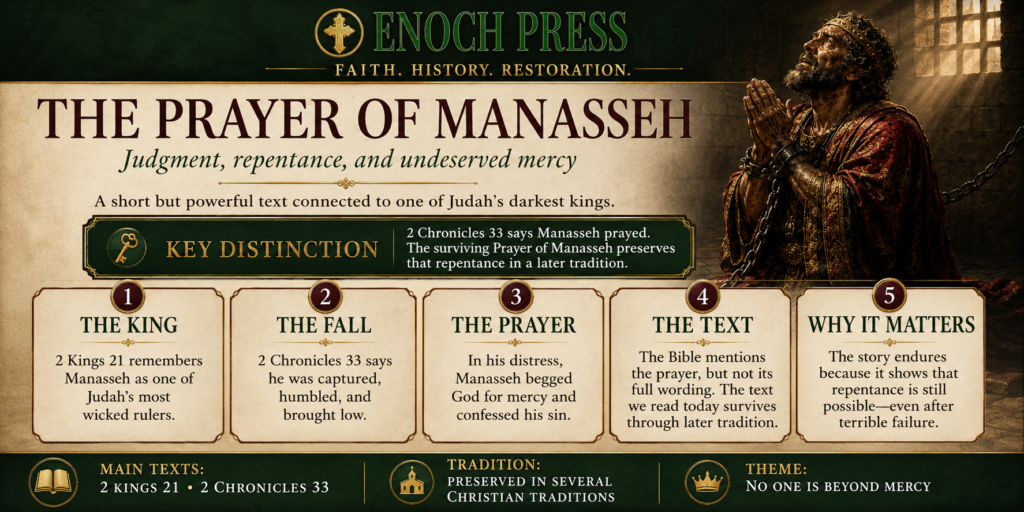
Manasseh, king of Judah, has spent years tearing down nearly everything his father Hezekiah tried to restore. He rebuilds pagan altars. He turns toward astral worship. He practices divination. He places an idol inside the Temple. The biblical writers accuse him of shedding innocent blood on a terrifying scale. In Kings, his reign becomes one of the reasons Jerusalem’s destruction is said to be unavoidable.
Then Chronicles does something startling.
The king who had spent decades refusing to listen is taken away in chains. In distress, he humbles himself. He prays. And God listens.
That should be the dramatic center of the story, but the Chronicler leaves us with a strange silence: the prayer itself is not given. We are told that Manasseh prayed. We are told that his prayer was recorded. We are told that he was restored. But the words that supposedly came from the mouth of Judah’s most notorious king are missing.
Centuries later, a short prayer began circulating under his name. It is only a few paragraphs long. Yet it does something larger books sometimes fail to do: it gives language to a person who has run out of excuses.
That text is the Prayer of Manasseh. And its real story is not simply whether a wicked king once said these exact words. It is how Jewish and Christian readers wrestled with a harder question: if someone has done terrible evil, is there still a road back?
Two Biblical Portraits of the Same King
Before we can understand the prayer, we have to meet the man whose name it carries—and here the Bible itself forces us to slow down.
Manasseh ruled Judah for much of the seventh century BC, during the long shadow of Assyrian power. Assyrian royal inscriptions independently name a ruler of Judah called Manasseh among the western kings subject to the empire. One inscription of Esarhaddon lists him among rulers summoned to provide materials and labor for royal building projects. That external evidence does not confirm every episode told about him in the Bible, but it does place Manasseh firmly inside the political world the biblical accounts describe: a small kingdom surviving beneath an enormous imperial system.
The theological portraits, however, are not identical.
Second Kings 21 is relentless. Manasseh reverses Hezekiah’s reforms, rebuilds high places, erects altars to Baal, makes an Asherah, worships the host of heaven, practices forbidden forms of divination, and sets a carved image in the Temple. The writer adds that he shed “very much innocent blood” until Jerusalem was filled with it. Later in Kings, even the reforms of Josiah cannot erase the judgment associated with Manasseh’s reign. He becomes a symbol of how deeply Judah had corrupted itself.
Second Chronicles 33 agrees about the early wickedness. It does not soften that part. Then it adds a chapter to the man’s life that Kings never tells.
According to Chronicles, Assyrian commanders capture Manasseh, bind him, and take him to Babylon. In his distress he seeks the Lord, humbles himself greatly, and prays. God hears him and brings him back to Jerusalem. The restored king then removes foreign gods, repairs the altar of the Lord, offers sacrifices, and commands Judah to worship Israel’s God.
Historically, we have to keep the categories clean. Assyrian records identify Manasseh as a vassal, but no surviving Assyrian inscription confirms this particular captivity and restoration. Babylon was part of the Assyrian imperial world during Manasseh’s reign, so the setting is not impossible, but the episode remains known from Chronicles rather than from independent external confirmation.
Literarily and theologically, though, the contrast is enormous. Kings remembers Manasseh as the king whose evil helped doom Judah. Chronicles remembers the same evil and then insists that even this man could humble himself.
The Prayer of Manasseh grows in the space between those two portraits.
The Missing Prayer
Chronicles does not merely say that Manasseh felt bad. It says he prayed—and then points beyond its own narrative to records in which his prayer and the events of his reign were written.
That small reference created an irresistible opening for later readers.
Imagine encountering the story in a synagogue, church, monastery, or household centuries after Manasseh’s lifetime. You hear that one of Judah’s worst kings was captured, broken, and restored after prayer. You hear that the prayer was written down somewhere. Then the reading moves on.
What did he say?
The surviving Prayer of Manasseh answers that question in literary form. It places a confession in the king’s mouth, beginning not with Manasseh himself but with God: creator of heaven and earth, powerful beyond measure, yet overflowing with compassion. The prayer then turns sharply inward. The speaker does not blame Assyria, bad advisers, political pressure, family history, or the culture around him. He admits that his sins are beyond counting. He says he is unworthy even to lift his eyes toward heaven. Then comes the line that has carried the prayer through centuries of worship: he bends “the knee of my heart.”
That image is the soul of the text.
A physical knee can bend while pride remains standing. The prayer asks for something deeper. The king who once demanded obedience now becomes the one who pleads. The ruler who filled Jerusalem with his choices stops defending himself before God.
The final movement is not despair. Manasseh asks for forgiveness precisely because he believes mercy is greater than his guilt. He expects salvation not because he has become deserving in the space of a few sentences, but because God is merciful.
That balance—no excuse, no minimizing, no surrender to hopelessness—is why the prayer survived.
Did King Manasseh Actually Write It?
This is where a compelling story can become bad history if we are careless.
The surviving Prayer of Manasseh should not simply be treated as a transcript recovered from the seventh-century king’s prison cell. Modern scholarship cannot establish that Manasseh wrote it, and the textual evidence points to a much later history of transmission.
The earliest clear literary setting for the prayer is the Didascalia Apostolorum, a Christian church order generally dated to the first half of the third century AD and originally composed in Greek, though fully preserved in Syriac. The prayer was later taken into the Apostolic Constitutions. By the fifth century, Codex Alexandrinus preserves it among a collection of biblical canticles or Odes associated with the Psalter.
That gives us a secure history of reception, but not a secure date of composition. Scholars have proposed Jewish origins, Christian origins, Greek composition, and Semitic antecedents. Ariel Gutman’s recent treatment in the Oxford Handbook of the Apocrypha emphasizes just how difficult the problem is: the author, date, original language, and earliest community cannot be established with confidence.
The wisest conclusion is therefore narrower than the traditional title. The prayer is an ancient penitential composition attributed to Manasseh because 2 Chronicles had already made his repentance famous and had already told readers that he prayed. The text gives literary voice to that biblical silence.
That does not make the prayer fraudulent. Ancient writers regularly composed speeches, prayers, attributed writings, and revelations in the voices of scriptural figures. The purpose was often interpretive: to enter a gap in an older story and ask what its meaning would sound like from inside the character.
With Manasseh, the gap was unusually powerful. If the Bible says the worst king prayed and was heard, later readers wanted to hear repentance strong enough to fit the story.
A Second Prayer of Manasseh—And Why It Matters
The Dead Sea Scrolls complicate the story in a fascinating way.
Among the fragments from Qumran is a collection known as 4Q381, sometimes called Non-Canonical Psalms B. One fragment contains a penitential prayer whose heading attributes it to Manasseh, king of Judah, in connection with imprisonment by the king of Assyria.
At first glance, that sounds like the discovery everyone would hope for: a Hebrew Prayer of Manasseh from the Second Temple period.
But it is not the same composition as the familiar Prayer of Manasseh preserved in Christian Bibles and liturgical collections.
That distinction matters. The Qumran text proves that the story of Manasseh’s repentance inspired more than one prayer in antiquity. It shows that Jewish writers before the rise of Christianity could imagine and preserve a penitential voice for this king. What it does not do is provide the lost Hebrew original of the later fifteen-verse prayer.
Scholars such as Eileen Schuller and Mika Pajunen have treated the relationship carefully because even the Qumran prayer’s connection to Chronicles is not simple. Was the superscription added to an existing penitential psalm? Did the prayer develop from the Chronicler’s account? Did both draw on older traditions? The surviving evidence does not settle every direction of influence.
For a general reader, the important point is beautifully simple: Manasseh became a figure through whom ancient communities thought about repentance. One prayer survived at Qumran. Another entered Christian liturgical tradition. The same biblical silence generated more than one answer.
What the Prayer Actually Says
The Prayer of Manasseh is short enough to read in a few minutes, but its movement is carefully built.
It begins high. God is the God of Abraham, Isaac, and Jacob, maker of heaven and earth, the one before whom creation trembles. This is not decorative praise before the “real” prayer begins. The speaker needs a God this large because his guilt is large. A small view of God would leave Manasseh with only two options: excuse himself or despair.
Then the prayer does something unexpected. It speaks of God’s mercy before it gives the full confession. Compassion is established first. Repentance is possible because God’s character makes it possible.
Only then does Manasseh describe his own condition. His sins are more numerous than the sands of the sea. He is weighed down by guilt. He cannot raise his head. The language is deliberately excessive because the biblical Manasseh is not being presented as an ordinary man who made a few regrettable choices. He stands for accumulated, deliberate wrongdoing.
At the center comes confession without negotiation: I have sinned; I know my lawlessness. The prayer never asks God to reinterpret evil as good.
Then comes the plea for mercy.
That order matters. Modern religious language can sometimes turn forgiveness into a way of avoiding moral seriousness: everyone makes mistakes, no one is perfect, move on. The Prayer of Manasseh does the opposite. Mercy becomes astonishing precisely because guilt is not minimized.
The text ends in praise. The penitent does not promise to spend eternity staring at his failure. He imagines a future in which his life becomes worship.
This is why calling the text merely a “prayer of guilt” misses half of it. It is a prayer about the possibility of a changed future.
The Strange Line About Abraham, Isaac, and Jacob
One passage often stops careful readers.
The prayer contrasts Manasseh with Abraham, Isaac, and Jacob, describing the patriarchs as righteous and speaking as though repentance had not been appointed for them in the way it had for sinners like Manasseh.
Read flatly, that can sound like a claim that the patriarchs never sinned at all—a claim that does not fit comfortably with the narratives of Genesis.
The line works better as rhetoric than as a systematic doctrine of patriarchal sinlessness. The speaker is magnifying the distance between himself and Israel’s honored ancestors. They function as models of covenantal righteousness; Manasseh places himself at the opposite end of the moral spectrum.
Ancient penitential prayer often uses sharp contrasts rather than careful theological footnotes. The point is not that Genesis has suddenly been rewritten. The point is that Manasseh has stopped comparing himself with people worse than he is.
That is another reason the prayer feels psychologically true. Self-defense survives by comparison: at least I am not as bad as that person. Repentance begins when the comparison game ends.
Where Did the Prayer Live in Christian Bibles?
The Prayer of Manasseh has had one of those textual careers that makes the phrase “Is it in the Bible?” impossible to answer without asking, “Which Bible, in which tradition, and in which period?”
In Greek Christian tradition, the prayer became associated with the biblical Odes—a collection of canticles used alongside the Psalms. Codex Alexandrinus, from the fifth century, preserves the Prayer of Manasseh among these songs. In Eastern Orthodox tradition it remains part of the broader scriptural and liturgical inheritance.
In the Latin West, its status was different. It was not part of Jerome’s original Vulgate translation. Later Latin Bibles often included it, and after the Council of Trent it was placed with other texts in an appendix to the Clementine Vulgate rather than counted among the Catholic canonical books.
The Protestant story is more surprising than many modern readers expect. Early English Protestant Bibles often printed the Prayer of Manasseh in an Apocrypha section. The 1611 King James Bible included it under the older spelling “The Prayer of Manasses.” Its disappearance from many later Protestant printings was part of the broader decline of the printed Apocrypha, not evidence that the prayer had never been known in English Christianity.
The Church of England still uses an adapted “Song of Manasseh” as a canticle in Common Worship. The text did not simply vanish when its canonical status was disputed. It continued to function as prayer.
For readers tracing how different Christian communities inherited different collections, Enoch Press’s article Why Was the Book of Enoch Removed From Most Bibles? follows another text whose reception history moved along very different lines.
And What About the Ethiopian Tradition?
For Enoch Press readers, this is where precision matters most.
The Ethiopian Orthodox Tewahedo Church’s official English canon list names eighty-one books, but the Prayer of Manasseh is not listed there as a separate numbered biblical book. That does not mean the Ethiopian tradition lacks it.
The Church’s own manuscript catalogue provides a more interesting picture. Ethiopic Psalter manuscripts preserve a collection of prophetic canticles after the Psalms. Among the prayers of Moses, Hannah, Hezekiah, Jonah, and others appears the Prayer of Manasseh—the same prayer identified with Septuagint Odes 12.
One catalogued manuscript from the Ethiopian Orthodox Patriarchate in Jerusalem places Psalm 151 at the end of the Psalms and then begins the canticles. The Prayer of Manasseh appears within that sequence. In other words, the text belongs to Ethiopia’s manuscript and worship tradition even though the official eighty-one-book list does not count it as a separate entry.
That distinction is exactly the kind of detail that disappears when people treat the Ethiopian Bible as nothing more than a longer Western table of contents. Ethiopian scriptural life includes books, grouped books, canticles, liturgical collections, and inherited arrangements that do not always map neatly onto modern English categories.
The Prayer of Manasseh is a good example. Asking only, “Is it one of the eighty-one?” misses the manuscript evidence. Asking how Ethiopian Christians actually preserved and used the text gives a richer answer.
Why Manasseh Became the Perfect Voice for Repentance
There were many sinners in biblical memory. Why did Manasseh become such a powerful figure for later penitential tradition?
Because his story pushes mercy to the edge.
David sinned grievously, but he was also remembered as the beloved king and psalmist. Peter denied Jesus, but his failure came in a night of fear and was followed quickly by restoration. Manasseh is different. The biblical record presents years of deliberate religious corruption, political responsibility, and bloodshed.
If repentance can reach him, readers are forced to reconsider where they imagine mercy ends.
That does not mean consequences disappear. This is one of the most important tensions in the biblical story. Chronicles restores Manasseh personally, yet Judah’s larger history does not simply reset. Kings continues to associate national judgment with the corruption of his reign. Individual repentance and historical consequence are not the same thing.
That tension keeps the Prayer of Manasseh from becoming cheap grace. Forgiveness is not time travel. The prayer does not resurrect victims, erase damage, or make past choices unreal. It asks whether guilt must have the final word over the guilty person.
The answer of the prayer is no.
That is a far more demanding hope than pretending nothing serious happened.
That theme also appears from another angle in The Books of Meqabyan: Ethiopia’s Forgotten Heroes of Faith, where repentance is treated as a real change of allegiance and conduct rather than a sentimental escape from judgment.
Why This Tiny Prayer Refused to Disappear
The Prayer of Manasseh survived because communities kept finding themselves inside it.
Monks sang it. Scribes copied it after Psalms and canticles. Syriac Christians preserved it through the Didascalia tradition. Greek manuscripts gave it a place among the Odes. Latin Bibles moved it around. English reformers printed it in the Apocrypha. Ethiopian manuscripts preserved it among prophetic prayers.
Its location changed because its canonical status changed from community to community. Its emotional usefulness did not.
There are prayers for gratitude, courage, sickness, enemies, wisdom, and grief. This one is for the moment after self-justification has failed.
It does not teach a technique for escaping accountability. It teaches how accountability can finally become honest enough to meet mercy.
That may be why the prayer feels surprisingly modern. We live in a culture that often swings between public denial and permanent condemnation. One side says nothing is really that serious. The other says a person is forever identical with the worst thing he has done.
The Prayer of Manasseh rejects both instincts.
Sin is serious enough to confess without disguise. Mercy is real enough to ask for without pretending the past was small.
What the Prayer Does Not Prove
Because the Prayer of Manasseh is unfamiliar to many readers, it attracts easy claims that sound stronger than the evidence.
It does not prove that archaeologists recovered Manasseh’s personal prayer. The surviving familiar text is first securely witnessed many centuries after the historical king.
The Qumran prayer attributed to Manasseh is not simply an earlier copy of the same text. It is a different composition.
The prayer’s presence in Orthodox and Ethiopic traditions does not mean every church counts it in the same way. Canon, appendix, canticle, liturgical use, and manuscript placement are related categories, but they are not identical.
And the biblical account of Manasseh’s captivity should not be presented as archaeologically confirmed. Assyrian inscriptions confirm the king and his vassal relationship to the empire; they do not independently verify the captivity episode told in Chronicles.
None of these cautions drain the story of interest. They make the real story better: an infamous king, a missing biblical prayer, multiple ancient attempts to imagine his repentance, and a short text that crossed languages and churches because people kept needing its words.
Conclusion
The Prayer of Manasseh begins with a king whose reputation should make hope impossible.
Second Kings remembers a ruler whose evil helped carry Judah toward disaster. Second Chronicles adds captivity, humiliation, prayer, restoration, and reform. The prayer that later took Manasseh’s name enters that opening in the story and gives the repentant king a voice.
We cannot prove that the historical Manasseh composed it. We cannot identify its anonymous author with confidence, or settle every question about its original language and date. What we can trace is its journey: early Christian transmission, Greek and Syriac witnesses, the biblical Odes, Western Apocrypha, Orthodox reception, and Ethiopic canticle manuscripts.
Across that long journey, one idea held the text together.
The man speaking has no defense left—and still believes he can pray.
That is why this little prayer remains larger than its fifteen verses. It asks a question people never stop asking, whether about themselves or someone else: how far can a person fall before repentance becomes meaningless?
The Prayer of Manasseh answers by pointing to the worst king it could find and letting him bend the knee of his heart.
Reflection
History and textual criticism can tell us where the prayer appears, what we can and cannot know about its author, and how different churches received it. Reflection asks a different question: what happens when its words reach us?
Manasseh’s remembered prayer is not comfortable because it leaves so little room for performance. There is no speech about good intentions. No list of pressures. No attempt to balance wrong actions with better ones. The heart bows.
That kind of repentance is harder than shame. Shame can remain centered on ourselves—our ruined image, our regret, our fear of consequences. Repentance turns toward God and tells the truth.
But the prayer refuses despair too.
For a Christian reader, that matters. Mercy is not permission to call evil harmless. It is the reason we can finally name evil without believing that confession itself destroys all hope. The cross stands at the center of that tension: sin taken with complete seriousness, grace offered at terrible cost.
There may be things in our past that cannot be undone. There may be people we need to make restitution to, patterns we need to stop, apologies we have delayed, consequences we still have to carry. Forgiveness does not make those responsibilities disappear.
It does mean we do not have to hide from God until we become worthy to return.
The Prayer of Manasseh gives us the words of someone who has finally understood that. He does not climb back to God by defending himself. He kneels.
And mercy is already the reason he dares to do it.