
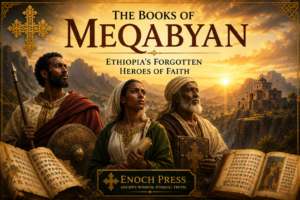
The Books of Meqabyan: Ethiopia’s Forgotten Heroes of Faith
Three Ge’ez books, a different Maccabean tradition, and a fierce theology of faithfulness, repentance, and resurrection
In the opening movement of 1 Meqabyan, an idol-worshiping king demands what no ruler has the right to claim. Three brothers – Abya, Sila, and Fentos – refuse to bow. The threat is fire. The answer is still no. Their names are unfamiliar to most English readers, but the conflict is instantly recognizable: political power reaches for worship, faithful people resist, and death is not allowed the last word.
That scene does not belong to the revolt of Judas Maccabee. Antiochus IV is absent. Jerusalem’s Temple is not being recovered. Hanukkah is not the destination. The Books of Meqabyan are three Ge’ez works received within the Ethiopian Orthodox Tewahedo biblical canon, and they are entirely different from the Greek books called 1-4 Maccabees. They share a family resemblance – persecution, idolatry, martyrdom, judgment – but not the same plot, characters, historical setting, or literary purpose.
So who are Ethiopia’s forgotten heroes of faith? They are not one army or one dynasty. They are martyrs who refuse coerced worship, a hostile king who turns back from his violence, prophets who confront rulers, and ordinary righteous people who choose humility before death closes the door to repentance. The three books move from public resistance to inward examination. Their central concern is not who controls a kingdom. It is who remains faithful when power, fear, pride, and desire all demand surrender.
They are also ‘forgotten’ only from the viewpoint of outsiders. Ethiopian Christianity did not forget them. The forgetting happened elsewhere.
The First Surprise: Meqabyan Is Not Maccabees
The title creates the first obstacle. English-language sources often call these works the Ethiopian Maccabees, and older Ethiopian canon lists may render their names in a form that looks like Maccabees. A reader naturally expects Judas Maccabee, the Seleucid Empire, the desecration of the Temple, and the revolt that began in the second century BC.
Those expectations belong to a different collection. Greek 1 Maccabees follows the Hasmonean struggle from the reign of Antiochus IV through the leadership of Judas, Jonathan, and Simon. Greek 2 Maccabees retells part of that crisis with greater attention to martyrdom, divine intervention, and the sanctity of the Temple. Greek 3 and 4 Maccabees are different again. None of them is the same work as 1, 2, or 3 Meqabyan.
Roger W. Cowley made the distinction bluntly in his study of the Ethiopian Orthodox canon: the three Ethiopian books are not the same as any of the four books of Maccabees transmitted in the Greek biblical tradition. The difference is not a technicality. It changes how the books must be read.
Meqabyan does not offer a second chronicle of the Hasmonean revolt. Its rulers do not map neatly onto the political history of Seleucid Judea. Its central figures are not the Maccabee family known from Jewish history. Its long teaching sections behave more like sermons than court annals. Lawrence Wills, writing about the apocryphal books preserved in Christian Bibles, describes the Meqabyan material as a series of teachings that draw moral and theological conclusions from biblical examples. That is much closer to the books’ real shape.
There are echoes of the wider Maccabean tradition. A tyrant imposes idolatry. Faithful people face death rather than worship falsely. Martyrdom becomes evidence that earthly defeat is not divine abandonment. Those parallels may help explain why the Ethiopian works received the related name. But resemblance is not identity. Calling Meqabyan merely an Ethiopian version of Maccabees erases the very thing that makes it important: Ethiopian Christian literature took familiar themes and formed a work with its own characters, arguments, and spiritual pressure points.
A Canonical Home in Ethiopia
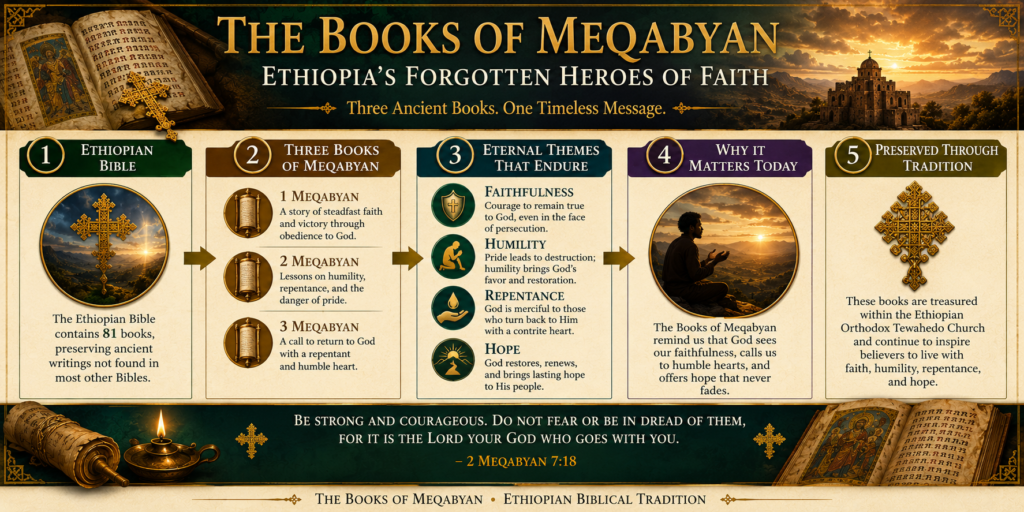
The Ethiopian Orthodox Tewahedo Church’s official list names an 81-book canon: 46 books in the older scriptural collection and 35 in the Christian apostolic collection. Within that official list appear ‘I Maccabees’ and ‘II and III Maccabees.’ Cowley explains the counting problem behind those labels. The text exists as three books, but some Ethiopian canon traditions reckon the second and third together, producing two canonical entries while preserving three literary works.
That detail matters because it corrects two common mistakes at once. First, the number three is not a modern invention. Printed Ge’ez and Amharic Bibles have included 1, 2, and 3 Meqabyan. Second, the appearance of only two Maccabean entries in some lists does not prove that one book disappeared. It reflects a different way of counting.
The official church list also reminds readers that Ethiopian canonicity cannot be flattened into a Western checklist. Cowley found real variation in how Ethiopian manuscripts and printed books arrange, name, and total canonical works. The traditional number 81 remains central, but the arithmetic is sometimes reached by grouping books differently. That does not make the canon imaginary. It means the history of a living canon is more complicated than a modern table of contents suggests.
For a broader introduction to that canonical world, Enoch Press’s article on the Ethiopian Bible’s 81 books gives the necessary map. The point here is narrower: Meqabyan is not a recently recovered curiosity being proposed for Ethiopian scripture. It belongs to the scriptural collection recognized and printed by the Ethiopian Orthodox Tewahedo Church.
How Old Are the Books? Honest Answers and Open Questions
Enoch and Jubilees carry readers into ancient Jewish literature whose early forms are witnessed among the Dead Sea Scrolls. Meqabyan is different. The surviving works are in Ge’ez, the classical language of Ethiopian Christianity, and specialists generally treat them as distinctively Ethiopian compositions rather than translations of Greek Maccabees.
Their exact date is not settled. Modern textual scholarship has placed the likely formation of the books in high medieval Ethiopia, often around the late fourteenth or early fifteenth century. The Encyclopaedia Aethiopica likewise argues that the work is probably no earlier than the fifteenth century. The evidence does not justify naming a single author, a precise year, or an ancient Hebrew original. Those claims may sound impressive, but they outrun what the manuscripts can prove.
This later date does not make Meqabyan fraudulent or spiritually insignificant. Canonical traditions contain books from many periods and literary settings. What changes is the kind of question we ask. Meqabyan is not valuable because it secretly preserves an eyewitness report from the age of Antiochus. It is valuable because it shows Ethiopian Christian teachers using scriptural history, martyr traditions, royal warnings, and resurrection faith to speak into their own theological world.
A manuscript now cataloged by the British Library as Or 506 offers one tangible witness to that continuing life. Copied in Ethiopia in the eighteenth century, it contains the Book of Maccabees together with an exposition. The manuscript is much later than the work’s likely composition, yet its arrangement is revealing: Meqabyan was not merely stored. It was copied with interpretation, read as a text that required and rewarded explanation.
This is where careful canon history matters. Some popular accounts claim that every distinctive Ethiopian book must descend unchanged from the earliest centuries of Christianity. Meqabyan refuses that shortcut. Its importance is not borrowed from an exaggerated age. It belongs to the history of Ethiopian Christianity on its own terms.
1 Meqabyan: Faithfulness in the Furnace
The first book is the longest, running to thirty-six chapters in the printed tradition Cowley described. It begins in a deliberately shadowed political landscape: the days of Moabites and Medes, an idol-worshiping ruler of Media and Midian named Tsirutsaydan – also transliterated Tseerutsaydan – and a faithful Benjaminite named Meqabis.
The geography is difficult to reconcile with conventional ancient history, and the king’s name has invited attempts to connect him with Tyre and Sidon or with distant memories of Seleucid rule. Those proposals remain interpretations. The book itself is less interested in locating the reader on a historian’s map than in staging a moral collision. Tsirutsaydan represents royal power swollen into idolatry. Meqabis and his household represent obedience that refuses to be purchased by survival.
The account names Abya, Sila, and Fentos among Meqabis’s sons. It later speaks of five martyrs, while only three are consistently named in the surviving summaries. Rather than smoothing that difficulty away, a responsible reading leaves it visible. The tradition remembers a company of faithful sons, centers three names, and presents their refusal as the decisive fact.
They will not worship the king’s idols. They will not confess that carved or manufactured things possess divine authority. The book drives the contrast hard: human hands make an image, then human fear pretends the image can command the soul. The brothers understand that the king can destroy bodies but cannot turn falsehood into truth.
The result is martyrdom by fire. Yet the narrative refuses to let the flames interpret the event. From the king’s viewpoint, the dissidents have been eliminated. From the book’s viewpoint, the king has exposed his own impotence. Their bodies are preserved within the story’s miraculous frame, the martyrs appear before the ruler, and the judgment he tried to execute returns as a summons to repent.
That reversal explains the emotional force of the episode. The heroes do not win because the furnace never touches them. They win because coercion cannot make idolatry true, and death cannot erase the righteous from God’s knowledge. Meqabyan’s martyrs are heroes of faith precisely because their faithfulness is not dependent on rescue before suffering.
When the Story Turns Into a Sermon
Readers expecting thirty-six chapters of continuous action may be startled. The martyr story occupies only the opening movement. Much of 1 Meqabyan becomes instruction: warnings to rulers, reflections on death, examples from earlier biblical figures, arguments for bodily resurrection, and repeated appeals to humility.
That shift is not a failure of composition. It reveals the book’s purpose. Narrative provides the wound; teaching presses on it. The martyrdom asks whether faith can survive pressure. The sermons ask whether the reader has understood why pressure succeeds in the first place.
Again and again, pride appears as the hidden engine of idolatry. The proud ruler does not merely worship a false god. He begins to act as though his own command creates reality. Wealth, military strength, public honor, and the obedience of frightened subjects become evidence, in his mind, that judgment cannot reach him. Meqabyan answers with the certainty of death. Every throne has a final boundary. Every ruler becomes answerable. The Angel of Death needs no royal permission to enter.
The same warning moves down from kings to ordinary life. People are tempted to trust property, appetite, cleverness, and reputation because these things can be measured now. Resurrection cannot. Judgment cannot. The unseen future therefore tests what the heart believes about the present.
This emphasis gives 1 Meqabyan a distinctive rhythm. It moves from public spectacle to private conscience. The furnace is dramatic, but the more dangerous fire may be the quieter one: the desire to preserve status at the price of truth. The king commands a visible bow. Pride teaches the same posture from inside.
2 Meqabyan: The Enemy Who Turns Back
The second book begins with a reversal that complicates the simple division between righteous Israel and wicked foreign rulers. A king of Moab named Meqabis wages war against Israel. The text interprets the invasion as punishment for Israel’s own wrongdoing, and a prophet named Re’ay confronts the king with the limit of his power.
Then something unexpected happens. The aggressor repents.
Meqabis turns from his violence, learns the law of the God of Israel, and teaches what he has learned. The enemy becomes a penitent. The ruler who had functioned as an instrument of judgment becomes evidence that judgment can lead to restoration when pride breaks and the heart turns.
This does not erase the harm he caused, and the book does not reduce repentance to regret. Repentance changes allegiance and conduct. The king receives instruction, abandons false confidence, and uses his remaining authority differently. In a collection remembered for martyrs who will not bend, 2 Meqabyan adds another kind of hero: the person who has been wrong and truly turns back.
After Meqabis’s death, the name Tsirutsaydan returns, along with idolatry and the persecution of faithful sons. The second book revisits the martyr pattern rather than giving readers an entirely separate universe. But its earlier movement has changed the moral field. A foreign king can repent. An Israelite can require correction. Heritage alone does not guarantee faithfulness, and guilt does not make repentance impossible.
The book’s later teaching sections sharpen the warning. A boastful king speaks as though his strength makes him untouchable. Death answers before his speech can become reality. Elsewhere the reader is urged to repent while time remains, to reject greed, and to remember the resurrection of the body and the judgment to come.
That is why repentance in Meqabyan is never sentimental. It is urgent because life is brief, moral because injustice must cease, and hopeful because the person who turns is not trapped forever inside the worst thing he has done.
3 Meqabyan: The Battle Moves Inside
The third book is the shortest, only ten chapters in Cowley’s outline, and the least like a conventional historical narrative. It ranges across Adam, Job, David, wealth, poverty, temptation, death, resurrection, and final judgment. In the accessible English form, its Christian horizon is explicit: Christ’s victory over the devil stands behind the book’s appeal to resist deception.
If 1 Meqabyan stages faithfulness before a furnace, and 2 Meqabyan stages repentance within a ruler, 3 Meqabyan carries the battle into daily moral life. The enemy does not always arrive wearing a crown. Temptation comes through wealth, appetite, lust, false signs, unjust gain, and the quiet belief that there will always be more time to change.
One of the book’s most practical concerns is economic honesty. It condemns greed and the manipulation of measures, the ancient equivalent of rigged scales and dishonest transactions. That detail keeps the theology from floating away into abstractions. A person may confess one God and still cheat a neighbor. Meqabyan refuses to separate worship from conduct.
The same realism governs its treatment of death. The book does not encourage panic, but it does reject delay. Repentance must happen before death because death ends the season in which choices can be revised. Bodily resurrection means human actions are not discarded with the body. The person who lived, harmed, served, exploited, endured, or repented is the person summoned to judgment.
This is severe teaching, but not hopeless teaching. The warnings exist because return is still possible. The door is open now. Pride says tomorrow will belong to us. Wisdom says today is the time we have been given.
What the Three Books Are Building Together
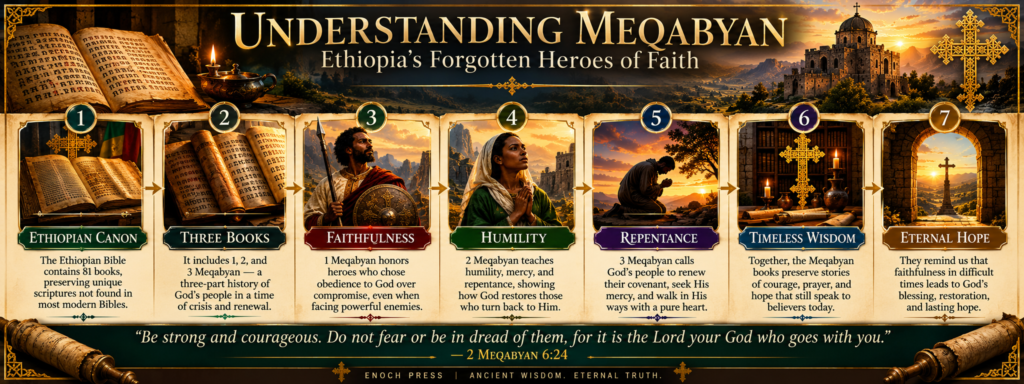
Read separately, the books can feel uneven: a martyr narrative interrupted by sermons, a hostile king who repents, a final collection of moral instruction. Read together, a coherent movement appears.
First comes faithfulness under external force. The ruler threatens the body and demands worship. The faithful answer that political authority has a limit.
Then comes repentance after moral failure. A violent king turns, learns, and teaches. The books answer that wickedness need not be the final identity of the wrongdoer.
Finally comes the hidden contest within ordinary life. Greed, lust, pride, deception, and delay do what a tyrant’s decree could not: they invite a person to surrender willingly. The books answer that faithfulness must shape money, desire, speech, power, and preparation for death.
The sequence matters. Courage without humility can become another form of pride. Repentance without changed conduct becomes theater. Hope without judgment becomes wishful thinking. Meqabyan holds all three together under the conviction that God sees truly, remembers the faithful, receives the repentant, and judges without being impressed by rank.
The movement can be summarized as Ethiopian canon, three distinct books, faithfulness, repentance, and hope. That summary is useful, but the books’ full argument is sharper than a list of virtues. Faithfulness is costly. Humility is the surrender of false greatness. Repentance is a turn that must happen while time remains. Hope rests on resurrection and divine justice, not on the promise that every faithful person will escape suffering.
Why English Readers Have Barely Met Meqabyan
The obscurity of Meqabyan is not proof that someone successfully hid it. The reasons are more ordinary and, in some ways, more revealing.
The books survive in Ge’ez and are also read in Amharic, languages that have received far less attention in Western biblical publishing than Greek, Hebrew, Latin, or Syriac. Scholarly work exists, including the early study by Josef Horovitz, Cowley’s canon research, and Yonatan Binyam’s modern textual-history treatment, but the field remains small. Reliable, widely distributed English translations and full critical commentaries are still difficult for general readers to obtain.
The title adds another barrier. A cataloger, bookseller, or search engine sees ‘Maccabees’ and assumes the familiar Greek books. An English reader searches for Meqabyan and finds pages that repeat each other, confuse the characters, or make spectacular claims about a lost ancient history. The result is a strange double invisibility: the books are overlooked by mainstream readers and distorted by some of the people most eager to promote them.
The right response is neither dismissal nor hype. It is patient reading with controlled claims. We can say with confidence that the books belong to the Ethiopian Orthodox canon, differ from Greek Maccabees, survive in Ge’ez, and center on martyrdom, repentance, moral instruction, resurrection, and judgment. We can describe their plots from the text and from scholarly summaries. We should remain cautious about precise authorship, historical identifications, and the route by which the collection acquired its name.
That caution does not weaken the story. It clears the smoke away so the story can finally be seen.
What Meqabyan Does Not Claim
Because Ethiopian biblical traditions are often marketed through the language of secrets and suppression, a few boundaries are necessary.
The Books of Meqabyan are not an alternative eyewitness history of Judas Maccabee or the Hasmonean revolt. They do not replace Greek 1 or 2 Maccabees, and they do not explain the historical origin of Hanukkah. Their kings and wars should not be forced into the second century BC simply because the titles sound related.
They are not evidence that every book in the Ethiopian canon was composed in the first centuries of Christianity. Meqabyan appears to be a high medieval Ethiopian work. A later composition can still become canonical, shape worship, and carry profound theological authority within the tradition that receives it.
They are not proof of a conspiracy that removed them from Western Bibles. Western churches did not reject Meqabyan at a famous council after a public trial. The books developed and circulated within a different linguistic and ecclesial history. The gradual story of how 1 Enoch disappeared from most Western Bibles is a different process and should not be pasted onto Meqabyan. The absence of a text from Rome, Constantinople, or Reformation Europe does not require a hidden plot; sometimes communities simply inherited different libraries.
And the books do not teach that suffering itself makes a person righteous. Their martyrs are praised because they refuse idolatry. Their repentant king is praised because he changes. Their moral teaching repeatedly connects faith with humility, justice, and obedience. Pain without faithfulness is only pain. Authority without repentance is only danger.
Why These Forgotten Heroes Still Matter
The heroes of Meqabyan are easy to admire from a safe distance. Fire, tyrants, and public confession create clean moral lines. Most readers will never stand before a king who orders them to worship an idol. That does not make the books remote. It makes their second movement more important.
Every age creates forms of compelled worship. Some are political. Some are economic. Some are social. They promise safety, acceptance, influence, or profit in exchange for a small bow – a word we do not believe, an injustice we agree not to see, a loyalty we pretend is absolute. Meqabyan’s martyrs ask what belongs to God alone.
Every age also produces leaders who confuse power with innocence. Tsirutsaydan matters because he cannot imagine a court beyond his own. The repentant Meqabis matters because he discovers that authority can kneel without ceasing to act. Together they offer a severe political theology: rulers are accountable, domination is temporary, and repentance is more honorable than self-protection.
Then 3 Meqabyan brings the question home. Honest scales. Restrained desire. Mercy toward the vulnerable. Repentance before death. These are not spectacular acts, but they reveal whether worship has reached ordinary conduct.
There is a useful contrast here with the Watchers in 1 Enoch. The Watchers story asks what happens when heavenly beings misuse knowledge and authority. Meqabyan asks the same moral question at human scale: what happens when kings, families, merchants, and individuals use power without humility? Both traditions insist that status does not cancel accountability. Meqabyan adds that repentance remains a real path for human beings while life remains.
That may be the books’ most surprising gift. Their remembered heroes are not flawless conquerors. Some endure. Some turn. Some simply refuse to cheat, boast, or postpone obedience. Faithfulness has more than one face.
Conclusion: Ethiopia’s Heroes Were Never Truly Lost
The Books of Meqabyan are three Ge’ez scriptural works in the Ethiopian Orthodox Tewahedo canon. They are not the Greek Books of Maccabees, not alternate histories of Judas Maccabee, and not relics that can be dated confidently to the ancient Hasmonean world. They are distinctively Ethiopian Christian writings, probably formed in the high medieval period, that gather martyr stories, royal warnings, biblical examples, sermons on repentance, and hope in bodily resurrection.
Their heroes include the sons who refuse an idol and enter the fire, the hostile king who turns and learns, the prophet who speaks to power, and the ordinary believer who practices justice before death. Across all three books, the same conviction holds: God is not deceived by crowns, wealth, violence, or public appearances. The faithful are remembered. The proud are answerable. The repentant are called to change while the door remains open. The dead will rise.
Most of the Christian world forgot these books because it never inherited them. Ethiopia did. The task now is not to turn that difference into a slogan. It is to read carefully enough to hear what the Ethiopian tradition preserved: courage without arrogance, judgment without despair, and hope strong enough to survive the furnace.
Reflection
Meqabyan leaves us with an uncomfortable question: what are we being asked to bow to now? The demand may not arrive through a throne room. It may come as fear of rejection, hunger for recognition, protection of income, resentment we refuse to release, or the quiet excuse that obedience can wait until tomorrow.
The martyrs remind us that faithfulness may cost something. The repentant king reminds us that failure does not have to become our final name. The warnings about pride remind us that power is safest in the hands of people who know they will answer to God.
Christian hope does not promise that every furnace will cool before it burns. It promises that God sees, judgment is real, mercy is offered, and death does not own the last word. That is why repentance is urgent – and why faithfulness is never wasted.
Lord, make us brave enough to refuse what is false, humble enough to turn when we are wrong, and faithful enough to live today in the light of resurrection.
ENOCH PRESS | ANCIENT WISDOM. ETERNAL TRUTH.
Read Next: To explore how these texts fit into ancient traditions, check out our deep dive into the history of the books of Meqabyan as Ethiopia’s hidden scripture.