
The Forged Seal and the Scribe Behind It
In 1975, a small lump of clay surfaced on the antiquities market in Jerusalem. Someone had pressed a seal into it two and a half thousand years earlier, and the impression was still sharp enough to read: thirteen millimeters by eleven, a few lines of ancient Hebrew script running across the width of a fingernail. Belonging to Berekhyahu, son of Neriyahu, the scribe. Berekhyahu is the long form of a name most people know in its short form: Baruch. For a moment, it looked like archaeology had reached out and touched the actual hand of Jeremiah’s scribe, the man later tradition credits with writing the book that carries his name.
It hadn’t. A second bulla with an identical impression turned up in 1996, and over the next two decades, scholars picked the pair apart — the grain on the back of the clay, the way the cord had been pressed into it, the chemistry of the surface itself. Most of that forensic work concluded the seals were modern forgeries, skillfully made, sold into a market hungry enough for a piece of Jeremiah’s world that nobody asked too many questions about where they’d come from. The verdict isn’t perfectly unanimous even now — a handful of researchers have pushed back on parts of the case — but the field has largely moved on, treating the bullae as cautionary tales rather than relics.
It’s a strange way to begin a study of a book, admitting up front that its most tangible physical connection to its supposed author turned out to be fake. But the Book of Baruch has always lived exactly at that seam: a real man, well attested in scripture, and centuries of people afterward who wanted so badly to hold something of his that they were willing to press a false seal into wet clay just to feel closer to him.
Baruch the Scribe, and the Book Later Written in His Name
So, briefly, before anything else: who was Baruch, and what is the Book of Baruch that carries his name?
Baruch son of Neriah is not folklore. He shows up again and again in the book of Jeremiah doing a job we can picture with some precision, because the job itself is attested all over the archaeology of late-monarchy Judah. He was Jeremiah’s secretary — the man who took the prophet’s spoken warnings and turned them into ink on papyrus, who read those warnings aloud to a crowd in the Jerusalem Temple on a day of national fasting while the king who wanted him silenced sat a few streets away (Jeremiah 36). When Jerusalem finally fell and a remnant of frightened Judeans fled toward Egypt against Jeremiah’s advice, Baruch went with them, accused by his own countrymen of pushing the prophet toward exile (Jeremiah 43). And in one of the more tender moments in the whole book of Jeremiah, God addresses an oracle to Baruch by name — not a warning to the nation, but a private word to a frightened, disappointed scribe, promising that whatever else was lost, his life would be spared (Jeremiah 45).
That is Baruch in the Bible: a real assistant to a real prophet, present at the worst moment in his nation’s history, doing the unglamorous work of getting the words down and getting them out.
Centuries after that, a very different kind of text began to circulate under his name. Not dictation this time — a book. A confession spoken in the voice of the whole exiled nation. A hymn in praise of Wisdom. A closing vision of Jerusalem herself, personified, weeping over her scattered children and then straightening her shoulders to watch them come home. This is the Book of Baruch: three movements, one continuous argument, running from national guilt through the recovery of wisdom to the promise of return.
What follows is a Book of Baruch summary in full — not a plot synopsis, but the whole shape of the thing: what the book actually says, why most scholars doubt the historical Baruch wrote a word of it, and why the Ethiopian Orthodox Tewahedo Church, alongside Catholic and Eastern Orthodox tradition, has kept this small and often-overlooked book as scripture for two thousand years while most of Protestant Christianity quietly let it go.
When Was the Book of Baruch Actually Written?
Every book needs a setting, and Baruch’s is stated with unusual precision for something this old: written in Babylon, five years after the destruction of Jerusalem in 587 BC, read aloud to the exiled King Jeconiah and the community deported with him. Taken at face value, that would put the book’s composition around 582 BC, with Baruch himself holding the pen.
Modern critical scholarship doesn’t take it at face value, and the reasons are worth walking through rather than just asserting, because they say something true about how ancient books like this one actually came to exist. The near-consensus position is that the Book of Baruch is a composite — several originally separate compositions, gathered and framed under Baruch’s name by a later editor who wanted the whole thing to carry the weight of Jeremiah’s own circle. That wasn’t dishonesty by ancient standards; writing under the name of a revered figure to extend and honor their legacy was a recognized and respected practice across the ancient Near East and the Hellenistic world alike. The clue that gives the game away is textual, and it’s a good one: the long confession of sin that opens the book, in chapters 1 and 2, tracks so closely in wording and structure with the prayer in Daniel chapter 9 that most specialists are confident one text is drawing directly on the other — and the internal logic runs in Daniel’s favor, since that prayer fits naturally inside Daniel’s own narrative in a way it doesn’t quite in Baruch’s. Daniel is usually dated to the 160s BC, in the thick of the Maccabean crisis. If Baruch is borrowing from Daniel, the confession section can’t be older than that.
The wisdom poem that follows, in chapters 3 and 4, tells the same story from a different angle. It leans so heavily on the Book of Sirach — written by Jesus ben Sira around 180 BC in Jerusalem — that most scholars place this section in the same general window, the decades when the Jerusalem Temple had just been desecrated by Antiochus IV Epiphanes and then triumphantly rededicated by Judas Maccabeus in 164 BC. That’s not incidental. A book obsessed with exile, guilt, and the promise that Jerusalem will be restored lands very differently in a community that has just watched its own Temple get profaned and then reclaimed. The narrative frame says Babylon, 582 BC. The theology underneath it is breathing the air of Jerusalem, roughly four centuries later.
None of this erases the historical Baruch. It just separates two different questions that are easy to blur together: whether Baruch ben Neriah existed and served Jeremiah as his scribe — which the biblical record supports independently and repeatedly — and whether he personally composed the confession, the wisdom poem, and the closing hymn that later tradition placed in his mouth. Enoch Press treats those as related but genuinely separate claims, and this article keeps them that way throughout.
Scrolls, Seals, and a Scribe’s Actual World
It helps to picture what writing meant, physically, in Baruch’s world, because it explains why a scribe mattered as much as he did. Jeremiah’s scroll wasn’t paper. It was almost certainly papyrus, imported reed-pulp sheets glued edge to edge into a long strip and rolled around a wooden core, the kind of object you’d carry rolled and tied, not folded. When a document needed to be sealed — a land deed, a contract, a scroll meant to travel with authority attached to it — the cord binding it was pressed into a blob of wet clay, and a personal seal, carved in reverse into stone or metal, was pressed into that clay before it dried. That impression, the bulla, was both a signature and a lock. Real bullae from Baruch’s own historical moment have survived from controlled excavations in Jerusalem — a “House of Bullae” containing dozens of seal impressions from officials of exactly this period, contemporaries whose names also appear in the book of Jeremiah. Baruch’s own seal impression may be lost to us for good, buried under the ash of the same fire that destroyed the city he served, or simply never recovered. But the world that made bullae like his real, and valuable enough to fake two and a half millennia later, is not in question.
Is the Book of Baruch in the Bible? Why the Answer Depends on Whose Bible You Hold
Here’s the question worth answering plainly and early, because it trips up more readers than almost anything else about this text: is the Book of Baruch in the Bible?
It depends entirely on which Bible is in your hands. The Book of Baruch was never part of the Hebrew Bible — no Hebrew manuscript of it has survived, if a Hebrew original ever existed at all. What we have is Greek, preserved as part of the Septuagint, the great Greek translation of Jewish scripture produced in the centuries before Christ. Every Christian tradition that eventually received Baruch as scripture inherited it through that Greek text, not a Hebrew one.
From there, the canon split, and it split along lines that still shape which Bible ends up on which shelf today. The Catholic Church settled the question definitively at the Council of Trent in 1546, listing Baruch among the deuterocanonical books — a term meaning, roughly, “belonging to a second, later-affirmed canon,” not “second-rate.” Jerome, translating the Vulgate around the year 400, had his own doubts about several of these Greek-only books, but included Baruch anyway, bowing to the weight of existing Christian usage even where his own philological instincts pulled the other way. The Eastern Orthodox Church holds Baruch as part of its Old Testament too, inherited straight from its own Septuagint-based tradition, though Orthodox Bibles usually treat the Letter of Jeremiah — appended to Baruch as a sixth chapter in Catholic editions — as its own short, separate book rather than folding it into Baruch itself.
Protestant reformers went a different way. Martin Luther, translating his German Bible in the 1530s, moved Baruch and its companion texts into a separate section he labeled Apocrypha — worth reading, in his judgment, but not on the same footing as scripture proper. Most Protestant Bibles that followed dropped these books from the Old Testament entirely, which is the main reason so many readers today have simply never encountered Baruch at all.
The Ethiopian Orthodox Tewahedo Church, meanwhile, holds Baruch as unambiguously canonical, one book among the eighty-one that make up its Old and New Testament together — a canon shaped by its own independent contact with the Septuagint tradition centuries before Trent, Luther, or the Synod of Jerusalem ever weighed in. If you want the full picture of how that eighty-one-book canon came together and why it holds so many books the West eventually set aside, “The Ethiopian Bible: 81 Books Most Christians Have Never Read” lays out that whole story.
It’s worth being precise about one more thing here, because the names get tangled easily. The Ethiopian tradition also preserves a second, wholly different work connected to Jeremiah’s circle: the Paralipomena of Jeremiah, sometimes called 4 Baruch, a later text describing events after Jerusalem’s fall in a very different narrative voice. That is not the book this article is about. Everything here concerns the Book of Baruch proper — the confession, the wisdom poem, the hope for Jerusalem — a text with its own distinct shape and its own separate history.
The differences in how these traditions built their Old Testaments aren’t a footnote; they’re the whole reason a book this old and this widely read for most of Christian history can feel, to a modern reader raised on a sixty-six-book Bible, like something newly discovered. Different churches inherited different collections at different moments, shaped by geography, language, and which councils happened to be making the decisions. If that broader canon story interests you, “Why Was the Book of Enoch Removed From Most Bibles?” traces a closely related case — a different book, but the same underlying pattern of divergence.
Three Movements: Confession, Wisdom, and the Promise of Return
Strip away the introductions and footnotes, and the Book of Baruch moves through three distinct movements, each with its own voice, doing work the one before it couldn’t do alone.
A Nation Confesses (1:1–3:8)
The book opens with a scene, not a sermon. Baruch reads his words aloud to the exiled King Jeconiah and the community deported with him, and the reaction is immediate and physical — weeping, fasting, a collection taken up on the spot. The exiles pool their money and send it back to Jerusalem along with the Temple vessels Babylon had carried off as war spoil, instructing that the funds be used to offer sacrifices — and, in a detail that startles most first-time readers, sacrifices offered specifically on behalf of Nebuchadnezzar and his son Belshazzar, the very kings who had conquered them. It reads less like flattery than like an act of submission to a judgment the text insists was earned.
What follows is one of the starkest communal confessions anywhere in ancient Jewish literature:
“The Lord hath watched over us for evil, and hath brought it upon us: for the Lord is just in all his works… and we have not hearkened to his voice.” (1:20)
There’s no attempt to soften the blow or spread the blame outward. Scholars call this shape the Deuteronomic cycle — sin, punishment, confession, restoration — the same grammar that runs through the covenant curses and blessings of Deuteronomy 28 through 30, and the same grammar Daniel’s own prayer in chapter 9 works through almost word for word. Among the central Book of Baruch themes, this one comes first for a reason: nothing else in the book makes sense until the guilt has been named without flinching.
Wisdom Found Where It Was Always Hiding (3:9–4:4)
This is the book’s most original stretch of writing, and its most quietly radical idea. It opens by turning directly to address the exiles:
“Hear the commandments of life, O Israel: give ear to understand wisdom.” (3:9)
Then it asks the question that ancient wisdom literature had been circling for centuries, most famously in Job 28 — where, in all creation, can wisdom actually be found? The poem goes looking in all the obvious places. It checks in with the powerful nations and finds nothing. It checks the wealthy, the clever, even legendary giants of old, and finds the same emptiness everywhere, because wisdom was never a prize that could be seized by strength or cunning.
The poem’s answer is the theological center of the whole book, and it’s not subtle: wisdom in the Book of Baruch has already been given, once, completely, in the form of the Law entrusted to Israel.
“She is the book of the commandments of God, and the law that endureth for ever.” (4:1)
Exile, on this reading, was never a failure to locate wisdom somewhere out past the horizon. It was a failure to hold on to wisdom that had been sitting in Israel’s hands the entire time. That reframing does real theological work — it turns exile from senseless catastrophe into something closer to a forgotten inheritance, recoverable the moment the people choose to reach for it again.
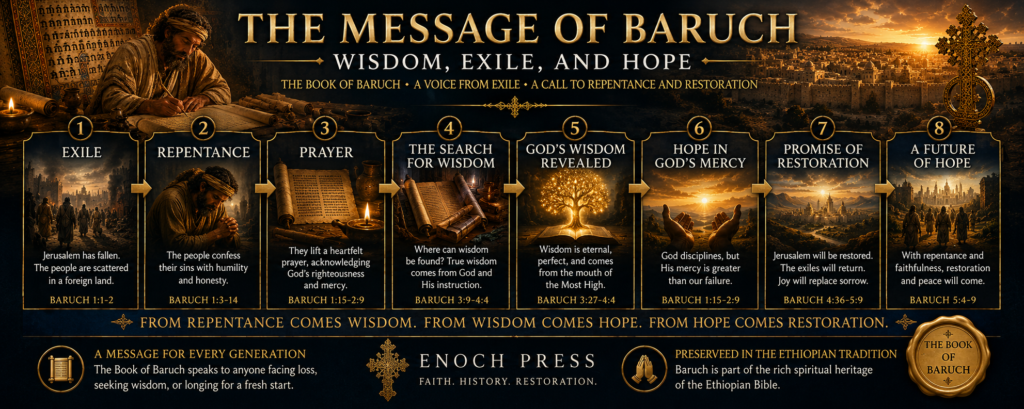
Jerusalem Speaks, and Then Is Comforted (4:5–5:9)
The tone shifts here, decisively, from confession to consolation. The poet turns to address the scattered exiles directly, urging them toward courage. And then, in the boldest literary move in the whole book, Jerusalem herself begins to speak — personified as a grieving mother, mourning the children Babylon carried away from her, but also urging those same children toward hope, promising with her own voice that she will watch them come home. The book closes on an extended, almost cinematic image: Jerusalem told to strip off the sackcloth of mourning and put on the beauty of God’s own glory, standing on a height to watch her sons and daughters led back to her in safety, guided by God like a procession of returning royalty. Book of Baruch hope and restoration, in the end, isn’t an abstraction. It’s addressed to a city, given a voice, and told to go stand somewhere it can actually see its children coming.
The Scholarship Behind the Story: Daniel, Sirach, and the Disputed Bullae
None of the connections drawn above are speculative flourishes; they’re the kind of thing you can trace sentence by sentence against the wider body of Hellenistic Jewish writing, and doing so only sharpens what Baruch is actually doing.
The wisdom-as-Torah move in chapters 3 and 4 isn’t an idea original to Baruch. Ben Sira makes almost the identical equation a generation or so earlier: he who holds to the law will obtain wisdom (Sirach 15:1), and in Sirach 24, personified Wisdom announces in her own voice that she has taken up permanent residence in the book of the covenant of the Most High God, the law which Moses commanded us (Sirach 24:23). Scholars who set Baruch 3:9–4:4 next to Sirach 24 and Job 28 side by side notice a real difference in technique alongside the obvious similarity: Sirach lets Wisdom speak for herself in the first person, while Baruch mostly speaks about wisdom, addressing Israel directly instead of letting Wisdom take the microphone. Two writers, doing closely related theological work, choosing different literary tools to do it.
The confession in chapters 1 and 2 tells a parallel story of dependence with Daniel 9. The overlap in wording is close enough that almost no specialist treats it as coincidence — some form of direct literary borrowing clearly happened. The near-universal judgment is that Baruch is the one borrowing, because Daniel’s version of the prayer fits its surrounding narrative more naturally than Baruch’s does. It’s worth separating two claims that sound similar but aren’t: the existence of a textual relationship between the two prayers is about as well documented as anything in this field gets. The direction of that relationship — which text came first — is a scholarly judgment built on strong but not absolute evidence, and Enoch Press treats it accordingly, as a well-supported majority position rather than settled fact.
On the historical Baruch specifically, the record is more solid than the fake bullae controversy might suggest. Baruch ben Neriah appears independently across Jeremiah 32, 36, 43, and 45, in a role — professional scribe, seal-bearer, secretary to a prominent figure — that matches everything archaeology has recovered about how the Judean royal administration actually functioned in the final years before Jerusalem’s fall. The two bullae claiming to be his personal seal impression surfaced through the antiquities trade rather than a controlled dig, which is itself a warning sign in this field, since it means no verified findspot or surrounding archaeological layer exists to check the objects against. A 2014 forensic study by Yuval Goren and Eran Arie, examining the wood grain, cord pattern, and clay composition on the back of both bullae, concluded they were modern forgeries; a 2016 response from a different set of researchers challenged several of those specific findings without claiming to prove the seals genuine. The consensus today leans toward forgery, but credentialed specialists have argued both sides in print, which is exactly why this article treats the historical Baruch as secure — attested directly in the biblical text — while treating the physical bullae as a live, unresolved question rather than settling it either way.
Why Baruch’s Theology Still Matters
What the Book of Baruch is doing, structurally, is something distinct among exile-era Jewish writing. It takes the raw historical trauma of 587 BC and builds a complete theological architecture around it: sin explains the exile, honest confession opens the road toward restoration, and wisdom — specifically, fidelity to Torah — is presented as the exact thing that was lost and the exact thing that has to be recovered before anything else can heal. That’s a very different posture from Job’s refusal to explain suffering at all, or Ecclesiastes’ skepticism that any of it adds up to meaning in the first place. Baruch isn’t wrestling with whether meaning can be found. It already knows where meaning lives: obedience to the Law, understood not as dry rule-keeping but as literal access to Wisdom herself, present and available rather than locked away in heaven.
That wisdom-as-Torah equation reaches well past this one book. It’s part of a broader current running through Hellenistic Jewish thought — visible in Sirach, and later still in works like 4 Ezra and 2 Baruch, an entirely separate, later apocalyptic text not to be confused with the book covered here — that took the freer-floating figure of Lady Wisdom from Proverbs and Job and anchored her permanently in the five books of Moses. That move had a long afterlife. Early Christian writers, Irenaeus among them, read Baruch 3:36–38 — the passage describing Wisdom appearing on earth and living among human beings — as an Old Testament foreshadowing of the incarnation, a reading taken seriously enough that the Second Vatican Council’s Dei Verbum cites Baruch 3:38 directly when describing how God chose to dwell among his people.
What Baruch Teaches About Guilt, Wisdom, and Hope Today
Baruch’s central movement — guilt named honestly, followed by a hope that never asks anyone to pretend the guilt wasn’t real — isn’t an antique curiosity. It’s a pattern plenty of people recognize from their own lives without needing a scholar to point it out: the pull either to deny wrongdoing outright, or to let shame curdle into something closer to despair, when the harder and far more durable path is naming exactly what went wrong and choosing to hope anyway, on the far side of that honesty rather than instead of it.
The book’s argument about wisdom carries its own sharp modern edge. Baruch’s poem surveys the ancient world’s most obvious places to go looking for wisdom — political power, wealth, sheer cleverness — and comes back empty-handed from every one of them. Updating that list for the present moment doesn’t take much imagination; the substitutes change shape every generation, but the emptiness the text describes hasn’t gone anywhere. Baruch’s answer was never anti-intellectual. It’s a claim that lasting wisdom can’t be separated from moral and covenantal commitment — that information and cleverness are not the same thing as wisdom, and never were — a claim thinkers well outside any particular religious tradition have found worth taking seriously on its own terms, long after the Babylonian exile itself became ancient history.
A Small Book’s Long Endurance
The Book of Baruch is a smaller, quieter book than 1 Enoch or Jubilees. It makes no claim to visions of the heavens, no angelic rebellions, no cosmic geography. What it offers instead is a community’s unflinching reckoning with catastrophe, an argument that wisdom was never actually lost — only set aside — and a closing image of Jerusalem restored, watching from a height as her children come home. Whether or not the historical Baruch ben Neriah — a real scribe, a real friend of Jeremiah’s, a man whose actual seal may or may not survive anywhere on earth — ever wrote a single line of it, the book that carries his name held together well enough that Catholic, Eastern Orthodox, and Ethiopian Orthodox Christians have all kept it as scripture for most of two thousand years. That kind of endurance isn’t an accident of church politics. It’s what happens when a text keeps saying something a community needs to hear.
For readers curious how a small, often-overlooked book like Baruch fits into the wider shelf of Ethiopian Orthodox scripture — sitting alongside other unfamiliar treasures most Western Christians have simply never been handed — “The Books of Meqabyan” is a good next stop; Baruch’s message of confession, wisdom, and hope sits in good company there.
From History to Devotion: Sitting With Baruch’s Order of Confession
Here the tone shifts from history to devotion, and this closing section should be read as exactly that — a shift, not a continuation of the historical argument above.
There’s something worth sitting with in the order Baruch’s book insists on. Confession comes first, in full, without shortcuts, and only once the sin has been named honestly does the text turn toward wisdom — and only after wisdom is recovered does the text finally turn toward hope. Nothing gets skipped. The exiles in this story don’t rush past their own responsibility to reach the comforting part sooner. For a reader inside the Ethiopian Orthodox Tewahedo tradition, that sequence mirrors the actual shape of repentance: it doesn’t begin with comfort, offered too early to mean anything, and it doesn’t stay parked in guilt either, as though guilt itself were the destination. It moves, deliberately, one honest step at a time, toward a Jerusalem told at last to take off her mourning clothes and stand somewhere she can watch for her children coming home.