Few passages in ancient religious literature have generated as much curiosity as the story of the Watchers in the Book of Enoch.
For many readers, this narrative becomes the turning point that transforms the Book of Enoch from an unfamiliar ancient text into a fascinating exploration of rebellion, corruption, judgment, and hope.
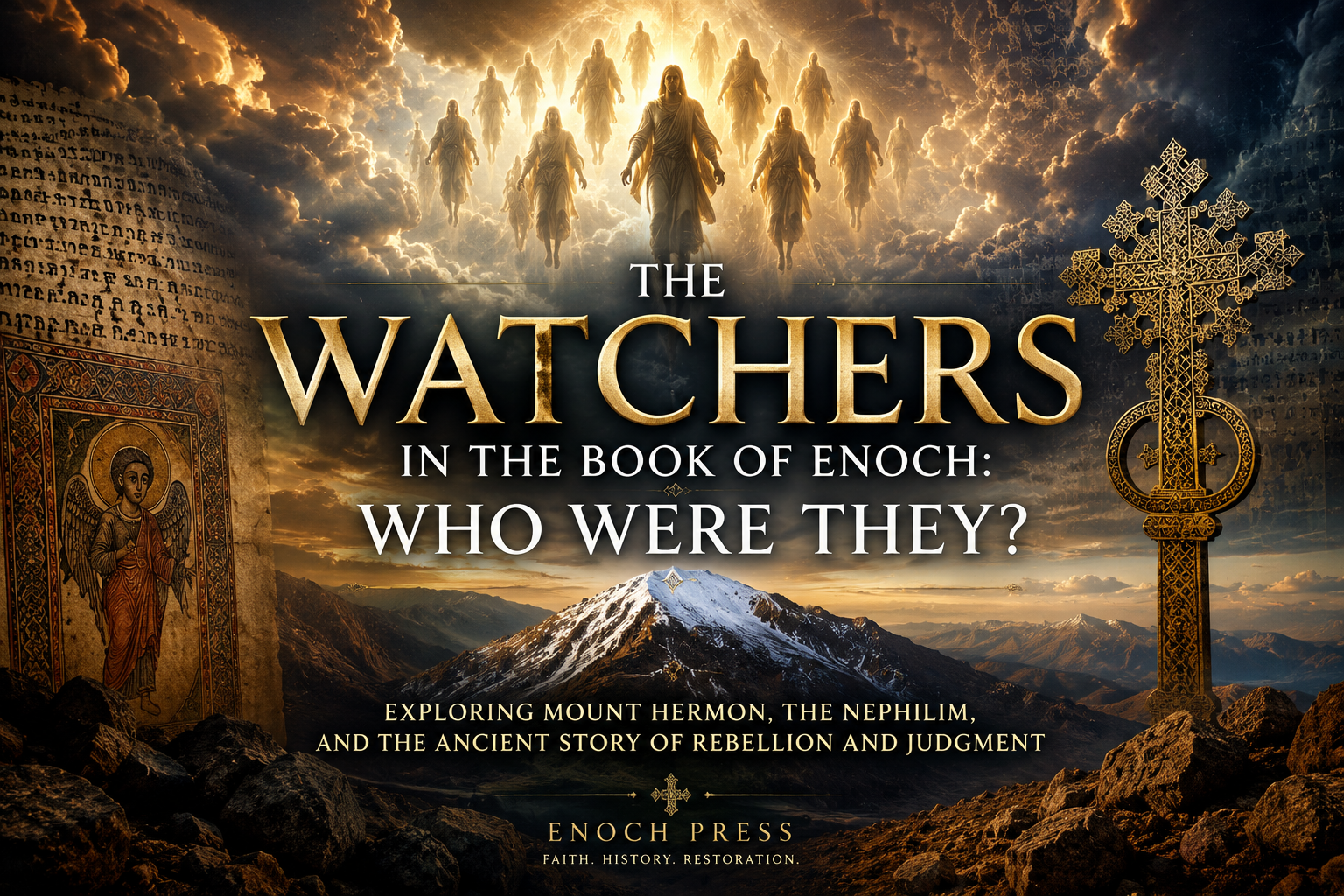
The story appears in 1 Enoch 6–16, a section commonly known as the Book of the Watchers. It expands upon the brief and mysterious passage found in Genesis 6:1–4 and provides a much more detailed account of heavenly beings, human corruption, and divine intervention.
Understanding the Watchers is essential for understanding why the Book of Enoch became so influential in ancient Jewish and early Christian thought.
Who Were the Watchers?
The term "Watchers" refers to heavenly beings who were assigned responsibilities connected to the created order.
The concept of heavenly watchers also appears in the Book of Daniel, where watcher language is used for heavenly beings who observe earthly events.
In 1 Enoch, however, a group of these beings abandons its appointed role.
Rather than remaining faithful to God's order, they descend to earth and become involved in human affairs.
The narrative portrays this decision as a deliberate act of rebellion.
Their actions become the catalyst for many of the events that follow.
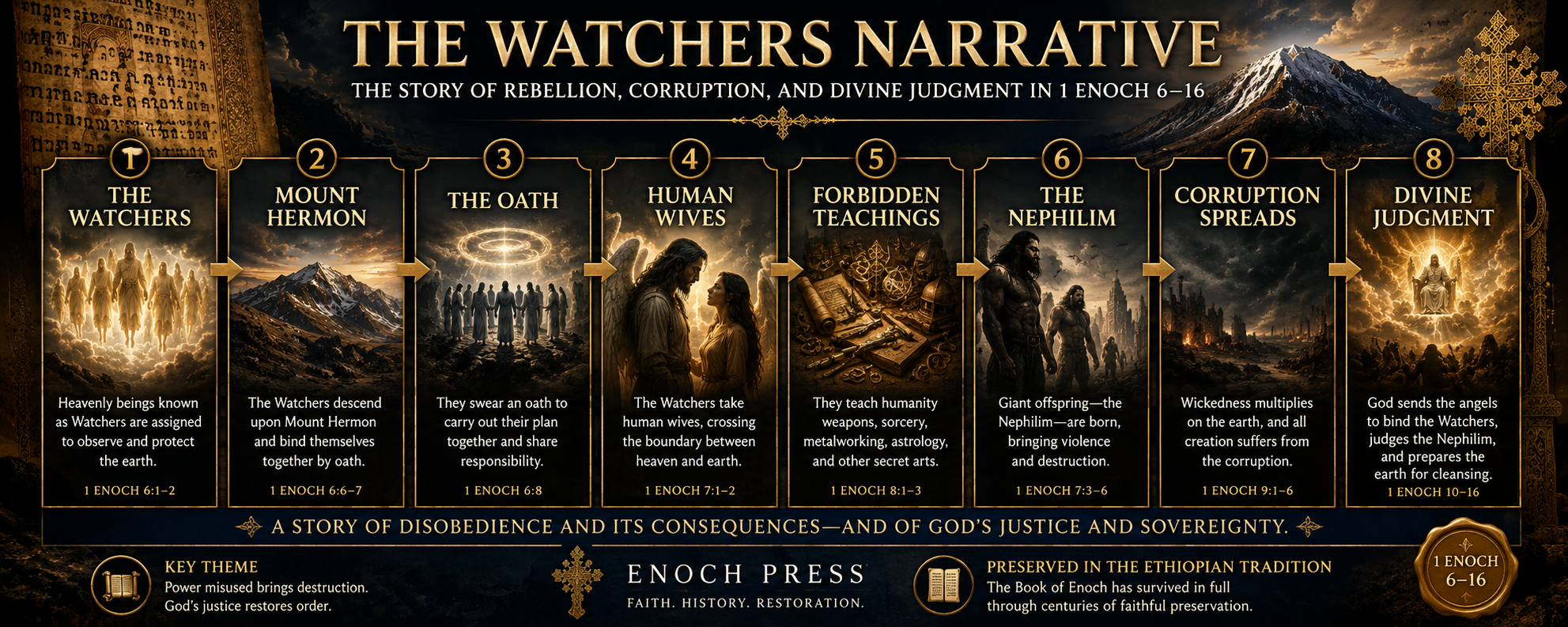
The Descent on Mount Hermon
One of the most distinctive features of the Enochic account is its naming of Mount Hermon.
According to 1 Enoch 6, a group of Watchers descends upon the mountain and binds itself together by oath.
The text emphasizes that the decision was collective.
The Watchers feared the consequences of their actions and agreed that all participants would share responsibility.
This oath becomes a pivotal moment in the narrative.
Rather than a single act of disobedience, the story describes an organized rebellion carried out by numerous heavenly beings.
Mount Hermon therefore becomes a symbol of the choice to abandon divine authority. For more on the Enochic calendar system tied to these texts, see The Ethiopian Bible Explained: The 364-Day Calendar.
The Marriage of the Watchers
After descending to earth, the Watchers take human wives.
This element connects directly to the brief statement in Genesis that "the sons of God" took wives from among human women.
The Book of Enoch expands this account significantly.
The narrative describes the relationships as part of the broader rebellion against God's established order.
The resulting unions become one of the central causes of corruption within the story.
This portion of the text has been interpreted in various ways throughout history. For broader context on why the Book of Enoch itself occupies such a controversial place in biblical history, see Why Was the Book of Enoch Removed From Most Bibles?
What remains clear is that the Book of Enoch presents these events as a violation of proper boundaries between heaven and earth.
The Forbidden Teachings
Perhaps the most influential aspect of the Watchers narrative involves the knowledge they impart to humanity.
The text attributes various teachings to specific Watchers.
These include:
- Weapon making
- Warfare
- Metalworking
- Sorcery
- Magical practices
- Astrology
- Certain forms of secret knowledge
The narrative does not condemn knowledge itself.
Rather, the concern centers upon knowledge being used in destructive ways or being transmitted outside of God's intended order.
As these teachings spread, corruption increases throughout the world.
Violence becomes more common.
Human society deteriorates.
The consequences of rebellion extend far beyond the original participants.
Who Were the Nephilim?
The offspring produced through the unions between the Watchers and human women are commonly identified as the Nephilim.
The Book of Enoch describes them as giants whose presence contributes to widespread destruction and suffering.
Modern readers often focus on their extraordinary size.
The text itself places greater emphasis on the chaos associated with them.
The Nephilim become symbols of a world that has moved further and further away from God's intended design.
Their existence illustrates how rebellion produces consequences that affect entire communities rather than only the original offenders.
Enoch's Role in the Story
One of the most important differences between Genesis and the Book of Enoch is the role assigned to Enoch himself.
Rather than appearing briefly in a genealogy, Enoch becomes a central figure.
The Watchers seek his help after judgment is announced against them.
They ask him to intercede on their behalf.
Enoch carries their request before God.
The answer he receives is not what they hoped for.
Instead of forgiveness, the Watchers are informed that judgment has already been determined.
The opportunity for repentance that exists for humanity is not presented in the same way for the rebellious Watchers.
This moment reinforces the seriousness of their actions within the narrative.
Divine Judgment
The story ultimately moves toward judgment.
God responds to the corruption that has spread throughout creation.
The Watchers face punishment.
The Nephilim face destruction.
The earth is prepared for cleansing.
The message is clear.
No rebellion remains hidden forever.
No corruption escapes divine notice.
The Book of Enoch consistently emphasizes that God remains sovereign despite the apparent growth of evil.
Judgment is not arbitrary.
It is portrayed as a response to widespread corruption and injustice.
Why the Story Matters
The Watchers narrative has fascinated readers for centuries because it addresses questions that remain relevant today.
How should power be used?
What happens when authority is abused?
What are the consequences of crossing moral boundaries?
How does corruption spread through societies?
The story does not merely recount ancient events.
It explores enduring themes concerning responsibility, accountability, and the misuse of influence.
Whether one approaches the text historically, theologically, or literarily, the narrative continues to provoke reflection.
The Watchers and the Ethiopian Biblical Tradition
The Book of Enoch survived in complete form because it was preserved within the Ethiopian tradition.
Without that preservation, large portions of the Watchers narrative would likely have been lost.
Today, readers interested in the history of biblical literature often encounter the Book of Enoch through The Ethiopian Bible: 81 Books Most Christians Have Never Read and the Ethiopian manuscripts and traditions that safeguarded the text for centuries.
For more on related Ethiopian scriptural texts, see The Books of Meqabyan: Ethiopia's Forgotten Heroes of Faith and The Book of Enoch: A Beginner's Guide to the Lost Scripture.
This preservation allows modern audiences to engage with one of the most influential works of ancient Jewish literature.
Reflection
The story of the Watchers is ultimately a story about choices.
The Watchers possessed influence, knowledge, and authority.
Yet they chose rebellion.
Enoch, by contrast, is remembered for faithfulness.
The contrast invites readers to consider how they use their own opportunities, gifts, and responsibilities.
Power alone is not what defines a life.
Faithfulness does.