
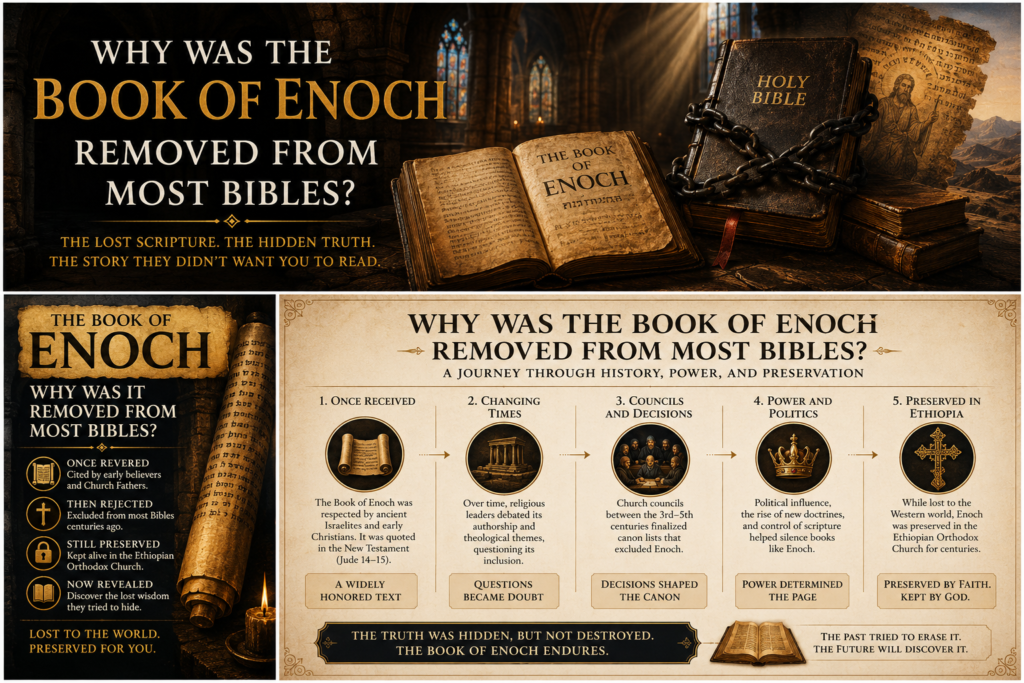
It was quoted by the New Testament. It was found in the Dead Sea Scrolls. It was scripture for the first five centuries of Christian history. And then, in most of the world, it disappeared. Here is the story of how that happened — and why Ethiopia kept the faith.
Once Revered: The Book of Enoch in Early Christianity
Before the word “canon” ever entered Christian vocabulary, the Book of Enoch was already at work in the early church. The Epistle of Jude (written somewhere between 60 and 90 CE) quotes it directly — twice in two verses. “Behold, the Lord comes with ten thousands of his holy ones, to execute judgment upon all, and to convince all that are ungodly among them of all their ungodly deeds which they have ungodly committed in that way, and of all their hard speeches which ungodly sinners have spoken against him.” Jude 1:14–15 tracks almost verbatim to 1 Enoch 1:9.
That is not a coincidence. Jude treats Enoch’s words as authoritative — as something his readers would recognize and accept. The writer of the Epistle assumes the book is scripture. So do the early church fathers who cite it: Origen, Clement of Alexandria, Justin Martyr, and Athanasius all reference Enochic material. For the first three centuries of Christian history, the book occupied a space of genuine respect.
The Dead Sea Scrolls confirm why. When Qumran cave 4 was excavated in the 1950s, researchers found more copies of 1 Enoch than any other text — more than Genesis, more than Isaiah, more than any biblical book. The community that produced those scrolls was Jewish, not Christian, but it demonstrates something important: Enoch was central to Second Temple religious thought. Whatever early Christians inherited from their Jewish roots included Enochic tradition prominently.
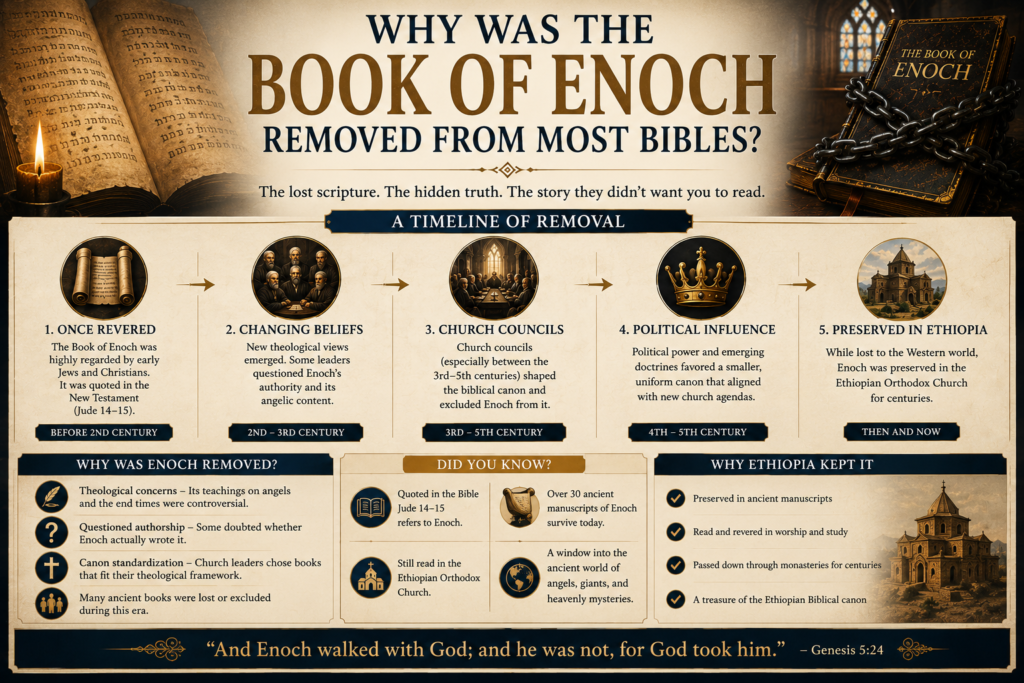
Changing Beliefs: The 2nd and 3rd Century Debates
The first cracks appeared as Christianity moved from house churches into structured theological debate. The 2nd century brought a new question into sharp focus: what makes something scripture? And who decides?
Irenaeus of Lyons argued fiercely for four Gospels and against texts he considered marginal. Marcion proposed a truncated canon with only a modified Luke and ten Pauline letters. The gnostic communities produced their own revelations with elaborate cosmologies and competing claims. In this environment, the question of Enoch became harder to answer casually.
The Book of Enoch contains vivid descriptions of angelic hierarchies, the Watchers’ fall, and the origins of evil that felt, to some theologians, dangerously speculative. Clement of Alexandria included it in his Stromata and considered it useful for edification. But Origen, while citing it, grew more cautious — and by the mid-3rd century, figures like Cyril of Jerusalem were excluding it from catechetical instruction. The theological pendulum was swinging toward caution.
The concept of evil also created tension. Enoch attributes the origin of demons to the fallen Watchers — a view that sat uncomfortably beside emerging orthodox positions that located evil in free will, not in cosmic interbreeding. Augustine, who would become the most influential voice in western theology, initially found Enoch interesting but later rejected it as unfit for teaching. His authority shaped centuries of subsequent debate.
Church Councils: The 3rd and 5th Century Decisions
There was no single “Council of Nicaea for the Book of Enoch.” The decision was more diffuse — made in regional synods, in scriptorium practices, in the content of catechetical curricula over the course of two centuries. But the pattern is clear.
The Council of Laodicea (c. 363 CE) did not list the Book of Enoch among the canonical scriptures, and by the 5th century most eastern churches had settled the question by omission. The western church followed the same direction. When Pope Gregory the Great listed books to be read for spiritual edification but not held as authoritative, Enoch was absent. The Protestant Reformers, when they confronted the question of the apocrypha, treated Enoch as beyond the pale — not because Luther or Calvin had a personal vendetta against it, but because the question had already been settled centuries earlier.
The councils and the consensus they built were not purely theological. They were also institutional. A church trying to standardize doctrine, establish coherent hierarchy, and distinguish itself from gnostic and Jewish heterodox communities needed a clear, bounded canon. A text that contained unusual angelology, disputed origins, and no direct connection to apostolic authorship was a liability for that project. Enoch was not condemned so much as gently set aside.
Political Influence: Power and Doctrine
The canon decision was never purely about inspiration. It was about which institutions controlled what counted as scripture — and what that meant for their authority over doctrine, practice, and hierarchy.
The Emperor Constantine’s conversion in 312 CE transformed the church’s relationship to power. When the faith became an empire’s faith, its institutional structures needed to scale. Canonical lists served a political function: they created boundaries. A church with a clear, bounded canon was a church that could define orthodoxy, discipline heterodoxy, and train clergy consistently. Texts that resisted easy categorization — like Enoch, with its apocalyptic visions and unorthodox angelology — created friction in that system.
Some scholars argue that the exclusion of Enoch was also a deliberate move to suppress Jewish-Christian traditions that competed with emerging Pauline-centered theology. Whether or not that framing is complete, it is true that the texts that survived the canonical process were disproportionately those with apostolic association and wide geographical use in Greek-speaking churches. Enoch was Ethiopic, Aramaic, and Hebrew — not Greek — and it circulated most widely in communities that sat outside the emerging centers of Pauline Christianity.
The politics of canon are rarely clean. Texts that served the interests of the emerging ecclesiastical power structure survived. Texts that complicated it did not. The Book of Enoch complicated things. And so, in most of the Christian world, it went.
Preserved in Ethiopia: The Ethiopian Orthodox Church
Ethiopia kept it. This is not a footnote — it is the story.
When James Bruce returned from Ethiopia in 1773 with three complete manuscripts of the Book of Enoch, he had carried the full text out of the only place it had survived intact in the western world. The Ethiopian Orthodox Tewahedo Church had maintained Enoch as canonical scripture through fifteen centuries of Byzantine dominance, Islamic expansion, and colonial pressure. It had never stopped reading it, copying it, or teaching from it.
Ethiopia’s independence was partly geographical and partly theological. Cut off from the Mediterranean Christian centers by geography and, later, by the rise of Islam, Ethiopian Christianity developed its own traditions with less direct pressure from the institutional negotiations happening in Constantinople and Rome. The Ethiopian biblical canon, which includes 81 books total, reflects that independence. Enoch was not controversial there. It had always been scripture.
The Ethiopian monks who copied the text by hand through the medieval period were not preserving an artifact. They were maintaining a living tradition of worship. Enoch was read in churches, taught in monasteries, and held as inspired scripture throughout Ethiopia’s history. The fact that the western world had to travel to Africa to recover its own lost literature says something uncomfortable about how canon decisions actually worked.
Why Ethiopia Kept It
The Ethiopian preservation of the Book of Enoch is not a miracle — it is a story of monastic discipline and theological continuity.
Ethiopian monasteries, particularly those in the northern highlands around Lalibela and the Lake Tana islands, maintained scriptoria where monks copied religious texts by hand as a spiritual practice. This tradition extended across centuries, and it included the Enochic texts. The monks were not aware they were preserving something the rest of the world had lost. They simply read what scripture said, copied what scripture said, and taught what scripture said.
The Ethiopian Orthodox Church’s theology also accommodated Enoch more naturally than the post-Nicene western tradition. Ethiopian theology has historically placed greater emphasis on angelology, apocalyptic imagery, and the cosmic scope of divine judgment — all themes that run through 1 Enoch prominently. The text did not create the same theological friction it produced in Constantinople or Rome.
When European scholars began studying Ethiopian manuscripts in the 18th and 19th centuries, they found not just the Book of Enoch but a complete biblical tradition — 81 books, including Jubilees, Meqabyan, and other texts absent from the western canon — preserved in living practice. Ethiopia had not just kept one book. It had kept an entire biblical world.
“And Enoch walked with God; and he was not, for God took him.” Genesis 5:24
The church that excluded the Book of Enoch did not destroy it. It simply stopped copying it. And in one place — Ethiopia — the copying never stopped. Today that single act of monastic preservation gives modern readers access to a text that the rest of the world lost for fifteen hundred years. If you want to read the full Book of Enoch, as it was read by the first Christians, as Jude read it, as the Dead Sea Scrolls confirm it — the Ethiopian tradition is the reason you can.