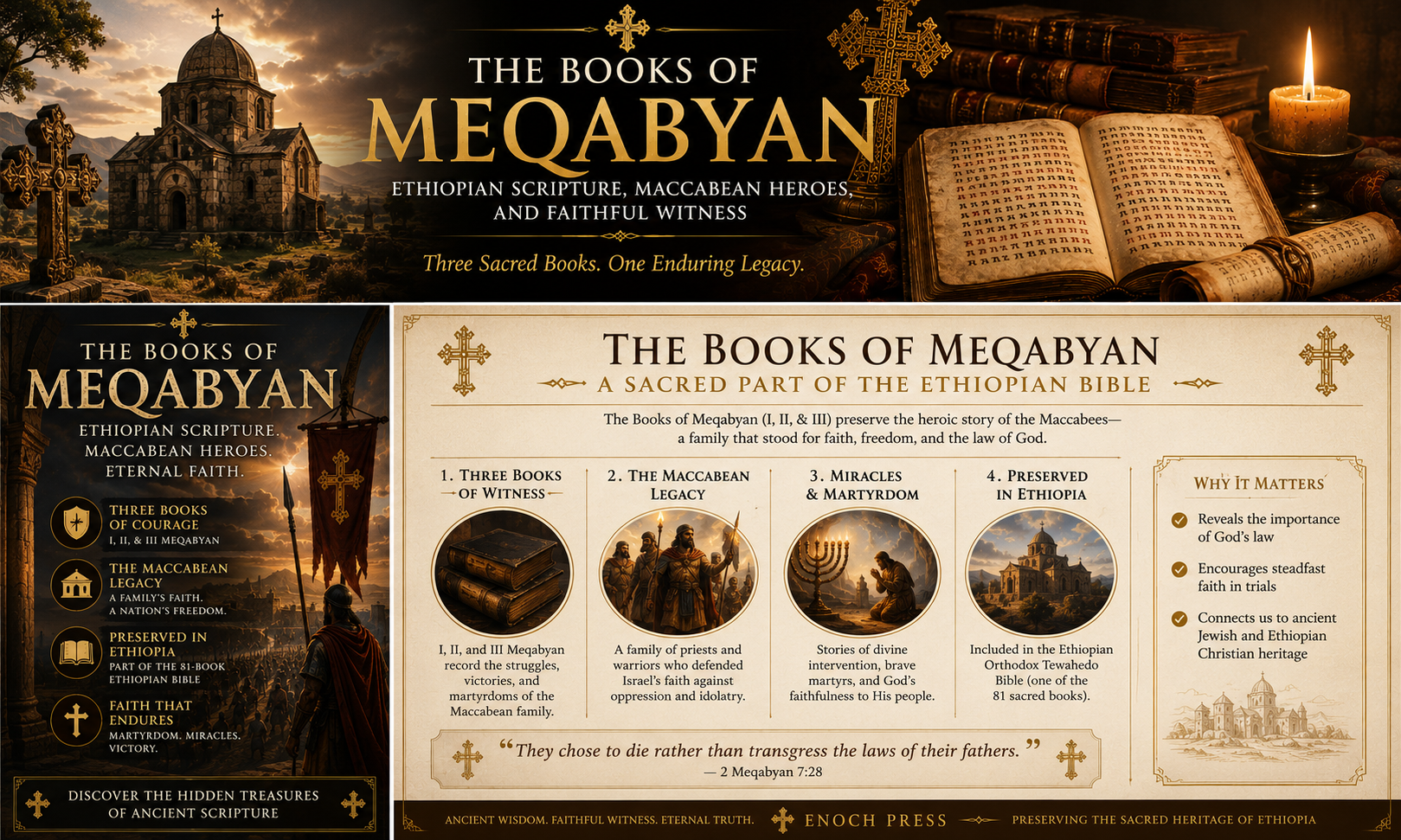
The Books of Meqabyan are among the least-known scriptures in the world. Preserved for more than a millennium in the Ethiopian Orthodox Tewahedo Church, they contain stories of martyrdom, royal perseverance, and fierce resistance to apostasy — and they have virtually no presence in English-language scholarship or popular religious literature. Most people who have never heard of them have been reading an incomplete Bible.
What Are the Books of Meqabyan?
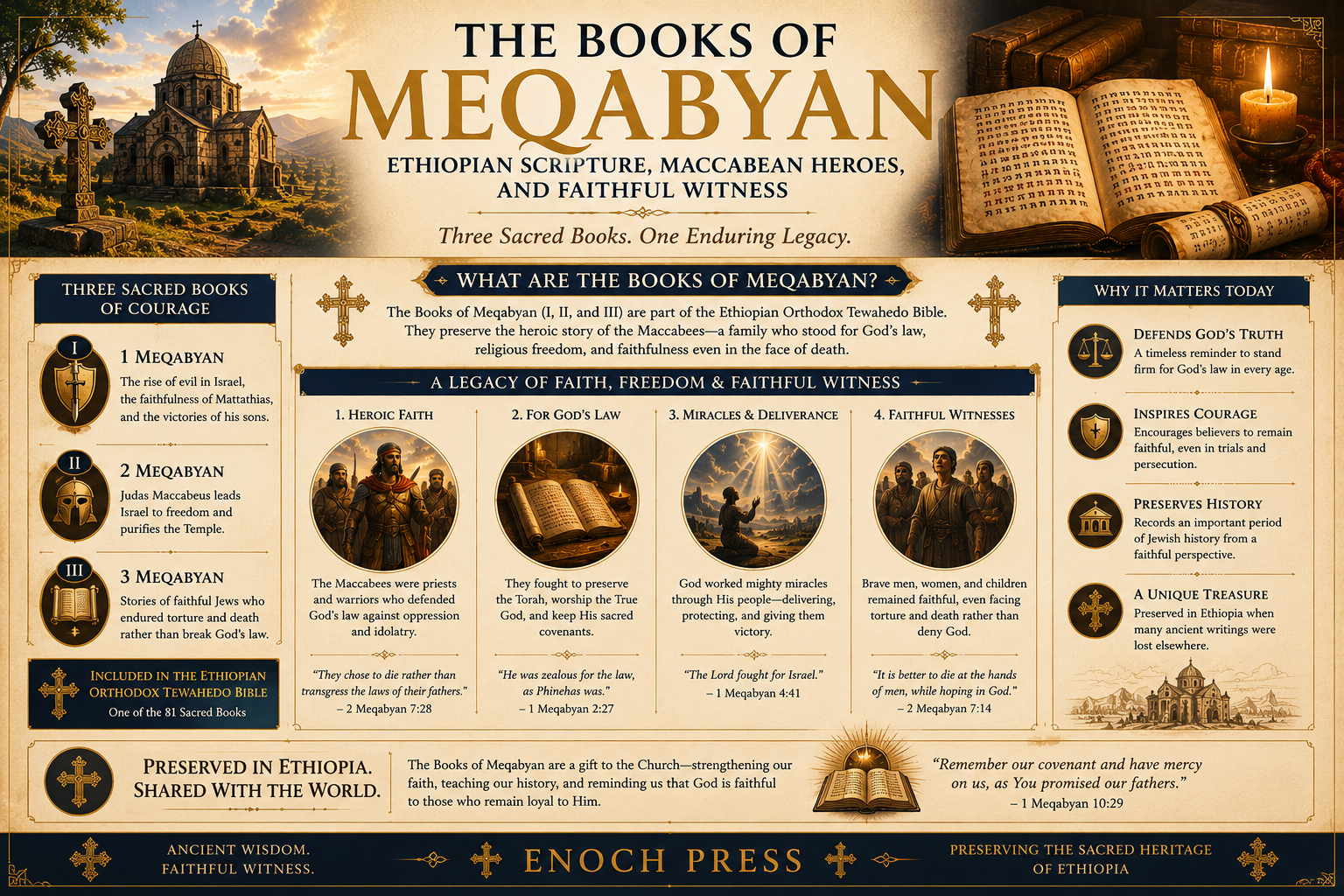
Meqabyan is a collection of three books — 1 Meqabyan, 2 Meqabyan, and 3 Meqabyan — that form part of the biblical canon of the Ethiopian Orthodox Tewahedo Church. They are distinct from the Books of Maccabees found in the Catholic Deuterocanon and the Orthodox Apocrypha. Though they share thematic territory — faithful Jews resisting forced apostasy, martyrdom, divine reward for the righteous — they are not the same texts, they are not translations of each other, and they tell different stories with different characters and a different theological emphasis.
The name "Meqabyan" derives from a Hebrew root related to gathering or assembling, and some scholars link it to the concept of burial — the gathering of the dead. Within the Ethiopian tradition, the books are attributed to a figure named Meqabyan, a righteous warrior-king whose story anchors the first volume. The three books together are considered sacred history: accounts of how God's people maintained their faith under conditions designed to destroy it.
The texts exist in Ge'ez, the classical liturgical language of Ethiopia, and have been part of the Ethiopian Orthodox canon for centuries. Outside Ethiopia and Eritrea, they are almost entirely unknown. There is no widely circulated English translation. The scholarly literature is sparse. The number of English-language articles analyzing their theology could fit on a single page. This is not because the books are unimportant — it is because the world has not yet paid attention.
Why They Exist Only in the Ethiopian Bible
The Ethiopian Orthodox Tewahedo Church has an 81-book biblical canon — the largest of any Christian tradition. It includes texts that were part of wider circulation in the Second Temple period and early Christian era before Western councils narrowed the canon: 1 Enoch, the Book of Jubilees, the Shepherd of Hermas, and several others. Meqabyan belongs to this wider inheritance.
Ethiopia received Christianity in the 4th century CE through the influence of the Alexandrian church and the missionary work of Frumentius, who became the first Bishop of Aksum. Alexandria, unlike Rome, had a more expansive view of what counted as scripture — one shaped by proximity to the Jewish communities of Egypt and to the intellectual traditions of Second Temple Judaism. The texts that flowed into the Ethiopian church reflected this breadth.
Crucially, Ethiopia's church developed in substantial geographic and political isolation from the European councils and reformations that progressively narrowed the Western biblical canon. The Council of Trent (1546) finalized Catholic scripture. The Protestant Reformation further reduced it. Neither of these events reached Ethiopia in any meaningful way. The Ethiopian church continued reading and canonizing the texts it had always read, including Meqabyan.
The result is a biblical tradition that preserved materials the Western church lost track of — not because they were rejected on theological grounds, but because they were never in the pipeline that led to European canon formation. Meqabyan didn't fail a doctrinal test. It simply wasn't in Rome.
What Makes Them Unique
The Books of Meqabyan are defined by three intertwined themes: martyrdom, faith under extreme persecution, and the conviction that God vindicates the righteous even when the wicked appear to triumph.
Martyrdom as witness. The central narrative concern is how faithful people respond when forced to choose between survival and faithfulness. Characters in Meqabyan face rulers who demand apostasy — worship of false gods, abandonment of the law, renunciation of Yahweh. The righteous refuse. They are tortured, killed, imprisoned, and humiliated. The books do not soften this. The deaths are specific, the suffering is real, and the text does not rescue its heroes before they suffer. What it promises is vindication — that God sees, that God records, and that God will act.
Royal faith under pressure. Unlike many martyrdom texts that focus on ordinary people, Meqabyan centers on figures of authority: kings, warriors, priestly leaders. The books imagine what it looks like when power is wielded faithfully — and what it costs when powerful people refuse to compromise. This gives the texts a political theology that differs from simpler accounts of passive suffering. Faith here is not merely endured; it is enacted, defended, and commanded.
The theology of divine memory. Running through all three books is a conviction that God does not forget. The righteous who are killed are not simply gone. Their deaths are seen, recorded, and will be requited. This is not merely a general promise — the texts are specific about divine attention to individual acts of faithfulness. Every refusal to bow, every martyr's prayer, every righteous act performed under coercion is registered in the divine economy. The books are, in this sense, a theology of witness: the faithful act for an audience that transcends their immediate circumstances.
How Meqabyan Differs from the Books of Maccabees
Western readers who encounter Meqabyan for the first time often assume it is the same as 1–4 Maccabees, which covers similar thematic ground: Jewish resistance to forced Hellenization, martyrdom, the Maccabean revolt. The comparison is understandable but wrong in important ways.
The Maccabees are set in a historically documented context: the Seleucid king Antiochus IV Epiphanes, the desecration of the Jerusalem Temple in 167 BCE, the guerrilla campaign of the Maccabean family. They are partially historical documents — corroborated by Josephus, referenced in other sources, connected to a specific geopolitical moment. The theology emerges from a dateable crisis.
Meqabyan is not grounded in the same historical specificity. Its kings and persecutors are named, but they don't map cleanly onto the historical record. The books function more as theological literature — stories shaped to carry a message about faith and persecution — than as chronicles of particular events. Where Maccabees is interested in who won and how, Meqabyan is interested in who remained faithful and why that matters to God.
Theologically, Meqabyan is also more focused on individual conscience and divine accounting than on national restoration. The Maccabees culminate in military victory and the rededication of the Temple — a national triumph. Meqabyan does not promise earthly victory in the same terms. Its reward structure is more oriented toward divine recognition of the individual righteous person, a theology that resonates with later traditions of sainthood and martyrology.
Why the Ethiopian Orthodox Church Considers Them Canonical
For the Ethiopian Orthodox Church, the question of why Meqabyan belongs in the Bible is not an open question. It is scripture because it has always been scripture — received, copied, read aloud in liturgy, studied, and transmitted as part of an unbroken canonical tradition.
But the theological reasons are also worth stating. The books speak directly to the experience of Christians who have faced persecution — and the Ethiopian church has a long memory of exactly that. Ethiopia was surrounded for centuries by Islamic kingdoms and faced repeated periods of religious conflict, including the devastating invasion of Ahmad ibn Ibrahim al-Ghazi (Ahmed Gragn) in the 16th century, which destroyed monasteries, burned manuscripts, and threatened the very survival of Ethiopian Christianity. A theology that insists God sees and vindicates the faithful who suffer is not abstract doctrine in that context. It is pastoral necessity.
The books also fit the Ethiopian church's broader theological emphasis on the continuity between the Hebrew scriptures and the Christian revelation. Ethiopian Christianity maintains strong connections to Old Testament observance — the Sabbath, dietary laws, the Ark of the Covenant (the Tabot) as the center of worship. Texts like Meqabyan, which are saturated with the theology of Torah faithfulness and covenant loyalty, are at home in this tradition in a way they might not be in traditions that have more thoroughly separated the Hebrew and Christian testaments.
"Let the righteous not fear the sword of the wicked, for the Lord has not forgotten those who call upon His name." — Books of Meqabyan
The Books of Meqabyan are not a curiosity at the margins of biblical history. They are a window into one of the oldest Christian traditions in the world and its understanding of what faithfulness costs and what it earns. They deserve to be read, studied, and taken seriously — not as a supplement to the Bible you already know, but as scripture that has shaped the faith of millions of people for over a thousand years.