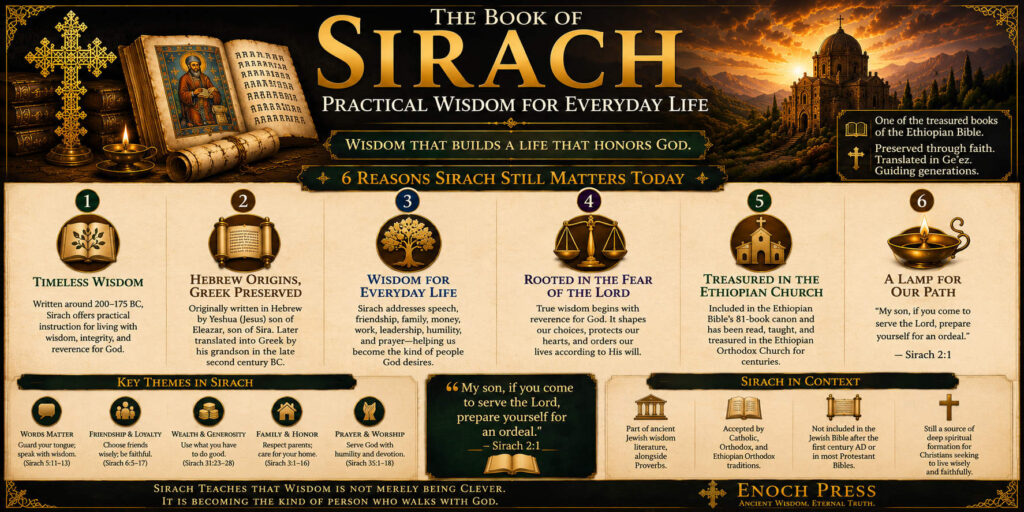
How Ben Sira connected reverence for God with speech, friendship, money, family, work, suffering, and moral character
A Hebrew Voice Returns From the Cairo Genizah
In 1896, two sisters returned from Cairo carrying a handful of old manuscript leaves. When they showed them to Solomon Schechter at Cambridge, he recognized something scholars had wanted to see for centuries: portions of the Book of Sirach in its original Hebrew. The text had never disappeared from Christian memory. It had lived in Greek, Latin, Syriac, Ethiopic, and other translations. Yet the sound of its Hebrew sentences had largely fallen silent.
The discovery set off a race through the Cairo Genizah, the storeroom of the Ben Ezra synagogue in Fustat where worn manuscripts had accumulated for generations. More Hebrew fragments followed. Later finds from Qumran and Masada reached even farther back, proving that copies of Ben Sira circulated in Hebrew close to the period in which the book was written. Cambridge University Library now identifies fragments from six Genizah manuscripts, while the Israel Antiquities Authority preserves images of the Ben Sira scroll from Masada.
That recovery suits the book. Sirach is a work about memory becoming practice. It gathers the observations of a Jerusalem teacher who believed wisdom must be carried from sacred instruction into ordinary conduct. He writes about prayer and worship, but also about anger, gossip, debt, physicians, dinner tables, friends, parents, rulers, employees, grief, and the slow formation of character.
The central answer is clear: the Book of Sirach teaches that practical wisdom is a life ordered by reverence for God. It is not cleverness, efficiency, or religious polish. It is faithful judgment made visible in the words we choose, the people we trust, the money we handle, the correction we receive, and the decisions we make when obedience becomes costly.
A Jerusalem Teacher Who Signed His Work
Unlike many ancient wisdom books, Sirach gives readers a name. Near the close of the work, the author identifies himself as Yeshua, son of Eleazar, son of Sira – usually shortened to Ben Sira, meaning son of Sira. The Greek form of the family name produced the title Sirach. The Latin title Ecclesiasticus, or Church Book, reflects the work’s extensive use in Christian moral instruction.
Ben Sira lived and taught in Jerusalem during the early second century BC. The book is commonly dated around 180 BC, before the persecution under Antiochus IV and the Maccabean revolt. His glowing description of the high priest Simon in chapter 50 appears to look back on a recently remembered figure, which helps place the work between the death of Simon II and the political crisis that erupted after 175 BC.
The book also comes with an unusual family record. Ben Sira’s grandson translated the Hebrew work into Greek for Jewish readers in Egypt. In his prologue, the grandson says he arrived during the thirty-eighth year of the reign of a king called Euergetes, generally understood as 132 BC. He warns that ideas expressed in Hebrew do not always carry the same force in another language. That sentence is more than a translator’s apology. It is one of antiquity’s clearest acknowledgments that translation is necessary, skilled, and imperfect.
The grandson also describes Israel’s sacred literature as the Law, the Prophets, and the other ancestral books. Scholars treat that wording as important evidence for how Jewish collections were being understood in the late second century BC. Sirach therefore stands at a crossroads: it looks backward to Israel’s Scriptures and worship while speaking from a Jewish world already negotiating Greek language and culture.
What Kind of Book Is Sirach?
Sirach is often compared with Proverbs, and the comparison is fair. Both books gather compact sayings about conduct. Both assume that wisdom is learned through discipline, observation, and reverence for God. Both can move quickly from one subject to another.
Yet Sirach is more than a second Proverbs. It is the work of a named teacher with a strong vision of how wisdom, Torah, worship, priesthood, history, and daily ethics belong together. Chapters 1 through 43 offer moral instruction across a startling range of subjects. Chapters 44 through 50 retell Israel’s story through a long praise of ancestors, moving from Enoch and Noah through the patriarchs, Moses, the judges, kings, prophets, and the high priest Simon. Chapter 51 closes with thanksgiving and an invitation to enter the house of instruction.
That broad architecture matters. Ben Sira does not separate private virtue from communal memory. The wise person must learn how to speak, spend, work, grieve, and choose friends. The same person must also know the story of God’s people, respect worship, and understand that wisdom did not begin with personal experience.
Chapter 24 makes the connection explicit. Wisdom is pictured as coming from God, ranging across creation, and finally taking root among God’s people. Ben Sira then identifies this wisdom with the covenantal instruction given through Moses. In his thought, wisdom is not a rival to revealed law. Wisdom is the law understood, loved, and embodied.
Between Jerusalem and the Greek-Speaking World
Ben Sira wrote in Hebrew, but he did not live in a sealed cultural room. Jerusalem in the early second century BC belonged to a region shaped by Hellenistic rule, trade, administration, education, and language. Greek influence was present long before the crisis under Antiochus IV turned cultural pressure into violent persecution.
Scholars therefore resist a crude picture of Ben Sira as a man rejecting everything Greek. His work is thoroughly Jewish in its loyalty to Israel’s God, Torah, Temple, and inherited writings, yet it also belongs to a wider Mediterranean culture of schools, teachers, moral maxims, public honor, household order, and educated scribes. The sharper question is not whether he knew a Greek world. It is how he placed that world under the authority of Israel’s wisdom.
The grandson’s translation carried that project into Egypt. He was writing for Jews living abroad who wanted instruction and were preparing to live according to the law. The Greek version did not erase the Hebrew work; it allowed a Jerusalem teacher to address readers whose daily language and intellectual environment had changed.
This history matters for modern readers because it prevents two opposite mistakes. Sirach is not a relic untouched by cultural exchange, and it is not a thin layer of Jewish vocabulary over Greek philosophy. It is a Jewish teacher’s sustained effort to show that genuine wisdom can meet a changing culture without surrendering its center.
The Fear of the Lord Is a Center, Not a Mood
Modern readers can misunderstand the phrase fear of the Lord. It may sound like panic, dread, or emotional terror. In Sirach, it is closer to reverent allegiance: knowing that God is God, that human judgment is limited, and that every area of life stands under divine authority.
This is why the book opens by tracing wisdom back to God rather than to human talent. People can be intelligent and still be destructive. They can be educated and still be vain. They can master strategy while losing the ability to tell the truth. Sirach refuses to call such people wise.
Reverence gives practical judgment a fixed center. It changes the questions. The reader no longer asks only, Will this work? The deeper questions become: Is it right? Is it honest? Does it protect the vulnerable? Can it be offered to God without disguise? What kind of person will this choice form in me?
Sirach 2 pushes that foundation into hardship. Service to God, the teacher warns, does not remove testing. The faithful person should expect seasons in which sincerity, patience, and trust are exposed under pressure. Wisdom is not proven when every choice is rewarded quickly. It is proven when pain does not become permission for betrayal.
The Tongue Is Where Wisdom Becomes Audible
Few themes return as often in Sirach as speech. The teacher has watched words build trust, break friendships, expose vanity, spread secrets, ignite anger, and turn private foolishness into public ruin. He treats the tongue as a moral instrument that reveals who is governing the heart.
That makes Sirach painfully current. Digital communication allows a thought to leave the mind and reach hundreds of people before judgment catches up. Outrage is rewarded for speed. Sarcasm is mistaken for courage. Public shaming can feel righteous because an audience applauds it.
Ben Sira’s answer is not silence at any price. Wisdom can speak firmly. It can correct, warn, teach, and defend. The issue is whether speech has been disciplined by truth, timing, humility, and responsibility. A wise person does not confuse immediate expression with moral honesty.
Sirach repeatedly asks readers to test words before releasing them. Is the statement true? Does the listener have a right to know it? Is the timing faithful? Is correction aimed at restoration, or at the pleasure of humiliating someone? Does the sentence serve justice, or merely discharge anger?
The book’s counsel reaches beyond manners. Reckless speech often reveals a deeper captivity. Pride needs the last word. Fear needs the defensive word. Envy needs the diminishing word. Wisdom does not merely polish vocabulary; it interrupts the desire that is trying to use the mouth.
Friendship Must Survive More Than Convenience
Sirach speaks about friendship with warmth and caution. A faithful friend is a treasure, but trust should not be handed out simply because someone is charming, useful, familiar, or eager for access. Time and pressure reveal what first impressions cannot.
This realism is not cynicism. Ben Sira knows that people need companions. He also knows that a false friend can normalize compromise, expose private matters, disappear during hardship, or flatter a person toward ruin. Friendship therefore belongs to the work of discernment.
The book’s strongest friendships are morally serious. A true friend does not merely confirm every emotion. That person helps obedience remain possible. Sometimes loyalty looks like comfort. Sometimes it looks like a warning given before foolishness hardens into consequence.
Modern readers often count visibility as closeness. We know who follows, comments, responds, and appears in photographs. Sirach asks a more demanding question: who remains truthful, discreet, steady, and faithful when there is no social advantage in staying?
The practical lesson is simple and costly. Love people generously, but do not confuse Christian love with unguarded access. Choose close companions whose presence makes honesty easier and compromise harder.
Money, Work, Medicine, and the Moral Weight of Ordinary Life
Sirach refuses to let spirituality float above material life. Money reveals loyalties. Work reveals discipline. Generosity reveals whether another person’s suffering can interrupt our comfort. Debt, wages, possessions, gifts, and business dealings all carry moral weight.
The book neither treats wealth as automatic proof of blessing nor poverty as a romantic virtue. It warns that riches can create false security and social arrogance. It also recognizes the humiliation and danger that poverty can bring. The question is not whether money exists, but whether money has become a master.
Generosity is especially important. Ben Sira connects care for the poor with worship rather than treating it as optional kindness. The reader cannot honor God in prayer while using wealth to ignore, exploit, or shame those in need. Practical wisdom reaches the account book.
The same grounded approach appears in the book’s teaching about health. Sirach 38 honors physicians and medicines while still locating healing under God’s authority. Prayer and skilled care are not enemies. That balance is striking: seek God, make moral repair where needed, and receive the work of those trained to heal.
Sirach also respects labor, even as its ancient social hierarchy gives the professional scribe a privileged place. Farmers, artisans, builders, and craftsmen sustain the city; the teacher sees their necessity. Yet he writes from the perspective of an educated male sage and imagines a social order very different from ours. That difference must remain visible if the book is going to be read honestly.
The Difficult Passages Cannot Be Hidden
Sirach contains wisdom that travels well across centuries. It also contains sayings shaped by a patriarchal household, an enslaving economy, and an imagined male audience. Some statements about women, daughters, servants, and physical discipline can sound harsh or morally unacceptable to modern readers. Pretending those passages are not there would be dishonest.
Scholars commonly note that Ben Sira writes from a decidedly male social location. His praise of wisdom as a woman does not erase his suspicion of women in several household sayings. His concern for family honor can become severe control. His assumptions about servants belong to an ancient system Christians should not baptize as timeless social policy.
Responsible reading requires more than choosing between total rejection and uncritical imitation. First, read the sayings in their second-century Jewish setting. Second, distinguish the theological center of the book from every social arrangement it assumes. Third, interpret difficult instructions alongside the broader biblical witness to human dignity, justice, mercy, and the example of Christ.
This is not a device for avoiding hard texts. It is the discipline used whenever ancient Scripture meets a changed moral and social world. Historical context explains a command’s setting; it does not automatically make every application righteous. Christians should resist any use of Sirach that excuses abuse, coercive control, contempt for women, or violence toward children.
The book becomes more trustworthy, not less, when readers refuse to turn it into something smoother than it is. Ancient wisdom deserves serious engagement, and serious engagement includes moral discernment.
Creation, Worship, and the Limits of Human Control
Practical wisdom can become cramped if it is reduced to rules for personal behavior. Sirach refuses that reduction. Near the end of the book’s long instructional section, chapters 42 and 43 turn outward in praise of creation – sun, moon, stars, snow, frost, wind, sea, and the ordered works of God.
The shift is important. Wisdom includes more than managing a household or avoiding a foolish sentence. It is the ability to see reality in proper scale. Human beings are creatures inside an order they did not design and cannot master. The heavens are not decorations above our private concerns; they are reminders that God’s wisdom exceeds human calculation.
That perspective disciplines anxiety and ambition. Much foolishness begins when people act as if every outcome can be controlled, every risk eliminated, every reputation secured, and every future forced into place. Sirach’s praise of creation interrupts that illusion. Faithful action matters, but control is not the same as faithfulness.
Worship therefore belongs to practical wisdom. It restores proportion. It teaches the successful that they are not sovereign, the frightened that chaos is not ultimate, and the proud that knowledge remains partial. A wise life is attentive to ordinary consequences, yet it also knows when to stop speaking and stand in wonder.
Suffering Reveals Whether Wisdom Has Roots
The most visible line in many editions of Sirach comes near the beginning: those who come to serve the Lord should prepare for testing. The book does not promise that wisdom will prevent grief, illness, betrayal, danger, or humiliation.
That refusal of shallow optimism is one reason Sirach has lasted. It recognizes that faithful people can suffer without having made foolish choices. At the same time, suffering creates new temptations. Pain can make revenge feel just, escape feel necessary, self-pity feel truthful, and bitterness feel like protection.
Ben Sira calls for endurance that is neither passive nor sentimental. Remain steady. Seek counsel. Pray. Accept help. Examine the heart. Do not let the wound choose the next sin. This is difficult wisdom because it asks obedience to survive after the emotional reward has disappeared.
For Christians, the value of this teaching is not that every ancient explanation of suffering must be accepted without question. Sirach sometimes speaks with the confidence of traditional retribution wisdom, while books such as Job challenge easy equations between conduct and circumstance. Read together, the wisdom writings create a fuller picture: choices carry consequences, innocent suffering is real, and faithfulness cannot be reduced to a formula for comfort.
Wisdom Needs a Memory Longer Than One Lifetime
After dozens of chapters on conduct, Sirach changes pace. The praise of the ancestors in chapters 44 through 50 walks through Israel’s remembered figures. The effect is deliberate. A student who has learned how to govern speech and desire must also learn to locate a life inside a sacred history.
Ben Sira praises Enoch, Noah, Abraham, Moses, Aaron, Joshua, the judges, David, Elijah, Isaiah, Josiah, Jeremiah, Ezekiel, and others. The sequence is selective and interpretive, not a neutral chronicle. It teaches readers which qualities deserve remembrance and how the past should shape present fidelity.
The section culminates in the high priest Simon, whose appearance in worship is described with the language of light, flowers, precious vessels, and ordered beauty. For Ben Sira, wisdom is not purely private morality. It belongs to a people, a sanctuary, a story, and a pattern of worship received across generations.
That movement corrects a modern weakness. Personal growth can become self-absorption when it has no memory beyond the individual. Sirach insists that wise character is formed by gratitude for those who carried faith before us – and by the sober knowledge that our own choices will become part of what others inherit.
Why Sirach Matters in the Ethiopian Biblical Tradition
The Ethiopian Orthodox Tewahedo Church’s official canonical list includes the Book of Joshua the son of Sirac among its forty-six books of the older Scriptures. The church’s published count joins those with thirty-five books in the Christian collection for a total of eighty-one.
Sirach is not unique to Ethiopia. It is received as canonical in the Catholic Church and in several Orthodox traditions. It is absent from the Jewish Tanakh and is not treated as canonical by most Protestants, though some Protestant editions place it among the Apocrypha for reading and instruction. Those differences should be stated plainly rather than turned into a conspiracy story.
Its place in Ethiopia still matters. Enoch Press readers often meet the Ethiopian Bible through books that are rare elsewhere, such as Enoch, Jubilees, and Meqabyan. Sirach reveals another side of that canon. The collection is not built only from visions, angels, ancient mysteries, and national crises. It also preserves a teacher asking how faith changes a conversation, a loan, a friendship, a family obligation, and a season of suffering.
For a wider view of how that collection developed, readers can continue with The Ethiopian Bible Canon: How It Formed and Why It Stayed Distinct. The earlier overview, The Ethiopian Bible: 81 Books Most Christians Have Never Read, explains why the number itself has captured so much attention. Sirach adds the more personal question: what kind of life should such a canon form?
How to Read Sirach Without Flattening It
Sirach rewards a slower method than a straight sprint through fifty-one chapters. Read it in thematic clusters. Follow one subject – speech, friendship, wealth, prayer, humility, grief – and notice how the teacher returns to it from different angles.
Compare translations when a saying seems unusually sharp or unclear. The Hebrew fragments, the Greek translation, and later versions do not always align perfectly, and verse numbering can vary. The grandson warned readers about this problem more than two thousand years ago.
Keep the book’s major claims in view. Wisdom comes from God. Reverence is its beginning. Torah, worship, moral conduct, and communal memory belong together. A clever application that detaches a saying from those foundations is not Sirach’s kind of wisdom.
Read the difficult passages with the same honesty. Do not hide the ancient social world. Do not import its every hierarchy into modern practice. Let historical knowledge, the full biblical witness, and mature Christian moral judgment work together.
Above all, resist turning Sirach into a collection of decorative quotations. Its purpose is formation. The question after reading is not merely, What line did I like? It is, What habit must change because wisdom has made my conduct visible?
Conclusion
The Book of Sirach survived because generations found it worth translating, copying, teaching, and carrying into worship. Its Hebrew pages resurfaced in Cairo, Qumran, and Masada, but its moral questions had never gone quiet.
Ben Sira’s answer to everyday confusion is demanding. Wisdom begins in reverence for God and takes bodily form. It governs the tongue before a sentence escapes. It tests friendship before trust is surrendered. It enters money, work, medicine, family, leadership, grief, and worship. It remembers the faithful who came before and asks what kind of inheritance our own habits will leave.
The book also requires honesty. It comes from an ancient male teacher whose social assumptions cannot all be treated as timeless Christian commands. Reading Sirach well means receiving its enduring moral vision without disguising its historical limits.
That balance is exactly why Sirach remains valuable. It does not offer effortless inspiration. It offers a school of attention – attention to God, to consequence, to neighbor, to memory, and to the character being built through choices that seem too ordinary to matter.
They matter. Sirach’s practical wisdom begins there.
Reflection
The historical and literary work is complete. What follows is a Christian reflection on the book’s challenge.
Sirach makes wisdom difficult to admire from a distance. It keeps moving toward conduct. The tongue. The wallet. The friendship. The hidden resentment. The correction we keep resisting. The responsibility no one praises.
Choose one ordinary place where foolishness has become repetitive. Do not choose the area that sounds most spiritual. Choose the one that is actually costing peace, honesty, trust, or obedience.
Bring that pattern before God without decoration. Ask for wisdom that can be seen, not merely discussed. Then make one faithful decision small enough to complete today: withhold the cruel sentence, tell the truth, repay what is owed, receive correction, call the neglected person, seek skilled help, or remain steady through one more difficult hour. In Sirach, wisdom grows through practiced reverence. It becomes visible one choice at