
Somewhere on the northern border of ancient Israel stands Mount Hermon, its summit snow-capped even in the desert heat. Today it’s a hiking destination and a ski resort. In the Second Temple period, Jewish readers told a very different story about it: that this was the mountain where two hundred angels once stood in a circle, swore a mutual oath, and stepped off the edge of heaven’s order — on purpose, together, so that no single one of them would have to bear the guilt alone.
That story has a name. It’s the story of the Watchers.
Introduction
If you’ve read Genesis 6:1–4, you’ve read the most compressed, most argued-over four verses in the entire Hebrew Bible. “Sons of God” see “daughters of man.” They marry them. Giants called the Nephilim appear on the earth. And then, with no explanation at all, the text moves straight on to Noah and the Flood.
Genesis doesn’t tell you who the “sons of God” were. It doesn’t tell you why their union with human women mattered enough to help trigger a global judgment. It doesn’t name a single angel, a single mountain, or a single sin beyond the marriages themselves.
The Book of Enoch does.
The short answer: in 1 Enoch, the Watchers were heavenly beings — “sons of heaven” — who abandoned their appointed place, descended together to Mount Hermon, entered forbidden unions with human women, revealed corrupting knowledge, and fathered violent giant offspring. They were judged not because embodiment or knowledge is evil, but because they misused power, broke a boundary they knew was not theirs to cross, and let the consequences spread far beyond themselves. The rest of this article is that answer, in full.
The central question this article answers: Who were the Watchers, what does the ancient literature actually say they did, and why has this obscure angelic rebellion shaped Jewish and Christian thought about evil for over two thousand years?
Historical Background
The text that gives the Watchers their name, their leaders, and their fate is 1 Enoch — specifically its opening section, chapters 1–36, known to scholars as the Book of the Watchers. Most specialists date this section to roughly the third century BC, which makes it one of the oldest pieces of the composite work we call 1 Enoch, and older than most of the book of Daniel.
The Book of the Watchers isn’t quoting Genesis so much as it is standing behind it. Many scholars who study the two texts side by side conclude that the author of Genesis compressed the fuller Watchers narrative, relying on an audience already familiar with the story — meaning Genesis 6 may be a summary of a tradition ancient readers already knew in fuller form, not the original seed of the story. Whether or not one accepts that specific theory, it’s clear the Book of the Watchers treats Genesis 6:1–4 as an outline waiting to be filled in, adding names, a location, a chain of command, and a detailed account of consequences.
We know this text mattered to real ancient communities because we don’t just have it in Ethiopic. Fragments of 1 Enoch, written in Aramaic, turned up among the Dead Sea Scrolls at Qumran. Eleven Aramaic-language fragments were found in Cave 4 in 1948, and the earliest of these — cataloged by the scholar Józef Milik as 4QEnª — dates from the first half of the second century BC. That’s a copy of the Watchers story circulating among Jewish readers roughly 150 years before Jesus was born, generations before any debate about “the biblical canon” as later Christians would define it. The Watchers weren’t a late legend. They were part of the furniture of Second Temple Jewish thought.
What does the name “Watcher” actually mean?
The word is worth pausing on before going further, because it does real work. “Watcher” translates an Aramaic term built on the idea of being awake, alert, on guard. On its own, the word isn’t a synonym for “fallen angel.” The Book of Daniel uses a related term for a very different kind of figure entirely: in Nebuchadnezzar’s dream, “a watcher, a holy one” descends from heaven simply to announce a divine decree — no rebellion, no transgression, just a heavenly messenger doing exactly what a watcher is supposed to do (Daniel 4:13, 17). Watchfulness was the job description. What a given Watcher did with that post — obedience or defection — was a separate question.
The Book of the Watchers applies the title to a specific category of heavenly beings, then narrows its attention to the ones who use their position to do the opposite of what a watcher exists for. Its language for them — “sons of heaven” — deliberately echoes Genesis 6’s “sons of God.” That echo is the tell: this text knows itself to be an interpretation of Genesis, not a freestanding myth grafted on afterward.
Here is where Enoch Press readers already know the larger story: 1 Enoch, including the Book of the Watchers, is canonical scripture in exactly one living Christian tradition today. By the fifth century, the Book of Enoch was mostly excluded from Christian biblical canons, and it is now regarded as scripture only by the Ethiopian Orthodox Tewahedo Church and the Eritrean Orthodox Tewahedo Church. Everywhere else — Catholic, Protestant, most of Eastern Orthodoxy — the text was read, cited, and eventually set aside.
That exclusion wasn’t universal or immediate. Early Christian writers took the Watchers seriously. Tertullian, writing in North Africa around the turn of the third century, defended the book’s authority, largely because the Epistle of Jude directly quotes from Enoch — a fact any reader can verify by opening a New Testament: Jude 14–15 names “Enoch, the seventh from Adam” and cites his prophecy of judgment almost word for word from 1 Enoch 1:9. Peter’s second letter, without naming Enoch, echoes the same tradition when it describes angels who sinned being cast into gloomy chains of darkness, held for judgment — language that lines up closely with the punishment scene in the Book of the Watchers itself.
So why did the West let it go while Ethiopia kept it? The Ethiopian Orthodox Tewahedo Church’s canon took shape independently, rooted in Christianity’s arrival at Aksum in the fourth century and preserved through the Ge’ez manuscript tradition rather than through the Greek and Latin canonical lists that eventually became standard in Rome and Constantinople. For centuries, in fact, Ethiopia held the only complete text of 1 Enoch known to the world until modern manuscript discoveries confirmed its antiquity. Ethiopia did not invent the Watchers. It preserved their story — and that preservation is why any of this article’s sourcework, from the Aramaic fragments to Jude’s citation, can be cross-checked at all. This is worth sitting with: without the Ethiopian Orthodox Church’s unbroken custody of this text, the fullest ancient account of the Watchers might never have survived.
(For the full story of how Enoch entered — and stayed in — the Ethiopian canon, see Blog 5: “Why Was the Book of Enoch Removed From Most Bibles?”)
Who the Watchers Were
Strip away the later embellishments and the Book of the Watchers tells a fairly specific story.
The name itself comes from an Aramaic word meaning “wakeful ones” — a class of heavenly beings whose original job, according to related tradition in the Book of Jubilees, was watching over creation and instructing humanity. Jubilees is explicit about this original commission: “the angels of the Lord descended on the earth, those who are named the Watchers, that they should instruct the children of men and that they should do judgment and uprightness on the earth.” These were not demons from the start. They were heavenly beings assigned a good purpose.
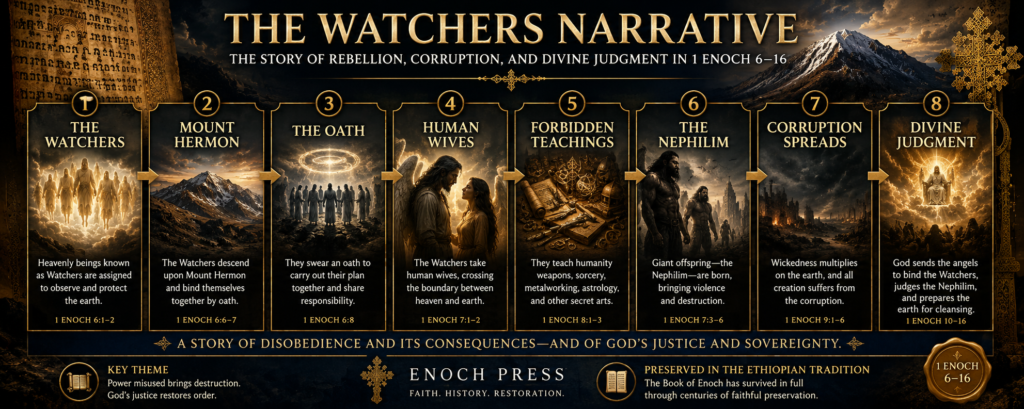
The rebellion. In the Book of the Watchers, a group of these angels look down at human women and decide to cross a boundary they were never meant to cross. Their leader hesitates — not out of conscience, but out of calculation. He knows what they are about to do is a transgression, and he’s afraid to bear the guilt alone. So the text describes something closer to a conspiracy than a temptation: a group of two hundred Watchers is called together at Mount Hermon to hatch a plan together, organized into regiments of ten, each with its own leader. They bind themselves with a mutual oath before they descend — which is itself a detail Genesis never mentions, and which the Book of the Watchers uses to make the sin a shared, deliberate crime rather than two hundred individual lapses.
The leadership. Two figures dominate the account. The first is the leader of the group of two hundred, named Shemihazah in the Aramaic material (rendered Semjaza or Semyaza in other translations). The second is a figure who, oddly, doesn’t appear in the initial list of two hundred at all but quickly becomes the story’s chief villain: Azazel. According to the text, Azazel taught men to make swords, knives, shields, and breastplates, revealed the working of metals, and taught women the use of cosmetics and eye-paint — arts the text blames for spreading vanity, violence, and “much godlessness.” Where Shemihazah’s crime is the marriages themselves, Azazel’s crime is teaching humanity things it wasn’t meant to know before it was ready to handle them. That distinction matters: the text isn’t condemning knowledge itself — elsewhere in 1 Enoch, careful knowledge of the heavens and the seasons is treated as a genuine good. What it condemns is knowledge disclosed without authorization and turned immediately toward weapons, deception, and domination.
The offspring. The unions between the Watchers and human women produce giant children — described across the tradition as unnaturally large, ravenous, and destructive. They consume what human communities produce faster than those communities can sustain them, then turn on humanity, on animals, and eventually on each other. Their violence, alongside the corrupting knowledge the Watchers taught, is what the text presents as the true trigger for the Flood: not human sin in the abstract, but a specific, traceable chain of angelic transgression with consequences that spiral out of control.
Supporting Evidence
The details above aren’t devotional flourishes; they come directly from the ancient text and its closest companion literature, and it’s worth seeing exactly how explicit the punishment scene is.
In 1 Enoch 10, God dispatches four archangels to deal with the crisis, each assigned a specific task. Raphael receives Azazel:
“And again the Lord said to Raphael: Bind Azâzêl hand and foot, and cast him into the darkness: and make an opening in the desert, which is in Dûdâël, and cast him therein. And place upon him rough and jagged rocks, and cover him with darkness, and let him abide there for ever, and cover his face that he may not see light. And on the day of the great judgement he shall be cast into the fire.”
Michael, meanwhile, is assigned to Shemihazah and the rest of the two hundred, who are told they will be bound for seventy generations under the hills of the earth until the day of judgment, when they will be cast into the abyss of fire. Gabriel is sent against the giants directly, setting them against one another until they destroy themselves — the text’s answer to how the earth was actually rid of them.
Scholars have long noticed that Azazel’s specific punishment — banished into the wilderness, burdened with the community’s sin, hidden from light — echoes the Yom Kippur scapegoat ritual in Leviticus 16, where a goat “for Azazel” is sent into the desert bearing Israel’s transgressions. Lester Grabbe has pointed to several parallels between the two accounts, including the similarity of the names Asael and Azazel, the punishment set in the desert, and the placing of sin on the figure followed by the healing of the land. Scholars disagree on the direction of influence — whether Enoch borrowed the ritual’s imagery or the ritual echoes an older shared idea — but the overlap is well documented rather than speculative.
It’s also important, in the spirit of separating sources rather than blending them, to note that Jubilees tells a meaningfully different version of events than 1 Enoch does. Where the Book of the Watchers frames the angels as corrupt from the moment of their descent, Jubilees insists their mission started well and only turned: the Watchers are dispatched during the era of Jared specifically to instruct humanity in righteousness and preserve justice on earth, and only later “unite themselves with the daughters of men” and become defiled. Jubilees also skips the Nephilim by name and instead develops what happens to the Watchers’ offspring after the Flood — introducing the angel Mastema as the post-Flood chief of the surviving spirits, granted authority by God himself to test and tempt humanity. These are two related but distinct ancient interpretations of the same seven verses in Genesis — not contradictory errors, but evidence of a living, developing tradition.
Watchers, Giants, Nephilim, Demons: Keeping the Cast Straight
It’s worth pausing to keep the story’s own categories straight here, because popular retellings collapse them constantly — and once collapsed, the text stops making sense. Within 1 Enoch’s own logic, these are related but not identical things:
- The Watchers are the heavenly beings themselves — Shemihazah, Azazel, and the rest of the two hundred — who descended and transgressed.
- The giants are their offspring, born of the unions with human women — the beings later tradition identifies with the Nephilim of Genesis 6:4.
- The evil spirits that go on troubling humanity are a third thing again: what the text says emerges from the giants’ bodies once Gabriel destroys them, not the Watchers themselves relocated into some new form.
Genesis uses the single word Nephilim; the Aramaic and Ethiopic witnesses to 1 Enoch use several different terms for the giant offspring, with real variation across the manuscripts. The most defensible description — and the one this article uses — is that 1 Enoch expands the Genesis tradition with an account of giant children produced through the Watchers’ unions, children the later interpretive tradition came to identify with Genesis’s Nephilim. Treating “Watcher,” “giant,” “Nephilim,” and “demon” as four interchangeable words for one thing erases distinctions the ancient text goes out of its way to draw — and it’s also worth saying plainly that the rebellious Watchers of 1 Enoch are not simply identical to later Christian ideas about Satan or a unified kingdom of fallen angels; that’s a later layer of tradition, not something this specific text asserts.
Significance
Why did Second Temple Jewish communities need a story this elaborate to explain seven verses of Genesis?
Because the Watchers narrative is doing real theological work: it’s an origin story for evil that doesn’t put the blame on God, and doesn’t leave it entirely on humanity either. The angels choose their rebellion freely, in full knowledge of the consequences — the text is emphatic that there will be no forgiveness for those who were meant to be immortal and pure but chose corruption, establishing the principle that greater knowledge and responsibility bring greater accountability. That’s a distinct theological claim: that some evil in the world has a source outside ordinary human weakness, introduced through willful transgression by beings who should have known better — and that this transgression, once loosed, spreads consequences no one fully controls.
This is also, functionally, the ancient world’s most detailed extant Jewish text on angelology and the origin of demons. Concepts that later become assumed background in Second Temple and early Christian thought — fallen angels, a hierarchy of archangels carrying out God’s judgment, demonic spirits with a traceable origin — get their fullest early articulation here, not in the Hebrew Bible itself.
Modern Relevance
You don’t have to search hard to find the Watchers’ fingerprints in contemporary religious conversation. Discussions of “fallen angels,” Nephilim, and Genesis 6 remain a persistent thread in popular theology, prophecy writing, and — increasingly — in frameworks people use to talk about UFO phenomena and “ancient aliens.” Enoch Press treats that popular fascination as a signal worth taking seriously, even where it needs correction: people are drawn to this story because it’s genuinely asking the right question — where does evil, especially organized, cooperative evil, actually come from? — even when the answers offered online drift far from what the ancient text says.
The New Testament writers who quoted and echoed 1 Enoch weren’t treating it as science fiction. Jude and 2 Peter used the Watchers tradition as a live moral warning to their own communities: a reminder that status, spiritual privilege, and proximity to the divine are not protection against catastrophic moral failure. That’s a claim with plenty of resonance left in it, regardless of one’s view of Genesis 6’s literal meaning.
What This Story Does Not Teach
One more thing is worth saying plainly, because the Watchers’ story attracts more speculation than almost anything else in ancient apocalyptic literature. The text does not identify the Watchers as extraterrestrial visitors. It offers no support for claims about modern bloodlines descended from angels, and it does not treat every ancient technological leap as proof of supernatural intervention. It does not authorize attempts to contact angels or recover “forbidden” ritual knowledge — if anything, it reads as a warning against exactly that impulse. And it does not place responsibility for the Watchers’ transgression on the women they pursued; the text is unambiguous that the guilt sits with the beings who held the greater power and the greater knowledge, and used both to take what wasn’t theirs.
None of that embellishment is necessary. The Book of the Watchers is unsettling enough on its own terms — a story about power without accountability — without anyone needing to dress it up as secret history.
Conclusion
Genesis 6:1–4 gives readers a locked door with no key. The Book of the Watchers — preserved complete for the world by the Ethiopian Orthodox Tewahedo Church, and confirmed ancient by fragments recovered from the caves of Qumran — hands us that key: names, a mountain, an oath, a chain of specific sins, and a judgment carried out by name in Raphael, Gabriel, and Michael. Jubilees complicates and enriches that key further, insisting the story didn’t start with corruption but with a good mission gone wrong. Together, these texts don’t just fill in a gap in Genesis. They preserve how an entire generation of Second Temple Jews — the generation into which Jesus himself was born — thought about angels, evil, and the price of forbidden knowledge.
Reflection
Here the tone shifts from history to devotion, and readers should hold this section distinctly from everything argued above.
There’s something sobering in the detail that Shemihazah hesitates before Mount Hermon — not from conscience, but because he doesn’t want to bear the guilt alone. Sin shared is not sin diminished; the text is clear that all two hundred bear full judgment together. For a reader in the Ethiopian Orthodox Tewahedo tradition, the Watchers narrative sits inside a bigger, hopeful frame: it names how corruption entered deeper into the world, but it does not end there. The same scriptural heritage that preserves the Watchers’ fall also preserves Enoch’s own story — a man who “walked with God, and was not, for God took him” (Genesis 5:24) — a picture of the opposite path held up right alongside it. The Watchers chose descent from glory. Enoch is remembered for the opposite journey.
Frequently Asked Questions About the Book of the Watchers
What is the Book of the Watchers?
The Book of the Watchers is an ancient apocalyptic text that details the fall of the angels (the Watchers) who rebelled against God, descended to earth, and fathered the Nephilim. It covers chapters 1 through 36 of the complete composite text.
Is the Book of the Watchers part of the Book of Enoch?
Yes, the Book of the Watchers is the first and oldest section of the Book of Enoch (1 Enoch). While some readers look for them as completely separate books, the Watchers narrative serves as the opening foundational chapters of the larger Enochian scriptural tradition preserved in the Ethiopian Bible.