Most of the world runs on a calendar that drifts. The Gregorian system adds leap days every four years to approximate the solar year, and still falls short of precision by 11 minutes and 14 seconds annually. But the Book of Jubilees describes an alternative: a perfect 364-day year of 52 weeks, divided into four equal quarters, built on the architecture of creation itself. That calendar survived. Ethiopia kept it.
The Calendar Described in Jubilees
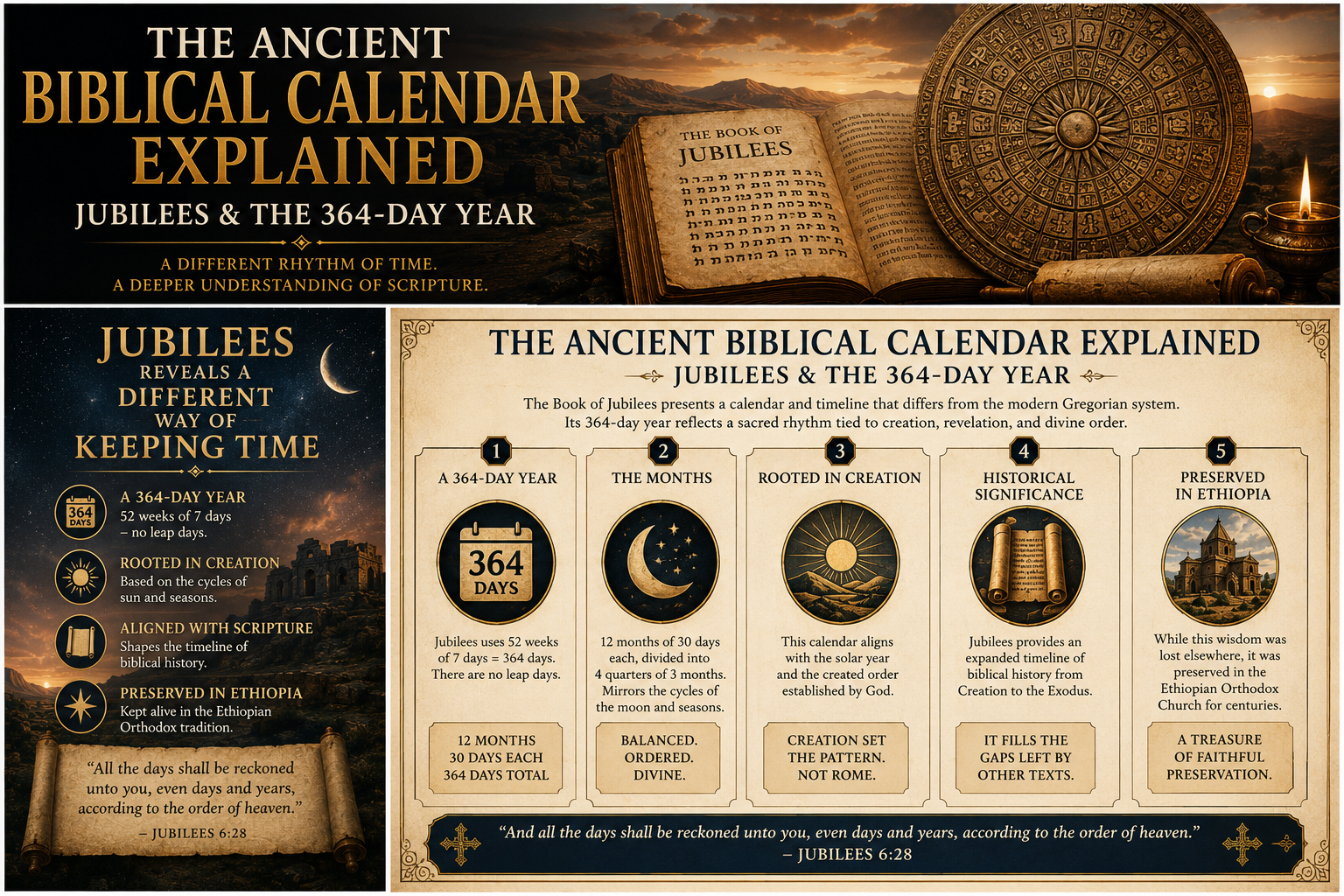
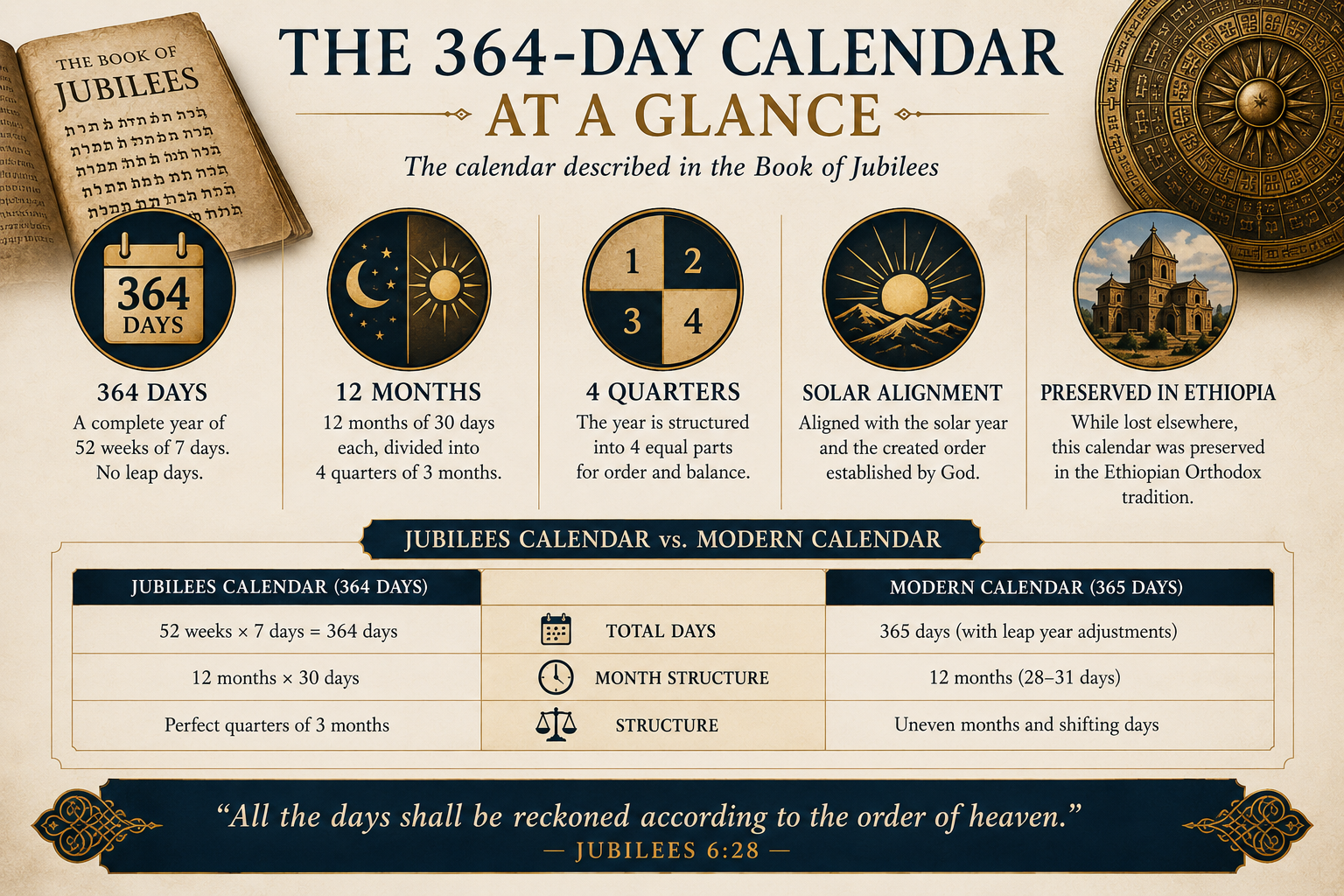
The Book of Jubilees, written in the 2nd century BCE and preserved in full by the Ethiopian Orthodox Church, lays out a calendar system unlike anything in modern use. Chapter 6 of Jubilees specifies that the year contains exactly 364 days, 52 weeks of seven days each, with no leap days, no corrections, and no accumulated drift.
The structure is architectural: 12 months of 30 days each, divided into four quarters of 91 days. Each quarter begins on the same day of the week. The calendar self-synchronizes because it was built to run on the order of creation itself, the sun and moon governed from the beginning to mark times, seasons, and festivals on their fixed days.
Jubilees 6:28 makes this explicit: "All the days shall be reckoned according to the order of heaven. Therefore they have no remainder of days, nor is there any division in them. For all the days of the year are of an equal number, and the months are of an equal number, and the weeks of months and the weeks of years are of an equal number." This is not approximation. It is a statement that the calendar needs no correction because it was designed to match the heavens exactly.
Why 364 Days Makes Sense
A 364-day year of 52 seven-day weeks is a mathematically elegant structure. Seven multiplied by 52 equals 364, no remainder, no awkward fractions. Each quarter contains exactly 13 weeks. Every month is 30 days. Every quarter begins on the same weekday. The entire system is self-consistent in a way that the Gregorian calendar, with its irregular month lengths and cumulative leap day adjustments, is not.
The practical advantage is predictability. In the Jubilees calendar, a given date always falls on the same day of the week. Feasts, fasts, and agricultural cycles calculated against the calendar structure never drift out of alignment with their intended day. A festival assigned to the third month of the first quarter always arrives in that quarter, on its proper day, year after year.
This is not a coincidence of approximation. It is the design. The year was constructed to be perfectly divisible by the week, and the quarter was constructed to be perfectly divisible by the month. The calendar does not require correction because it was built to be correct.
The Solar Alignment and the Roman Divergence
The 364-day calendar is solar, it tracks the sun cycle, not the moon. The Hebrew calendar used throughout Second Temple Judaism was lunisolar, adding leap months to keep pace with both the sun and the moon. The Jubilees calendar is a different approach: pure solar, independent of lunar counting, fixed to the solar year as it was understood at creation.
When Roman civilization adopted the Julian calendar in 46 BCE, it introduced a 365.25-day approximation of the solar year. By the 16th century, the Julian calendar had drifted approximately 10 days from the actual solar year. The equinoxes had shifted because the Julian system overestimated the length of the tropical year by 11 minutes. Pope Gregory XIII reformed the calendar again, dropping 10 days to realign and introducing the modern Gregorian system with its more precise leap year rules.
The Ethiopian Orthodox Church, which had developed independently of Rome and Constantinople through the medieval period, never adopted the Julian reform of 46 BCE or the Gregorian reform of 1582. It continued on the ancient 364-day solar system that Jubilees describes, without the accumulated corrections that Western Christendom applied over centuries. The Ethiopian calendar is still roughly 7 to 8 years behind the Gregorian year, and Ethiopian New Year falls on September 11 or September 12 in a leap year.
Preserved in Ethiopian Orthodox Practice
Ethiopian Orthodox Christians still use the 364-day calendar as part of their living liturgical tradition. The Ge'ez calendar, with its 12 months of 30 days, its quarter-system structure, and its fixed relationship to creation order, governs when feasts are observed, when fasts begin and end, and how the liturgical year is organized.
Enkutatash, the Ethiopian New Year, falls on September 11 in the Gregorian calendar, because Ethiopian time has never been corrected by the Western leap day system. Ethiopian Christmas, known as Genna, falls on January 7. These are not errors. They reflect the ancient solar year that Jubilees describes and that Ethiopian monastic tradition preserved across centuries when every other Christian tradition abandoned it.
The preservation was, again, a matter of monastic discipline and theological continuity. Ethiopian monks copied the Book of Jubilees as scripture, and scripture specified the calendar structure. There was no institutional pressure to correct it. The Ethiopian church had developed outside the Roman ecclesiastical system and never adopted the Julian reform. The calendar survived not because it was defended as superior, but because it was maintained as the order of heaven, and the monks who copied the text followed what scripture said.
What This Calendar Teaches
The 364-day calendar in Jubilees is not a historical curiosity. It is a window into a different way of organizing time. It reflects a cosmology in which creation itself establishes the framework for human timekeeping, where the week and the year are architecturally related by design rather than by accumulated correction, and where the calendar integrity depends on its relationship to the order of heaven rather than the decisions of later institutions.
Modern readers encounter it through the Ethiopic manuscript tradition, the same tradition that preserved the Book of Enoch, the Book of Jubilees, and Meqabyan in full when they had been lost or suppressed elsewhere. The calendar is one piece of a larger preservation: an entire biblical world maintained in active use rather than archived as a historical artifact.
The Ethiopian Orthodox Church still celebrates the liturgical year according to this ancient system. Every feast falls on its proper day according to the order of creation. Every fast begins at the right time. The calendar Jubilees describes is not a relic. It is the living calendar of a living tradition, maintained by the same monastic discipline that kept the text itself in circulation for two thousand years.
"All the days shall be reckoned according to the order of heaven." -- Jubilees 6:28
If you have been reading through the EnochPress blog series on the Ethiopian biblical tradition, you already know how deep this preservation runs. The 364-day calendar is one more piece of that tradition, a system for organizing time that the rest of the world let go of, and that Ethiopia maintained for over 1,600 years while everyone else tried to fix their calendars with periodic corrections. The precision of that system, and the faithfulness of its preservation, deserve attention.